
Structuralism Explained: Hidden Patterns Behind Language, Literature, Psychology, and Human Thinking
Have you ever wondered why stories from different cultures often follow similar patterns? Why myths across continents feature heroes, villains, or journeys that seem strangely familiar? Or why our language, thoughts, and even social relationships appear to follow invisible rules?
Structuralism offers an answer to these questions.
Rather than focusing on individual events or personal experiences, Structuralism explores the underlying structures that shape human language, literature, culture, and thought. It argues that beneath the diversity of human life lies an organized system of relationships that gives meaning to everything we say, read, and experience.
Originally developed in linguistics during the early twentieth century, Structuralism soon transformed literary criticism, anthropology, psychology, philosophy, and cultural studies. It encouraged scholars to look beyond surface appearances and discover the hidden frameworks that organize human behavior and communication.
Today, although many newer theories have emerged, Structuralism remains one of the most influential intellectual movements in the humanities and social sciences. Whether you are a student of English Literature, Psychology, Linguistics, or simply curious about how people create meaning, understanding Structuralism provides a powerful foundation for exploring the human mind.
In this guide, we will examine its origins, major ideas, key thinkers, practical applications, strengths, criticisms, and continuing relevance in the modern world.
What Is Structuralism?
Structuralism is a critical approach that understands literature through systems, patterns, and structures, rather than through personal expression or isolated texts.
“In language, there are only differences without positive terms.”— Ferdinand de Saussure
The Core Idea of Structuralism
Structuralism is based on three key beliefs:
- meaning is not natural or fixed
- meaning is produced through relationships and differences
- nothing has meaning on its own; it depends on the system it belongs to
For example, the word “night” has meaning because it exists in contrast to “day.” Likewise, the idea of “good” becomes meaningful because we understand it in opposition to “evil.”
Structuralists believe that humans naturally organize the world through patterns, oppositions, and relationships rather than isolated facts.
A Simple Everyday Example
Imagine a game of chess.

Each chess piece has a specific function—not because of its physical appearance, but because of the rules governing its relationship with other pieces.
A bishop is meaningful only because it moves diagonally.
A rook is different because it moves horizontally and vertically.
If every chess piece moved the same way, the game would lose its structure.
Structuralists argue that language, literature, and society work in much the same way.
Meaning emerges from relationships within a structured system.
The Basic Principle of Structuralism
Structuralism rests upon one fundamental assumption:
Every human activity operates according to an underlying structure.
These structures may not be immediately visible, but they shape how people communicate, think, tell stories, and organize society.
Examples include:
- grammar organizing language
- narrative structures organizing stories
- family systems organizing relationships
- cultural traditions organizing social behavior
- myths organizing collective beliefs
The visible world is therefore only the surface expression of deeper organizing principles.
Why Do Humans Naturally Look for Patterns?
Human beings are exceptional pattern seekers.
Our brains constantly classify information to make sense of reality.
Consider the following examples:
When meeting someone new, we instinctively categorize them by age, language, profession, or personality.
When reading a novel, we identify heroes, villains, conflicts, and resolutions.
When learning a language, we unconsciously recognize grammatical rules long before studying formal grammar.
According to Structuralism, this tendency is not accidental—it reflects the way human cognition naturally organizes experience.
Rather than processing isolated facts, the human mind searches for structures.
The Historical Development of Structuralism
Structuralism did not appear overnight.
It developed gradually through several disciplines before becoming one of the most influential intellectual movements of the twentieth century.
1. The Birth of Modern Linguistics
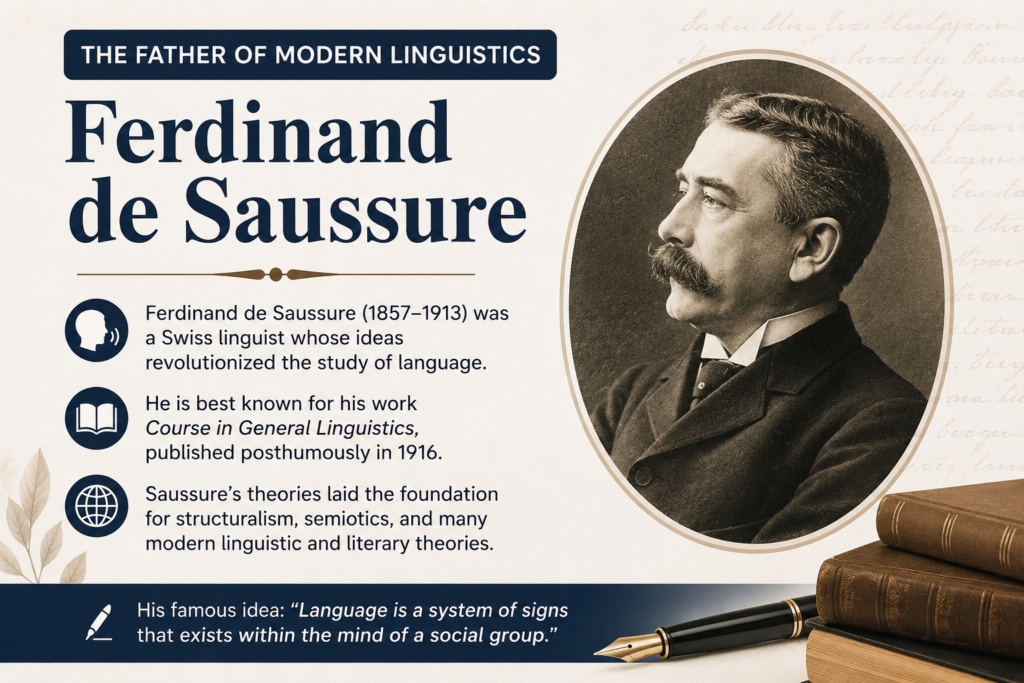
The origins of Structuralism can be traced to Swiss linguist Ferdinand de Saussure.
Although Saussure never used the word “Structuralism” extensively, his lectures fundamentally changed how scholars understood language.
Before Saussure, language was often studied historically by examining how words evolved over time.
Saussure proposed a revolutionary idea.
Instead of studying language historically, we should study it as a complete system existing at a particular moment.
This shift transformed linguistics and laid the foundation for Structuralism.
2. Structuralism Moves Beyond Language
During the mid-twentieth century, scholars realized that Saussure’s ideas could explain much more than language.
Anthropologists began studying myths and cultural rituals as structured systems.
Literary critics analyzed stories through recurring narrative patterns.
Psychologists explored how people organize experience through mental categories.
Philosophers investigated how systems of thought shape human understanding.
Structuralism gradually became an interdisciplinary movement rather than merely a linguistic theory.
3. The Rise of Literary Structuralism
Literary scholars asked an important question:
Instead of asking,
“What did the author intend?”
why not ask,
“What structures make this story meaningful?”
This shift redirected attention away from the author’s personal life and toward the text itself.
Stories began to be examined as systems composed of characters, symbols, conflicts, and recurring narrative patterns.
The Core Ideas of Structuralism
Although Structuralism has many branches, several principles unite them.
1. Meaning Comes from Relationships
Words have meaning because they differ from other words.
Characters have meaning because they contrast with other characters.
Ideas become meaningful because they exist within larger systems.
For example:
- hero vs villain
- life vs death
- freedom vs oppression
- civilization vs nature
These oppositions help organize human understanding.
2. Surface and Deep Structures
Structuralists distinguish between what we see and the hidden principles beneath it.
For example, two novels may seem completely different.
One may tell the story of a medieval knight.
Another may follow a modern superhero.
Yet both may share the same deeper narrative structure:
- ordinary world
- challenge
- struggle
- transformation
- return
The surface changes.
The underlying structure remains surprisingly similar.
3. Systems Are More Important Than Individuals
Structuralism focuses less on individual personalities and more on the systems governing them.
Instead of asking,
“Why did this character behave this way?”
Structuralists ask,
“What role does this character play within the overall structure?”
A king, mentor, trickster, or villain often serves structural functions regardless of individual personality.
4. Patterns Repeat Across Cultures
One remarkable observation made by Structuralists is that similar patterns appear across civilizations.
Myths from India, Greece, Africa, and South America often contain:
- creation stories
- heroic journeys
- sacred sacrifices
- magical helpers
- conflicts between order and chaos
These similarities suggest that human cultures may share universal ways of organizing experience.
Understanding the Building Blocks of Structuralism
Before exploring how Structuralism influences literature, psychology, and culture, it is important to understand the fundamental concepts that form the foundation of this theory. These ideas, introduced primarily by Swiss linguist Ferdinand de Saussure and later expanded by other scholars, explain how humans create and interpret meaning.
Rather than viewing language as a collection of isolated words, Structuralism sees it as an interconnected system in which every element gains meaning through its relationship with others. The following concepts are the building blocks of Structuralist thought.
1. The Sign: Signifier and Signified
One of the most influential contributions to Structuralism is Ferdinand de Saussure’s concept of the sign. According to Saussure, language is made up of signs, and every sign consists of two inseparable parts: the signifier and the signified.
What Is a Sign?
A sign is anything that communicates meaning. It can be a word, an image, a gesture, or a symbol. However, a sign does not possess meaning naturally. Instead, its meaning is created through shared social conventions.
For example, the word “tree” is a sign. There is nothing about the sounds t-r-e-e that naturally connects them to the tall plant we recognize. We understand its meaning because English speakers have collectively agreed to associate that word with the concept of a tree.
What Is the Signifier?
The signifier is the physical form of a sign. It is what we can hear, read, or see.
Examples include:
- The written word “book”
- The sound of the word “book”
- A red traffic light
- A national flag
In each case, the signifier is simply the form that carries meaning.
What Is the Signified?
The signified is the mental concept or idea that the signifier represents. It is the image or meaning that comes to mind when we encounter a sign.
For example:

- The word “Lotus” (signifier) may bring to mind the concept of a beautiful flower (signified).
- A heart symbol (♥) often represents the idea of love or affection.
- A white dove commonly signifies peace.
It is important to remember that the signified is not the physical object itself, but the concept associated with it in our minds.
Why Is This Idea Important?
Saussure argued that the relationship between the signifier and the signified is arbitrary. There is no natural reason why the object we call a “tree” could not have been given another name. Meaning exists because members of a language community accept the same conventions.
This idea transformed linguistics and became one of the cornerstones of Structuralism. It showed that language functions as a structured system of relationships rather than a simple collection of labels.
2. Langue and Parole
Another important distinction introduced by Saussure is the difference between langue and parole. These terms help explain how language operates as both a social system and an individual act.
What Is Langue?
Langue refers to the complete system of a language shared by a community. It includes grammar, vocabulary, pronunciation, and the rules that speakers unconsciously follow.
In simple terms, langue is the blueprint of a language.
For example, English grammar rules, sentence structures, and common vocabulary are all part of the English langue. Every English speaker relies on these shared conventions to communicate effectively.
What Is Parole?
Parole refers to the actual use of language by individuals in everyday communication. It includes conversations, speeches, emails, poems, and every sentence a person speaks or writes.
Each time you greet a friend, write an essay, or post on social media, you are using parole.
An Everyday Example
Imagine a game of cricket.
The official rules of cricket are like langue. They remain relatively stable and are shared by everyone who plays the game.
A particular match, with its unique players, strategies, and outcomes, represents parole.
Without the rules, the match could not exist. Likewise, without langue, meaningful communication through parole would be impossible.
Why Does This Matter?
Structuralists are primarily interested in langue because it reveals the underlying structure that makes communication possible. Individual conversations may vary, but they all depend on the same shared linguistic system.
3. Binary Oppositions: Meaning Through Opposites
Structuralists believe that people often understand the world through binary oppositions, or pairs of contrasting ideas. These opposites help organize our thinking and give meaning to concepts.
Common examples include:
- Good vs. Evil
- Light vs. Darkness
- Life vs. Death
- Nature vs. Culture
- Order vs. Chaos
- Freedom vs. Oppression
- Success vs. Failure
For instance, we understand the idea of light more clearly because it is contrasted with darkness. Similarly, the concept of good becomes meaningful because we recognize its opposite, evil.
These oppositions appear not only in language but also in myths, novels, films, advertisements, and everyday conversations.
Binary Oppositions in Literature
Many famous literary works are built around contrasting forces.
In Shakespeare’s Romeo and Juliet, love is constantly contrasted with hatred, while youth is opposed to age.
In Mary Shelley’s Frankenstein, humanity is contrasted with monstrosity, and scientific ambition is opposed to moral responsibility.
Structuralists argue that these oppositions are not accidental. They provide the framework through which readers interpret a text and construct meaning.
4. Structuralism and Later Thinkers
Although Ferdinand de Saussure laid the foundation of Structuralism, many influential scholars expanded his ideas into new fields, including anthropology, literary criticism, linguistics, and cultural studies.
Ferdinand de Saussure (1857–1913)
Known as the father of modern linguistics, Saussure introduced the concepts of the sign, signifier, signified, langue, and parole. His work shifted the study of language from historical development to the analysis of language as a structured system.
Roman Jakobson (1896–1982)
Jakobson extended Structuralist principles into linguistics and literary studies. He examined how language functions in different contexts and emphasized the importance of patterns and communication.
Claude Lévi-Strauss (1908–2009)
Lévi-Strauss applied Structuralism to anthropology. By studying myths, kinship systems, and cultural practices, he argued that all human societies share similar underlying mental structures.
Roland Barthes (1915–1980)
Barthes explored how signs operate not only in literature but also in popular culture, fashion, advertising, and media. His work demonstrated that everyday objects can function as systems of meaning.
Gérard Genette (1930–2018)
Genette focused on narrative structure, analyzing how stories are organized through techniques such as chronology, perspective, and narrative voice. His work became central to structural narratology.
Tzvetan Todorov (1939–2017)
Todorov developed Structuralist approaches to storytelling by identifying common narrative patterns and genres. He believed that stories, despite their differences, often follow similar structural principles.
Why Structuralism Matters Today
At first glance, Structuralism may seem like an old academic theory.
However, its influence continues to shape modern life in surprising ways.
When streaming platforms recommend movies based on genre patterns…
When artificial intelligence recognizes language structures…
When advertisers use symbolic associations…
When psychologists study cognitive patterns…
When literary scholars analyze narratives…
They are all, in different ways, applying structural thinking.
Structuralism reminds us that beneath everyday experiences lie invisible systems that shape communication, meaning, and understanding.
Frequently Asked Questions (FAQs)
1. What is Structuralism?
Structuralism is an intellectual approach that studies the underlying structures that shape language, literature, culture, and human thought. It argues that meaning is created through relationships within a system rather than by individual elements alone.
2. Who is considered the founder of Structuralism?
Swiss linguist Ferdinand de Saussure is widely regarded as the founder of Structuralism. His theories on the sign, signifier, signified, langue, and parole laid the foundation for Structuralist thought.
3. What is the main idea of Structuralism?
The central idea of Structuralism is that meaning is produced through systems of relationships and patterns. Nothing has meaning in isolation; everything gains significance through its connection with other elements.
4. What is the difference between Structuralism and Post-Structuralism?
Structuralism believes that language and culture follow stable structures that create meaning. Post-Structuralism challenges this view, arguing that meanings are fluid, unstable, and open to multiple interpretations.
5. What is the difference between a signifier and a signified?
According to Ferdinand de Saussure:
- Signifier is the physical form of a sign, such as a word, image, or sound.
- Signified is the concept or meaning associated with that sign.
Together, they form a sign.
6. What are Langue and Parole?
Langue refers to the shared system of language, including its grammar and rules. Parole refers to the actual use of language in everyday speech and writing by individuals.
7. What are Binary Oppositions in Structuralism?
Binary oppositions are pairs of contrasting concepts—such as good and evil, light and darkness, or nature and culture—that help create meaning. Structuralists believe these oppositions are fundamental to human thinking and literary analysis.
8. How is Structuralism used in literature?
In literary studies, Structuralism examines the hidden patterns, symbols, character roles, and narrative structures within a text instead of focusing only on the author’s intentions or historical background.
9. Is Structuralism relevant to psychology?
Yes. Although Structuralism originated in linguistics, its emphasis on patterns and systems has influenced psychology by encouraging the study of how the human mind organizes experiences, language, and perception.
10. Why is Structuralism important today?
Structuralism continues to influence literary criticism, linguistics, anthropology, cultural studies, media analysis, and even artificial intelligence. Its focus on patterns and systems remains valuable for understanding how meaning is created in different contexts.
Key Takeaways
- Structuralism studies the hidden structures that shape language, literature, culture, and human thought.
- Ferdinand de Saussure is regarded as the founder of Structuralism.
- Every sign consists of a signifier (form) and a signified (concept).
- Langue is the shared system of language, while parole is its actual use in communication.
- Structuralists believe that meaning is created through relationships and patterns, not isolated elements.
- Binary oppositions, such as good/evil and nature/culture, play a key role in producing meaning.
- Structuralism has influenced linguistics, literary criticism, psychology, anthropology, and cultural studies.
- Despite criticism from Post-Structuralism, Structuralism remains one of the most influential theories in the humanities.
Conclusion
Structuralism fundamentally changed the way we understand language, literature, psychology, and culture. Instead of treating words, texts, or human actions as isolated entities, it encourages us to look for the underlying structures that organize meaning. From Ferdinand de Saussure’s concepts of the sign, signifier, signified, langue, and parole to Claude Lévi-Strauss’s analysis of myths and Roland Barthes’ study of cultural symbols, Structuralism demonstrates that meaning is created through relationships rather than existing naturally.
Its influence extends far beyond literary criticism. In psychology, Structuralist ideas inspire the search for patterns in human thought. In anthropology, they reveal the shared structures underlying cultures and traditions. In linguistics, they explain how language functions as a system of interconnected signs. Even today, Structuralist principles continue to shape fields such as media studies, cultural analysis, communication, artificial intelligence, and semiotics.
Although later theories such as Post-Structuralism questioned many of its assumptions, Structuralism remains one of the most influential intellectual movements of the twentieth century. It provided scholars with new methods for analyzing texts, myths, symbols, and social systems, leaving a lasting impact on the humanities and social sciences.
Ultimately, Structuralism teaches us an important lesson: meaning does not exist in isolation. Every word, story, symbol, and cultural practice becomes meaningful because it belongs to a larger system of relationships. By learning to recognize these hidden patterns, we gain a deeper understanding not only of literature and language but also of the ways human beings think, communicate, and make sense of the world.
Whether you are a student of English Literature, Psychology, Linguistics, Anthropology, or simply someone fascinated by human thought, Structuralism offers a powerful framework for exploring the invisible structures that shape our everyday lives.
📖 Suggested Reading:
- 👉The Ultimate Roadmap to English Literature: A Chronological Guide for UGC NET/JRF Aspirants
- 👉 Feminist Criticism: The Ultimate One-Stop Guide for UGC NET English
- 👉 New Historicism: Summary, Key Concepts, and Major Critics (UGC NET Notes)
- 👉 What is Allegory? | 2 Types & 5 Forms of Expression | M.H. Abrams ‘Glossary of Literary Terms’
Disclaimer
Save this post—you’ll need to return to it regularly before exam day.
This article is written for educational purposes and is based on multiple academic sources, interpreted in the author’s own words.
About the Author
ShariyaWrites believes that literature is not a burden to memorize, but an emotion to understand. Through blogs, reels, and videos, she simplifies English Literature for students who want to connect texts with life.
🔗 Explore more here:
https://linktr.ee/shariyawrites