
IGNOU MEG-07 Solved Assignment 2025–26 (Indian English Literature)
Introduction
Are you looking for the IGNOU MEG-07 Solved Assignment 2025-26 | (Indian English Literature) | Complete Answers? This article provides complete, well-structured model answers for the MEG-07: Indian English Literature assignment for the 2025–26 session.
MEG-07 introduces students to some of the most significant writers and texts in Indian English literature. The assignment covers fiction, poetry, literary history, narrative technique, characterization, and questions of identity, society, culture, and the self.
The questions include writers and works such as Mulk Raj Anand, Anita Desai’s Clear Light of Day, Sri Aurobindo, Raja Rao’s Kanthapura, Salman Rushdie’s Midnight’s Children, Vikram Seth, Gajar Halwa, Henry Louis Vivian Derozio, Kamala Das, A. K. Ramanujan, and R. Parthasarathy.
These model answers are written in clear academic English to help IGNOU MA English students understand the key arguments and prepare their assignments effectively.
Note: These answers are intended for academic guidance. Students should understand the arguments and present them in their own words while preparing the final assignment.
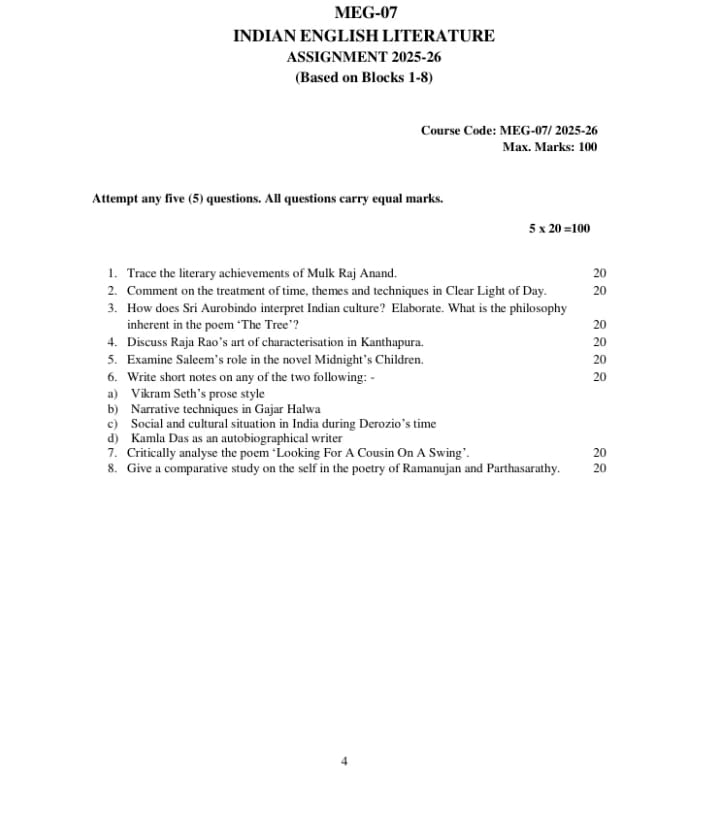
IGNOU MEG-07 Assignment Details
| Particular | Details |
|---|---|
| Programme | M.A. English (MEG) |
| Course Code | MEG-07 |
| Course Title | Indian English Literature |
| Assignment Session | 2025–26 |
| Based on | Blocks 1–8 |
| Maximum Marks | 100 |
| Questions to Attempt | Any Five |
| Marks per Question | 20 |
Table of Contents
Table of Contents
IGNOU MEG-07 Solved Assignment 2025–26 (Indian English Literature) Questions with Answers
Question 1
Trace the Literary Achievements of Mulk Raj Anand.
Introduction
Mulk Raj Anand (1905–2004) was one of the pioneering Indian writers in English and an important figure in the development of the Indian English novel. His fiction is particularly known for its concern with poverty, caste discrimination, social inequality, exploitation, and the lives of marginalized people. Through realistic characters and socially committed narratives, Anand brought the experiences of ordinary and oppressed people into Indian English literature.
His major novels include Untouchable (1935), Coolie (1936), Two Leaves and a Bud (1937), The Village (1939), Across the Black Waters (1939), and The Sword and the Sickle (1942). His literary career reflects a strong commitment to social justice and human dignity.
Mulk Raj Anand’s Literary Achievements
One of Anand’s greatest achievements is his contribution to the Indian English novel. Along with writers such as R. K. Narayan and Raja Rao, he helped establish the novel in English as an important form of Indian literary expression. However, Anand’s fiction is particularly distinguished by its strong social and political concerns.
His first major novel, Untouchable, focuses on Bakha, a young sweeper who belongs to the lowest level of the caste hierarchy. Through Bakha’s experiences during a single day, Anand exposes the cruelty and humiliation produced by untouchability. The novel is significant because it gives literary representation to a section of Indian society that had traditionally remained marginalized.
Anand continued his exploration of economic exploitation in Coolie. The novel follows Munoo, a poor young boy who moves through different environments in search of survival. His experiences reveal poverty, child labour, class inequality, and the exploitation of workers. Through Munoo’s tragic life, Anand shows how social and economic structures can limit an individual’s freedom.
In Two Leaves and a Bud, Anand turns his attention towards the exploitation of plantation workers under colonial rule. The novel presents the harsh working conditions of Indian labourers and examines the unequal relationship between the colonizers and the colonized.
Another important achievement of Anand is his realistic portrayal of ordinary people. His characters are not merely representatives of social problems; they are presented with emotions, desires, weaknesses, and hopes. This human dimension gives his social criticism greater emotional force.
Anand’s writing also reflects the influence of socialism and humanism. He was deeply concerned with creating a more equal society and repeatedly questioned systems based on caste, class, colonial power, and economic exploitation. His novels therefore combine literary representation with social criticism.
His language is another notable feature. Anand developed a form of English capable of representing Indian speech patterns, cultural realities, and local experiences. He used English not simply as a colonial language but as a medium through which Indian social life could be expressed.
Conclusion
Mulk Raj Anand’s major literary achievement lies in his ability to combine realism, social criticism, and humanism. By bringing the lives of untouchables, labourers, peasants, and other marginalized communities into Indian English fiction, he expanded the scope of the Indian novel. His works remain important because they question social injustice while emphasizing the dignity and humanity of the individual.
Question 2
Comment on the Treatment of Time, Themes and Techniques in Clear Light of Day.
Introduction
Anita Desai (1937– ) is one of the most important Indian English novelists, particularly known for her exploration of inner consciousness, memory, relationships, loneliness, and psychological conflict. Her novel Clear Light of Day, published in 1980, focuses on the Das family and explores how the unresolved experiences of childhood continue to influence the lives of the characters in the present.
The novel is especially remarkable for its treatment of time and memory. Instead of presenting events in a simple chronological order, Desai moves between the past and the present to reveal the emotional history of the family.
Treatment of Time
An interesting feature of Clear Light of Day is its connection with T. S. Eliot’s Four Quartets. Desai was influenced by Eliot’s treatment of time, and this influence can be noticed in the way she organizes her novel. The story is divided into four parts, and the narrative does not move in a straight line from the past to the present. Instead, Desai takes us between different stages of the Das family’s life. This movement makes the reader understand that the past is not completely separate from the present; old experiences continue to affect the characters even years later.
Time in Clear Light of Day is not merely a sequence of past, present, and future. It is closely connected with memory and personal experience. The novel begins in the present, but the characters repeatedly return to their childhood through memories.
The relationship between Bim and Tara, the two sisters, provides the main framework for this movement between different periods of time. Their childhood experiences, the separation of the family, and events surrounding their brother Baba and sister Mira gradually emerge through recollection.
Desai therefore uses non-linear narration. The past is not presented as something completely finished; it continues to influence the emotional lives of the characters. Bim’s bitterness, Tara’s sense of guilt, and the family’s unresolved relationships can only be understood by looking back at their childhood.
By bringing the past and present together, Desai shows that psychological time can be very different from chronological time. A painful memory from childhood may remain emotionally present even after many years.
Major Themes
One of the central themes of the novel is memory. The characters must confront their memories before they can understand their present relationships.
Another major theme is family and relationships. The Das family has experienced emotional distance, misunderstanding, and separation. Yet the novel gradually suggests the possibility of reconciliation.
Loneliness and isolation are also important themes. Bim, Tara, and Baba respond to their circumstances differently, but each experiences some form of emotional isolation.
The novel also explores change and the passage of time. Buildings, relationships, and people change, but memories continue to connect the past with the present.
Narrative Techniques
Desai uses several techniques to represent the psychological lives of her characters. The most important is the flashback, through which past events enter the present narrative.
She also uses interior consciousness, allowing readers to understand the emotions and thoughts of the characters. Symbolic details, particularly the family house and the changing natural surroundings, contribute to the atmosphere of memory and change.
The narrative shifts between different perspectives and periods, creating a layered understanding of the Das family’s history.
Conclusion
Clear Light of Day is a powerful exploration of time, memory, family, and emotional reconciliation. Anita Desai’s non-linear narrative technique allows the past to remain alive within the present, showing how childhood experiences continue to shape adult consciousness. Through its psychological depth and sophisticated treatment of time, the novel demonstrates Desai’s distinctive contribution to Indian English fiction.
Question 3
How does Sri Aurobindo interpret Indian culture? Elaborate. What is the philosophy inherent in the poem The Tree?
Introduction
Sri Aurobindo (1872–1950) was an Indian poet, philosopher, nationalist, and spiritual thinker who made an important contribution to Indian English literature. His literary works are closely connected with his ideas about Indian civilization, spirituality, human evolution, and the relationship between the material and the spiritual worlds.
Sri Aurobindo viewed Indian culture as something much deeper than a collection of customs, rituals, or social practices. For him, its central strength lay in its spiritual vision and its attempt to understand the deeper purpose of human life. His poem The Tree can also be read in the light of this spiritual outlook, as the tree becomes a significant image through which ideas of life, growth, rootedness, and spiritual aspiration can be understood.
Sri Aurobindo’s Interpretation of Indian Culture
Sri Aurobindo’s understanding of Indian culture begins with the idea that spirituality is at the centre of Indian civilization. He does not see spirituality as something limited to religious rituals. Rather, he understands it as a way of looking beyond material existence and discovering a deeper reality within human life.
According to this perspective, Indian culture has traditionally given importance to the relationship between the individual self and a larger spiritual reality. Ideas such as yoga, meditation, self-discipline, and the search for higher consciousness therefore become important aspects of Indian thought.
At the same time, Sri Aurobindo does not suggest that Indian culture should remain frozen in the past. He believes that a culture must continue to grow and evolve. India’s ancient spiritual heritage can provide a foundation, but it must respond creatively to changing circumstances.
His interpretation therefore combines tradition with development. Indian culture should preserve its spiritual core while allowing new ideas and experiences to contribute to its growth.
Another important feature of his thought is his belief in the unity underlying human diversity. Different religions, philosophies, and cultural practices may appear different on the surface, but they can represent different approaches to a deeper spiritual truth.
Philosophy in The Tree
The image of the tree provides an effective way of understanding ideas of growth and spiritual development. A tree remains connected to the earth through its roots while simultaneously reaching upwards towards the sky. This makes it a natural image for the relationship between the material and spiritual dimensions of existence.
The roots can be associated with one’s origins, history, and connection with the earth, while the upward movement of the tree suggests aspiration and the desire to reach something higher.
The tree can therefore be understood as a symbol of continuous growth. Just as a tree develops gradually, human consciousness also has the possibility of moving from a limited state towards a higher level of awareness.
The poem can also be connected with Sri Aurobindo’s larger philosophy of evolution. Human beings are not presented as spiritually complete; they possess the possibility of further development. Physical existence and spiritual aspiration are not necessarily opposites. Instead, the material world can become a starting point for spiritual transformation.
Conclusion
Sri Aurobindo’s interpretation of Indian culture is based primarily on its spiritual vision, its search for higher consciousness, and its belief in the possibility of human development. He values India’s ancient traditions but does not regard them as something that should remain unchanged.
In The Tree, the natural image of the tree provides a meaningful way of approaching these ideas. Its roots and upward growth suggest the connection between origin and aspiration, earth and spirit, and present existence and future development. Thus, the poem reflects Sri Aurobindo’s broader belief that human life has the potential to move towards a higher spiritual consciousness.
Question 4
Discuss Raja Rao’s Art of Characterisation in Kanthapura.
Introduction
Raja Rao (1908–2006) was one of the major pioneers of Indian English fiction. His novel Kanthapura, published in 1938, presents the impact of the Indian freedom movement and Gandhian ideas on a small South Indian village. Instead of presenting the struggle for independence only through famous political leaders, Rao shows how national awakening enters the everyday lives of ordinary villagers.
Characterisation in Kanthapura is therefore closely connected with the community and the freedom movement. Some characters are highly individual, while others also represent particular social attitudes, traditions, or responses to Gandhian nationalism.
Characterisation and the Village Community
One of the distinctive features of Rao’s technique is that Kanthapura does not revolve around only one individual. The novel presents a large group of characters, allowing the reader to see how an entire community changes under the influence of the freedom struggle.
The narrator, Achakka, is particularly important. She is an elderly woman from the village who tells the story of Kanthapura. Her narration combines everyday events with legends, religious stories, local beliefs, and memories. Therefore, she is not simply a narrator standing outside the story; she is also part of the community she describes.
Moorthy
Moorthy is the central male figure and the main force behind the Gandhian movement in Kanthapura. He returns to the village with a strong belief in Gandhi’s principles and attempts to spread ideas of truth, non-violence, khadi, equality, and resistance to colonial rule.
His character develops through conflict. His rejection of caste discrimination brings him into opposition with traditional religious authority, and his political activities eventually lead to his imprisonment. Through Moorthy, Rao represents the arrival of modern nationalist consciousness in a traditional village.
Rangamma
Rangamma is one of the strongest female characters in the novel. She is educated, intelligent, and willing to participate actively in the freedom movement. When Moorthy is absent, she takes on an important leadership role and helps organize the women of the village.
Her character is significant because she demonstrates that the nationalist movement is not restricted to men. Through Rangamma and the other women, Rao shows how political awakening gradually changes traditional female roles.
Ratna
Ratna represents another form of social change. As a young widow, she faces the restrictions imposed by traditional society, but she does not remain passive. She becomes associated with the Gandhian movement and participates actively in the struggle.
Her character connects the questions of women’s position, caste restrictions, and political freedom.
Bhatta and Venkamma
Rao also creates characters who resist the changes taking place in Kanthapura.
Bhatta, a powerful and self-interested figure, represents the conservative forces that benefit from existing social structures. Waterfall Venkamma, known for her hostility and sharp criticism, represents another side of village conservatism.
These characters are important because they create opposition to Moorthy’s movement and make the social transformation of the village more visible.
Individual and Representative Characters
Rao’s characters have individual personalities, but they also represent larger forces operating within Indian society. Moorthy represents Gandhian nationalism, Rangamma represents women’s participation, Bhatta represents conservative self-interest, while the villagers collectively represent the transformation of traditional rural society.
This combination of individual identity and social representation is one of the strengths of Rao’s characterisation.
Conclusion
Raja Rao’s art of characterisation in Kanthapura is closely connected with his portrayal of a community undergoing political and social transformation. Through Moorthy, Achakka, Rangamma, Ratna, Bhatta, Venkamma, and numerous other villagers, Rao presents different responses to Gandhian nationalism, caste, tradition, gender, and colonial rule.
His characters are therefore important not only as individuals but also as parts of the larger story of India’s awakening. Through them, Kanthapura becomes a novel about both individual lives and collective transformation.
Question 6
Write Short Notes on Any Two of the Following:
(a) Vikram Seth’s Prose Style
Vikram Seth is known for a prose style that is clear, controlled, detailed, and highly readable. Unlike writers who deliberately make their prose difficult or experimental, Seth generally prefers a direct style that allows the story and its characters to remain at the centre.
His prose is particularly effective in A Suitable Boy (1993), where he manages a very large number of characters, relationships, and social situations without making the narrative difficult to follow. His writing combines detailed observation with humour, dialogue, description, and an interest in everyday life.
One of the important qualities of Seth’s prose is his attention to detail. He carefully describes families, social gatherings, political discussions, marriages, friendships, and ordinary domestic situations. These details help him create a broad picture of Indian society.
Seth also has a strong sense of structure and balance. His narratives may be extensive, but individual episodes remain connected to the larger story. His prose can move comfortably between serious subjects and lighter moments.
Another notable feature is his treatment of Indian English. His writing reflects Indian social and cultural realities while remaining accessible to readers in English. He does not need excessive linguistic complexity to communicate complicated social situations.
Humour is also an important element of his style. Seth frequently uses irony and gentle humour to reveal the weaknesses and contradictions of his characters and society.
Thus, Vikram Seth’s prose can be described as lucid, detailed, balanced, humorous, and socially observant. His ability to combine traditional storytelling with the complexity of modern Indian life makes his prose distinctive in Indian English literature.
(d) Kamala Das as an Autobiographical Writer
Kamala Das (1934–2009) is one of the most important voices in Indian English literature, particularly known for her frank treatment of female identity, love, marriage, loneliness, sexuality, and the search for selfhood. Her autobiographical writing is significant because she transforms personal experiences into a wider exploration of women’s emotional and social realities.
Her autobiography My Story, first published in 1973, is central to understanding her autobiographical approach. Instead of presenting herself as an idealized or perfect figure, Das writes openly about experiences that conventional society often considers private.
One of the most striking features of her autobiographical writing is its personal and confessional quality. She speaks directly about relationships, emotional dissatisfaction, marriage, motherhood, loneliness, and her desire for affection. This openness gives her writing a strong sense of individuality.
At the same time, her autobiography is not simply a record of personal events. Her experiences become a way of questioning the expectations imposed upon women. Marriage, for example, is not always presented as a source of emotional fulfilment. Das often highlights the gap between social expectations and a woman’s inner desires.
Her autobiographical voice is also important because she claims the right to speak about her own body, emotions, and experiences. This was particularly significant in a literary culture where women’s personal and sexual experiences were often expected to remain private.
However, Das’s autobiographical writing should not be treated merely as a factual diary. Memory, emotion, imagination, and literary presentation all influence the way personal experience is narrated. Her “self” becomes both the subject of her writing and a means of exploring the wider condition of women.
Thus, Kamala Das transforms autobiography into a form of self-expression and self-examination. Her courage to discuss experiences that were often considered taboo helped establish a powerful female voice in Indian English literature.
Important Tips for Writing the IGNOU MEG-07 Assignment
Before submitting your MEG-07 assignment, keep these points in mind:
- Read the question carefully and answer exactly what is being asked.
- Begin with a short and relevant introduction.
- Use headings and subheadings wherever they make the answer clearer.
- Do not simply narrate the story. Include analysis, themes, characters, and literary techniques according to the question.
- Mention the title of the text and author’s name correctly.
- Use relevant examples from the prescribed texts.
- Keep your answer focused and avoid unnecessary information.
- End with a clear conclusion that brings your main argument together.
- Write in your own words rather than copying model answers directly.
A simple structure to follow:
Introduction → Main Argument → Textual Analysis/Examples → Critical Discussion → Conclusion
Frequently Asked Questions
How many questions do I have to attempt in the MEG-07 assignment?
You need to follow the instructions given in the official assignment and attempt the required number of questions.
How many marks does each question carry?
Each question carries 20 marks, with the assignment carrying a maximum of 100 marks.
Can I use these answers directly in my assignment?
These are model answers for academic guidance. It is better to understand the arguments and rewrite them in your own words before submitting your assignment.
Do I need to write all four short notes in Question 6?
No. Question 6 provides four options, and students have to choose the required number according to the assignment instructions. In this article, we have provided two model short notes as examples.
Conclusion
The IGNOU MEG-07 Solved Assignment 2025–26 covers some of the most significant writers and texts in Indian English Literature. From Mulk Raj Anand’s social realism and Anita Desai’s treatment of memory to Sri Aurobindo’s spiritual vision, Raja Rao’s characterisation, Salman Rushdie’s narrative world, and the poetry of modern Indian writers, the course introduces students to the richness and diversity of Indian writing in English.
The model answers provided in this article are intended to make these topics easier to understand and help students prepare their assignments in a clear and organised manner. However, students should read the prescribed texts, understand the arguments, and write their final assignments in their own words.
For more IGNOU solved assignments, MA English study material, literary notes, PYQs, and exam-oriented resources, keep visiting Shariyawrites.com.
Keep learning, keep writing, and all the best for your IGNOU exams! 📚
Explore More IGNOU MEG Resources
If you’re preparing for the IGNOU M.A. English examination, you may also find these guides helpful:
- IGNOU MEG-01 Solved Assignment 2025–26 | Complete British Poetry Answers
- IGNOU MEG-02 Solved Assignment 2025–26 (British Drama)
- IGNOU MEG-03 Solved Assignment 2025–26 (British Novel) | Complete Answers
- IGNOU MEG 05 Solved Assignment 2025-2026 (Free PDF) | Literary Theory & Criticism
- IGNOU July 2026 Admission Last Date Extended to 31 July
- IGNOU MEG-01 Complete Syllabus & 16 Years PYQ Trend Analysis (2010–2025) | British Poetry
Disclaimer
Save this post—you’ll need to return to it regularly before exam day.
This article is written for educational purposes and is based on multiple academic sources, interpreted in the author’s own words.
About the Author
Shariya Writes believes that literature is not a burden to memorize, but an emotion to understand. Through blogs, reels, and videos, she simplifies English Literature for students who want to connect texts with life.
Explore more here:
https://linktr.ee/shariyawrites
Thank you so much! MEG-07 ke answers bohot acche aur structured hain, assignment prepare karne mein kaafi help mili. Please MEG-04 aur MEG-14 ka bhi solved assignment jaldi share kar dijiye, 30th September se pehle submit karna hai aur online unka koi accha material nahi mil raha hai.
Thanks for the appreciation! MEG-04 & MEG-14 ke assignments priority par hain aur next few days mein post ho jayenge. Keep visiting!”