
IGNOU MEG-06 Solved Assignment 2025-26 – American Literature

Introduction
IGNOU MEG-06: American Literature introduces students to important works, writers, literary movements and concerns that have shaped American literary tradition. The course brings together fiction, poetry and short fiction, allowing students to examine different aspects of American literary and cultural experience.
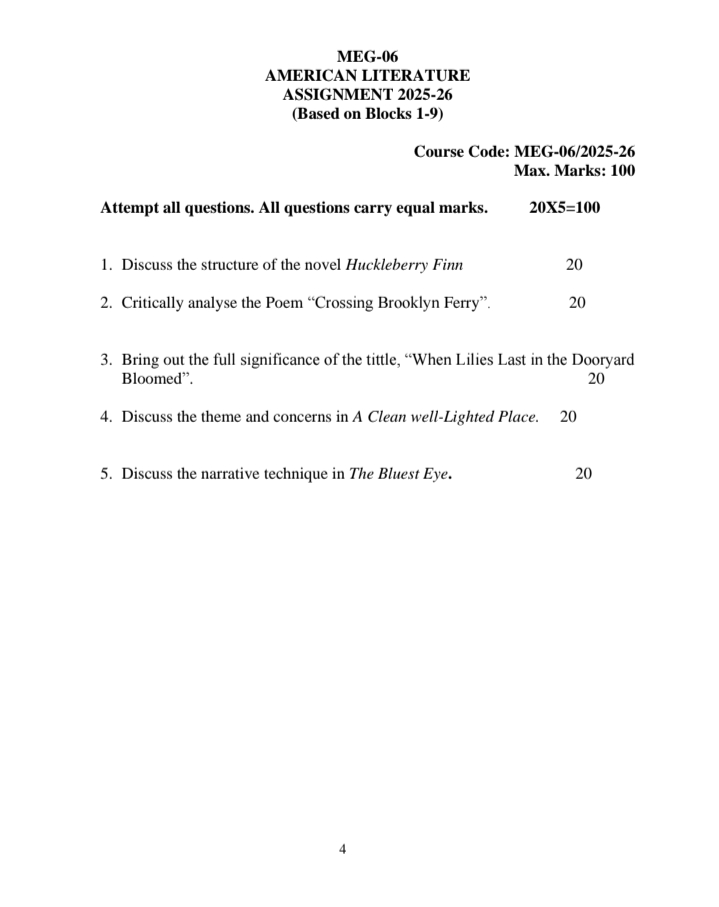
The IGNOU MEG-06 Assignment 2025–26 carries 100 marks and consists of five questions, with each question carrying 20 marks. The assignment requires students to engage critically with major texts prescribed in the course rather than merely reproduce their plots or summaries.
This article provides original, exam-oriented answers to all five questions of the MEG-06 assignment. The answers are organised according to the exact requirements of each question so that students can use them for understanding, revision and assignment preparation.
The five questions cover a range of important areas of American literature: the structure of Mark Twain’s Huckleberry Finn, Walt Whitman’s “Crossing Brooklyn Ferry”, the significance of the title of Walt Whitman’s “When Lilacs Last in the Dooryard Bloom’d”, the themes and concerns of Ernest Hemingway’s “A Clean, Well-Lighted Place”, and the narrative technique of Toni Morrison’s The Bluest Eye.
Note: Students should read the prescribed texts along with these study materials. The answers below are designed to help with understanding and exam-oriented preparation, not to replace the primary texts.
IGNOU MEG-04 Assignment Details
| Particular | Details |
|---|---|
| Programme | M.A. English (MEG) |
| Course Code | MEG-06 |
| Course Title | American Literature |
| Assignment Session | 2025–26 |
| Based on | Blocks 1–8 |
| Maximum Marks | 100 |
| Questions to Attempt | All Five |
| Marks per Question | 20 |
Table Of Contents
Table Of Contents
IGNOU MEG-06 Solved Assignment 2025–26 (American Literature) Questions with Answers
Q1. Discuss the Structure of the Novel Huckleberry Finn
IGNOU MEG-06 | 20-Mark Master Answer
Introduction
Mark Twain’s Adventures of Huckleberry Finn, published in 1884, is one of the major novels of American literature. Narrated by the young Huck Finn, the novel follows his journey down the Mississippi River with Jim, an enslaved man who is trying to reach freedom. Although the novel appears at first to be an adventure story, its structure allows Twain to explore much larger questions concerning freedom, slavery, race, morality, society and individual conscience.
The structure of Huckleberry Finn is particularly important because the novel develops through a combination of first-person narration, episodic movement, picaresque adventure, the river journey and a series of encounters with different communities. The Mississippi River provides the central geographical and symbolic thread that connects these episodes. At the same time, Huck’s movement from one place to another also becomes a movement from the moral values imposed by society towards his own developing understanding of right and wrong.
Thus, the structure of the novel is not simply a sequence of adventures. Its different episodes gradually contribute to Huck’s moral and psychological development.
1. First-Person Narrative Structure
One of the most important structural features of Huckleberry Finn is its first-person narration.
Huck himself tells the story. Therefore, readers experience the events through the consciousness of a young boy rather than through an all-knowing narrator.
This technique gives the novel an intimate and immediate quality. Huck describes what he sees, hears and experiences, while his limited understanding sometimes creates irony because the reader can understand the social implications of events more clearly than Huck does.
The opening itself establishes Huck’s connection with the earlier novel The Adventures of Tom Sawyer, while making it clear that this is Huck’s own story.
Because the story is filtered through Huck’s voice, the structure becomes closely connected with his development as a character.
2. Episodic Structure
Huckleberry Finn has a strongly episodic structure.
Instead of following one continuous action from beginning to end, Huck’s journey is divided into a series of episodes and encounters.
During the journey, Huck and Jim meet different people and enter different communities. These encounters introduce new situations, conflicts and forms of social behaviour.
Among the important episodes are:
- Huck’s escape from his father
- his meeting with Jim
- the journey on the raft
- encounters with the Grangerfords
- the arrival of the Duke and the King
- the Wilks episode
- the Phelps farm and the attempt to rescue Jim
Each episode has its own immediate action, but the episodes are connected by the larger journey.
The episodic structure therefore allows Twain to present different aspects of American society rather than restricting the novel to one location or one conflict.
3. The Picaresque Element
The structure of the novel also contains important features of the picaresque tradition.
A picaresque narrative generally follows the adventures of a central character who moves through different social environments and encounters people from different sections of society.
Huck’s journey has this quality.
He travels from place to place and encounters:
- wealthy families,
- religious communities,
- criminals,
- con artists,
- slaveholders,
- ordinary townspeople,
- and other social groups.
These encounters expose the contradictions of American society.
However, Twain uses the picaresque structure for more than entertainment. The adventures become a means of social observation and criticism.
4. The Mississippi River as the Structural Centre
The Mississippi River is the most important geographical element in the novel’s structure.
Huck and Jim’s raft journey provides continuity between the different episodes.
Whenever they move along the river, they experience a certain degree of freedom from the social rules and institutions of the shore.
The river therefore creates a contrast between:
River → movement, escape, freedom
and
Shore → society, authority, conflict and restrictions
The river is not simply a setting. It becomes the central thread that holds the narrative together.
It also gives the novel a sense of movement. Huck and Jim are constantly travelling, and their physical movement corresponds to Huck’s gradual moral development.
5. The Raft as a Structural Space
The raft is another important element of the novel’s structure.
Whenever Huck and Jim return to the raft, the narrative temporarily moves away from the conflicts of the outside world.
On the raft, Huck and Jim develop their relationship and experience moments of companionship and relative freedom.
The raft therefore provides a contrast with the social world on the shore.
The structural movement between raft episodes and shore episodes allows Twain to compare two different worlds.
The shore repeatedly exposes Huck and Jim to the prejudices and contradictions of society, while the raft becomes a temporary space in which their relationship develops more naturally.
6. The Journey as a Form of Development
The physical journey is closely connected with Huck’s moral journey.
At the beginning of the novel, Huck has absorbed many of the beliefs of the society around him. In particular, he has been taught that helping an enslaved person escape is morally wrong.
As the journey continues, however, Huck develops a personal relationship with Jim.
Huck gradually begins to see Jim not as property but as a human being, friend and companion.
This creates an important conflict between:
Social morality
and
Personal conscience
The structure of the novel allows this conflict to develop gradually through repeated experiences.
Therefore, the journey is both physical and psychological.
7. Structure and Social Criticism
The episodic structure also allows Twain to present a wide range of American society.
Each new episode introduces another social situation through which Twain can expose prejudice, hypocrisy, violence or greed.
For example, the Grangerford episode presents a family involved in a senseless feud.
The Duke and King episodes expose deception, greed and the willingness of people to be manipulated.
The Wilks episode demonstrates how easily sympathy and trust can be exploited.
These episodes may appear separate, but together they create a larger picture of a society marked by moral contradiction and social injustice.
8. The Grangerford Episode
The Grangerford episode is structurally important because it temporarily takes Huck into a different social environment.
The Grangerfords appear respectable, cultured and religious, yet they are involved in a violent and inherited family feud.
The contrast between their appearance and their behaviour illustrates one of the novel’s central concerns: the difference between social respectability and genuine morality.
The episode also prepares readers for the broader criticism of a society that accepts violence and injustice while considering itself civilised.
9. The Duke and the King Episodes
The arrival of the Duke and the King introduces another major stage in the novel.
These two con artists repeatedly deceive people for money.
Their presence adds humour and adventure to the narrative, but their episodes also expose the gullibility, greed and moral weakness of the communities they encounter.
Structurally, these episodes extend Huck and Jim’s journey while introducing a new form of social satire.
The novel therefore repeatedly moves between adventure and social criticism.
10. The Phelps Farm and the Final Section
The final section of the novel takes place at the Phelps farm, where Jim is being held captive.
Huck wants to help Jim escape, but Tom Sawyer becomes involved and turns the rescue into an elaborate adventure.
This section is structurally different from the earlier raft journey because the narrative becomes more complicated and deliberately theatrical.
The return of Tom also connects Huckleberry Finn with the world of The Adventures of Tom Sawyer.
The final section therefore brings together several strands of the novel:
- Huck’s relationship with Jim
- the question of freedom
- Tom Sawyer’s imaginative adventures
- slavery
- social conventions
- Huck’s moral development
11. Circular and Linear Movement
The novel has a basic linear movement because Huck travels forward along the river and through successive experiences.
At the same time, there are moments of return and repetition.
Huck repeatedly moves between situations of freedom and situations controlled by society.
This creates a structural pattern in which the central conflict between freedom and social restriction is repeatedly presented in different forms.
The journey therefore has both a geographical direction and a thematic pattern.
12. Language and Narrative Structure
The structure of the novel is also strengthened by Twain’s use of Huck’s distinctive language.
Huck’s narration is informal, conversational and shaped by his regional speech.
This makes the story sound as if Huck is speaking directly to the reader.
His language also reinforces the novel’s concern with American identity and vernacular speech.
Rather than using a highly formal literary narrator, Twain allows a young American boy to tell the story in his own voice.
This makes the narrative both immediate and distinctive.
13. Structure and Huck’s Moral Development
The different structural stages of the novel ultimately contribute to Huck’s development.
At first, Huck largely accepts the moral assumptions of his society.
His experiences with Jim gradually challenge those assumptions.
One of the most important moments occurs when Huck decides that he will help Jim even though he has been taught that doing so is wrong.
This moment demonstrates the central conflict between conventional morality and individual conscience.
Therefore, the structure of the novel can be understood as a sequence of experiences through which Huck develops an increasingly independent moral consciousness.
14. The Relationship Between Adventure and Serious Themes
Twain’s structure allows him to combine adventure, humour and serious social criticism.
On the surface, the novel contains escapes, journeys, tricks, conflicts and comic situations.
At a deeper level, these events raise questions about:
- slavery
- racism
- freedom
- morality
- social hypocrisy
- violence
- individual conscience
This combination is one of the major strengths of the novel’s structure.
The reader is entertained by the adventures while simultaneously being encouraged to think about the society through which Huck and Jim travel.
Conclusion
The structure of Huckleberry Finn is carefully shaped around Huck’s first-person narration, his journey with Jim, the Mississippi River, the raft, and a succession of episodic encounters. Although the novel has the appearance of an adventure narrative, its structure serves a much larger purpose.
The episodic and picaresque movement allows Mark Twain to expose different aspects of American society, while the river and raft provide continuity to the narrative. More importantly, Huck’s physical journey becomes a moral journey in which his inherited beliefs are gradually challenged by his personal experience and friendship with Jim.
Thus, the structure of Huckleberry Finn brings together adventure, social criticism, satire and moral development. Its episodes are not merely separate adventures; together they create a larger narrative about freedom, conscience and the contradictions of American society.
Q2. Critically Analyse the Poem “Crossing Brooklyn Ferry”
IGNOU MEG-06 | 20-Mark Master Answer
Introduction
Walt Whitman’s “Crossing Brooklyn Ferry” is one of the most significant poems in Leaves of Grass. The poem presents the speaker travelling across the East River between Manhattan and Brooklyn, but the ordinary ferry journey becomes an occasion for exploring much larger ideas about time, human unity, nature, democracy and the continuity of human experience.
Whitman transforms a simple everyday journey into a profound meditation on the relationship between the individual and the larger human community. The speaker observes the water, boats, people, buildings and movement around him, yet his thoughts gradually move beyond the immediate scene. He imagines future generations making the same journey and experiencing the same sights and emotions.
The poem is therefore not merely a description of a ferry ride. It becomes a celebration of shared human experience and the connection between people separated by time and space.
The Ferry Journey as the Central Situation
The poem begins with the speaker observing the activity around the ferry.
He sees:
- the water of the river,
- boats moving across it,
- people travelling,
- buildings and city life,
- sunlight and changing natural surroundings.
These ordinary sights become the basis for the speaker’s meditation.
The ferry itself is important because it carries people from one shore to another. Symbolically, this movement can be understood as a connection between different places, people and moments in time.
Thus, the physical journey becomes a means of exploring a much larger spiritual and philosophical journey.
1. Unity of Human Experience
One of the central ideas of the poem is that human beings are connected through shared experiences.
The speaker realises that the people travelling with him are participating in an experience that is not limited to his own individual life.
More importantly, people in the future will also cross the ferry and observe the same river, boats, sunlight and city.
The poem therefore moves from:
Individual experience → Collective human experience
Whitman suggests that although individuals live at different moments in history, certain fundamental experiences remain common to humanity.
2. Connection Between Past, Present and Future
The treatment of time is one of the most important features of the poem.
The speaker does not remain confined to the present moment.
As he watches the ferry journey, he imagines future generations experiencing the same scene.
The people of the future will:
- see the same river,
- cross the same waters,
- observe similar natural sights,
- experience similar emotions,
- and participate in the same human world.
This creates a powerful connection between past, present and future.
Whitman therefore presents time not simply as something that separates generations but also as something that connects them through recurring human experience.
3. The Poet’s Direct Address to Future Generations
An important feature of the poem is Whitman’s direct address to people who will live in the future.
The speaker imagines that future travellers will look upon the same sights that he is looking at.
This creates an unusual relationship between the poet and readers who do not yet exist.
The poem therefore becomes a kind of communication across time.
The poet’s experience is preserved through poetry, allowing future people to recognise themselves in his experience.
This is one reason why the poem has a strong sense of timelessness.
4. Democracy and Equality
Whitman’s poetry is deeply connected with the idea of democratic community.
In “Crossing Brooklyn Ferry,” the ferry carries many different people together in the same physical space.
The speaker observes people as part of a collective scene rather than focusing exclusively on social distinctions.
The ferry therefore becomes a democratic space where individuals participate in a shared experience.
The poem suggests that human beings are connected by common experiences regardless of differences in individual identity.
This idea is consistent with Whitman’s larger poetic vision of equality, individual freedom and democratic fellowship.
5. Nature and the Urban World
The poem brings together nature and modern city life.
Whitman does not separate the natural world from the modern urban environment.
The river, water, sky and sunlight exist alongside:
- buildings,
- boats,
- ferries,
- crowds,
- commerce,
- and the movement of the city.
This combination is significant because Whitman finds poetic value in ordinary modern life.
The city is not presented merely as an artificial environment. It becomes part of a larger living world.
6. The River as a Symbol
The river has an important symbolic function.
At the literal level, it is the body of water that the ferry crosses.
At a deeper level, it can be understood as representing time, continuity and the movement of human life.
The river continues to flow while different generations come and go.
The speaker’s generation crosses it, and future generations will cross it as well.
Thus, the river becomes a powerful image of continuity amid change.
7. Individual and Collective Identity
Whitman’s speaker begins with his own experience but gradually moves beyond the individual self.
The poem repeatedly connects the speaker with other people who are travelling, observing and feeling.
This movement reflects Whitman’s broader understanding of the self.
The individual is not isolated from humanity. Instead, the self participates in a larger collective existence.
The speaker can therefore imagine a profound connection with people whom he has never met and who will live long after him.
8. Spiritual and Philosophical Dimension
Although the poem begins with an ordinary physical journey, it gradually acquires a spiritual dimension.
The speaker asks how people can remain connected despite differences of time and circumstance.
His answer is not based on a specific religious doctrine. Instead, he finds a kind of spiritual unity in shared human consciousness and experience.
The ferry journey therefore becomes a meditation on the relationship between:
self and others,
past and future,
individual and humanity.
9. Whitman’s Use of Cataloguing
One of Whitman’s characteristic poetic techniques is cataloguing.
He presents a series of observations, people, objects and impressions rather than developing the poem through a tightly controlled traditional stanzaic pattern.
This technique creates a sense of abundance and movement.
The numerous details of the ferry journey make the reader feel present within the scene.
At the same time, the catalogue expands from physical objects to ideas and human experiences.
Thus, Whitman’s cataloguing technique helps transform the ordinary ferry ride into a larger panorama of life.
10. Free Verse and Poetic Form
“Crossing Brooklyn Ferry” demonstrates Whitman’s distinctive use of free verse.
The poem does not depend on a regular rhyme scheme or conventional metrical structure.
Instead, Whitman uses:
- long lines,
- repetition,
- parallel structures,
- catalogues,
- rhythmic variation,
- and direct address.
The flexible form suits the subject of the poem because the speaker’s thoughts move freely from immediate observation to philosophical reflection.
The form therefore reflects the poem’s expansive and democratic vision.
11. Repetition and Parallelism
Whitman frequently uses repetition and parallel structures.
These techniques give the poem a rhythmic quality even though it does not follow traditional metre.
Repetition also reinforces the idea that the same experiences will recur across generations.
The repeated references to people, water, movement and future travellers create a sense of continuity.
Thus, poetic repetition becomes connected with the poem’s central theme of recurrence and human connection.
12. The Ordinary as the Source of the Universal
One of Whitman’s greatest achievements in the poem is his ability to transform an ordinary event into a universal meditation.
A ferry journey might appear completely ordinary.
Yet Whitman uses this simple experience to explore:
- human identity,
- time,
- memory,
- democracy,
- nature,
- mortality,
- continuity,
- and collective experience.
This is characteristic of Whitman’s poetic method: the everyday becomes a gateway to larger philosophical meaning.
13. The Relationship Between Poet and Reader
The poem creates an unusual relationship between the poet and future readers.
Whitman imagines people who will experience the same sights long after his own time.
As a result, the reader becomes part of the poem’s imagined community.
The poem seems to say that although the poet and reader are separated by time, they can still share an experience through poetry.
In this sense, poetry becomes a bridge between different individuals and generations.
Critical Significance
“Crossing Brooklyn Ferry” is significant because it combines personal observation with universal reflection.
Whitman begins with a particular location and a particular moment, but he refuses to keep the poem restricted to that moment.
The Brooklyn ferry becomes a meeting point between:
- city and nature,
- individual and community,
- present and future,
- physical experience and spiritual reflection.
The poem also demonstrates Whitman’s contribution to the development of American poetic voice and free verse. Instead of depending upon traditional European poetic conventions, Whitman develops a flexible style capable of expressing the energy and diversity of modern American life.
Major Themes
The important themes of the poem can be remembered as follows:
1. Human Unity
People separated by time and place can share common experiences.
2. Continuity of Time
Past, present and future are connected through recurring human experiences.
3. Democracy
The ferry becomes a shared space representing social and human fellowship.
4. Nature
The river, water, sky and sunlight become essential parts of the speaker’s meditation.
5. Individual and Collective Self
The individual is connected to the larger human community.
6. Modern Urban Life
Whitman finds poetry in ordinary city life and everyday experience.
Literary Features
Whitman uses free verse, repetition, parallelism, cataloguing, direct address and vivid imagery throughout the poem.
His long poetic lines create a sense of expansiveness and movement, while his catalogues reproduce the variety of people and objects present in the urban environment.
The direct address to future generations makes the poem unusually intimate and universal at the same time.
The combination of concrete imagery and philosophical reflection allows Whitman to transform an everyday ferry journey into a meditation on human existence and continuity.
Conclusion
“Crossing Brooklyn Ferry” transforms an ordinary journey into a profound meditation on human connection, time and shared experience. The ferry connects two physical shores, but Whitman’s imagination extends this idea further: the poem connects individuals across generations.
The river becomes a symbol of continuity, while the ferry becomes a shared space in which people participate in a common human experience. Through free verse, repetition, cataloguing, direct address and vivid imagery, Whitman creates a poetic form capable of embracing both the ordinary details of modern life and larger philosophical questions.
The lasting significance of the poem lies in its belief that human beings are connected despite the boundaries of time, place and individual existence. What begins as one man’s journey across the Brooklyn Ferry ultimately becomes a celebration of the enduring continuity of human life.
Q3. Bring Out the Full Significance of the Title When Lilacs Last in the Dooryard Bloom’d
IGNOU MEG-06 | 20-Mark Master Answer
Note: The assignment image gives the title as “When Lilies Last in the Dooryard Bloomed.” The standard title of Walt Whitman’s poem is When Lilacs Last in the Dooryard Bloom’d. I am using the standard title below.
Introduction
Walt Whitman’s When Lilacs Last in the Dooryard Bloom’d is one of the most important poems in his elegiac poetry. Written after the assassination of President Abraham Lincoln in 1865, the poem is a profound meditation on death, grief, nature, memory and the possibility of acceptance. However, Whitman does not write a conventional political elegy that simply praises Lincoln. Instead, he transforms his personal and national grief into a universal reflection on mortality.
The title itself is highly significant because it brings together three important elements of the poem: the lilac, the season of spring and the dooryard. These images become recurring symbols through which Whitman expresses grief and remembrance. The title also establishes the connection between natural renewal and human death: while spring brings flowers back to life, human beings must eventually die.
Thus, the title provides an important key to understanding the poem’s central movement from personal grief towards acceptance of death and continuity of life.
The Historical Background of the Poem
The poem was written in response to the assassination of Abraham Lincoln, who was killed in April 1865 shortly after the end of the American Civil War.
Lincoln’s death was therefore not simply the death of an individual. It occurred at a moment of enormous national importance.
Whitman transforms this historical tragedy into a larger meditation on:
- death,
- mourning,
- war,
- national loss,
- memory,
- nature,
- and spiritual acceptance.
However, Lincoln is not repeatedly named in the poem. Instead, Whitman refers to him indirectly through images such as the coffin, the journey of the funeral train and the mourning nation.
This makes the poem more universal. Lincoln becomes not only a historical figure but also a symbol of human mortality and collective grief.
Significance of “Lilacs”
The first major element of the title is the lilac.
The lilac is a spring flower, and its recurring appearance becomes one of the central symbols of the poem.
Whitman associates the lilac with love, memory, grief and death.
The speaker repeatedly encounters the lilac while mourning the dead President. Therefore, the flower becomes permanently associated with the memory of Lincoln.
The lilac is also significant because it is a living natural object.
Human beings die, but nature continues to bloom.
This creates an important contrast:
Human death → permanence of memory
Natural renewal → continuity of life
The flower therefore becomes a symbol through which grief is connected with the continuing cycle of nature.
“Last” and the Idea of Recurrence
The word “last” in the title is equally important.
The phrase “When lilacs last…” immediately suggests a particular moment in the recurring cycle of nature.
Lilacs bloom seasonally. Their flowering therefore suggests return and recurrence.
The death of Lincoln, however, is irreversible.
Whitman places these two realities together:
Nature repeatedly renews itself, while human life is finite.
Every spring, the lilacs may bloom again, but the dead person does not return.
Yet this repetition also gives the speaker a form of consolation. The flower becomes a recurring reminder of the dead, so memory survives even when physical life ends.
Thus, “last” suggests both a particular season of mourning and the recurring power of memory.
Significance of the “Dooryard”
The word “dooryard” refers to the area immediately outside a house.
This is important because Whitman does not choose a grand or distant landscape for his central floral image. He chooses an ordinary domestic space.
The dooryard makes the poem intimate and personal.
It suggests:
- home,
- familiarity,
- childhood,
- everyday life,
- memory,
- and personal attachment.
The lilac growing in the dooryard therefore becomes something familiar and emotionally close.
The ordinary domestic setting allows Whitman to transform a national tragedy into a deeply personal experience of mourning.
The Title and Lincoln’s Death
The title also becomes significant when understood in relation to Lincoln’s death.
The lilac blooming in spring coincides with the historical moment of Lincoln’s assassination.
Thus, the natural event and the political tragedy become emotionally connected.
The speaker’s experience of the flower can never again be separated from the memory of death.
The poem therefore demonstrates how a particular natural object can become a permanent symbol of historical memory.
Whenever the lilac returns, the memory of loss can return with it.
The Seasonal Symbolism
The poem is set against the background of spring.
Spring traditionally suggests:
- renewal,
- rebirth,
- growth,
- beauty,
- and hope.
But Whitman’s spring is also marked by death.
The natural world is renewed precisely when the nation is mourning its dead leader.
This creates a powerful paradox:
Life is renewed while human beings die.
The title captures this tension perfectly.
The lilac is beautiful, but its beauty is inseparable from grief.
Therefore, Whitman does not present nature as simply cheerful or comforting. Nature becomes a complex reminder that life and death exist together.
The Lilac as a Symbol of Memory
The lilac eventually becomes a symbol of remembrance.
The speaker repeatedly returns to the flower, and it becomes associated with the dead President.
The natural object therefore preserves the emotional memory of the deceased.
This is particularly important because the poem is not only about Lincoln’s physical death. It is also about the question:
How can the dead continue to exist in the consciousness of the living?
Whitman’s answer is partly through memory, poetry and nature.
The lilac becomes a living memorial.
The Title and the Three Central Symbols
The poem is structured around three major symbolic images:
1. The Lilac
The lilac represents love, grief, memory and recurring remembrance.
2. The Star
The star represents Lincoln and the presence of the dead figure in the speaker’s consciousness.
3. The Hermit Thrush
The hermit thrush represents death, mourning and the possibility of spiritual acceptance through its song.
These symbols work together to develop the poem’s movement from grief towards reconciliation with mortality.
The title introduces the first of these major symbols and therefore prepares the reader for the poem’s symbolic structure.
The Title and the Theme of Death
Death is the central concern of the poem.
However, Whitman does not present death simply as something terrifying.
Instead, he gradually attempts to understand death as a natural part of existence.
The repeated return of the lilac suggests that while individual lives end, nature continues.
The poem therefore moves from:
Shock → Grief → Mourning → Reflection → Acceptance
The title begins this process by connecting the beautiful renewal of the lilac with the painful reality of death.
The Title and the Theme of Memory
Memory is another major concern.
The death of Lincoln becomes part of the collective memory of the American nation.
The lilac acts almost like a natural memorial.
Every return of the flower can recall the earlier moment of loss.
Thus, the title suggests that memory is not static. It returns repeatedly, just as the seasons return.
The natural cycle therefore becomes a metaphor for the continuing life of remembrance.
The Title and Whitman’s Democratic Vision
Although the poem is connected with Lincoln, Whitman’s treatment is broader than the mourning of one political leader.
Lincoln’s death becomes a symbol of the suffering experienced by the entire nation during the Civil War.
The poem therefore moves from individual grief to collective grief.
Whitman’s democratic imagination allows him to transform one man’s death into a meditation on the suffering and emotional experience of a whole people.
The title’s ordinary image of the lilac helps make this national tragedy intimate and accessible.
The Title and Nature
Nature plays a central role in Whitman’s poetry.
In this poem, however, nature does not simply provide a pleasant background.
The natural world participates in the speaker’s mourning.
The lilac, star and bird all become symbolic elements through which the speaker processes grief.
Nature therefore becomes a language through which human emotions can be expressed.
The title immediately places the reader within this natural-symbolic world.
The Title and the Structure of the Elegy
The significance of the title becomes even clearer when we consider the poem’s overall structure.
Whitman develops the elegy through recurring images and meditations.
The poem repeatedly returns to the lilac, the star and the bird.
This recurrence gives the poem a cyclical quality.
The structure reflects the poem’s central idea that although death is final, memory and natural cycles continue.
Therefore, the title is not simply decorative. It introduces the image that becomes part of the poem’s entire symbolic and structural pattern.
Elegy and Universal Human Experience
Although the poem originates in a specific historical event, Whitman makes it universal.
The death of Lincoln becomes an opportunity to think about the death of all human beings.
The grief experienced by the speaker becomes recognisable to anyone who has lost someone.
The lilac therefore moves beyond its historical association and becomes a symbol of love remembered through grief.
This universal quality is one reason why the poem remains significant beyond the specific circumstances of Lincoln’s assassination.
Major Themes Connected with the Title
The significance of the title can be remembered through these major themes:
Death and Mortality
The blooming flower exists alongside the death of Lincoln.
Grief and Mourning
The lilac becomes associated with the speaker’s sorrow.
Memory
The recurring flower keeps the memory of the dead alive.
Nature and Renewal
Spring represents the continuing cycle of natural life.
National Loss
Lincoln’s death becomes a symbol of collective American grief.
Acceptance
The poem gradually moves towards an acceptance of death as part of existence.
Literary Significance of the Title
The title is significant because it is symbolic, visual and emotionally suggestive.
It does not directly announce that the poem is about Lincoln’s assassination.
Instead, Whitman chooses an image from nature.
This indirect approach is important because it allows the poem to move beyond historical mourning and become a meditation on universal mortality.
The title also creates an emotional atmosphere before the poem even begins. The reader encounters the image of the returning lilac and gradually discovers its connection with loss.
Thus, the title functions as a symbolic key to the entire poem.
Conclusion
The title When Lilacs Last in the Dooryard Bloom’d is deeply significant because it brings together the poem’s central concerns of nature, death, grief, memory and renewal. The lilac becomes associated with Lincoln’s death and the speaker’s mourning, while its seasonal return suggests the continuing cycles of nature and the persistence of memory.
The “dooryard” gives the poem an intimate and domestic quality, transforming a national tragedy into a deeply personal experience. The word “last” introduces the idea of recurrence and the contrast between the repeated renewal of nature and the finality of human death.
The title also prepares us for the poem’s larger symbolic structure involving the lilac, the star and the hermit thrush. Through these images, Whitman gradually transforms grief into reflection and finally towards acceptance.
Therefore, the title is not merely a reference to a flower. It becomes a symbolic expression of the entire elegiac movement of the poem—from the shock of death and the pain of mourning to the enduring power of love, memory and the continuing cycle of life.
Q4. Discuss the Theme and Concerns in A Clean, Well-Lighted Place
IGNOU MEG-06 | 20-Mark Master Answer
Introduction
Ernest Hemingway’s “A Clean, Well-Lighted Place” is a short story that explores the emotional and psychological condition of human beings living in a world that can appear empty, lonely and meaningless. The story is deceptively simple. It centres on an old man sitting alone in a café late at night while two waiters discuss him. Yet behind this simple situation lies a serious examination of loneliness, isolation, despair, dignity, darkness and the human need for companionship and a meaningful place to exist.
Hemingway presents these concerns through a restrained narrative style. Instead of explaining the characters’ emotions directly, he allows their conversations, silences and actions to reveal their inner condition. The café itself becomes more than a setting: its cleanliness, order and light offer a temporary refuge from the darkness outside.
Thus, the story’s significance lies not in a complicated plot but in its exploration of the human condition through an ordinary late-night encounter.
The Basic Situation of the Story
The story takes place late at night in a café.
An old deaf man sits alone drinking brandy. Two waiters observe him and discuss whether they should allow him to remain.
The younger waiter is impatient because he wants to go home to his wife.
The older waiter, however, understands the old man’s desire to remain in the café. He recognises that the old man needs the café because he does not want to return to an empty and lonely existence.
This simple situation establishes the central conflict between:
Youth and impatience
and
Age, loneliness and understanding.
The older waiter eventually reveals that he also understands the need for a clean and well-lighted place.
1. Loneliness and Isolation
Loneliness is the central theme of the story.
The old man is physically surrounded by people in the café, yet he remains emotionally isolated.
His deafness further separates him from the surrounding world.
He sits alone drinking, and his desire to remain in the café suggests that he is seeking protection from the loneliness of his own life.
The story therefore distinguishes between being physically alone and experiencing existential loneliness.
The old man’s problem is not simply that he has nobody sitting beside him. His deeper problem is that he seems to have lost a meaningful connection with life.
The older waiter recognises this condition because he also understands what it means to be alone.
2. Existential Despair and Meaninglessness
Another major concern is the sense that life may lack a stable or comforting meaning.
The old man has attempted suicide, suggesting the depth of his despair.
The older waiter also reflects on the emptiness that can surround human existence.
His thoughts move beyond the specific situation of the café towards a broader awareness of nothingness and uncertainty.
Hemingway does not provide a simple philosophical solution.
Instead, he presents a world in which human beings must find temporary ways of coping with loneliness and uncertainty.
The café becomes one such refuge.
3. The Importance of the Café
The clean, well-lighted café is the central symbol of the story.
It represents:
- order,
- cleanliness,
- light,
- dignity,
- comfort,
- companionship,
- and temporary refuge.
For the old man, the café is preferable to the darkness outside.
The café provides an environment in which he can sit quietly and maintain a sense of dignity.
The older waiter also values such a place.
Therefore, the café becomes much more than a location. It represents the small spaces of order and comfort that human beings create against loneliness and darkness.
4. Light and Darkness
The contrast between light and darkness is one of the most important symbolic structures in the story.
The café is clean and illuminated, while the outside world is dark.
Light suggests:
- safety
- order
- human presence
- dignity
- temporary comfort
Darkness suggests:
- loneliness
- emptiness
- fear
- isolation
- existential uncertainty
The old man does not want to leave the light because leaving the café means returning to a darker and more isolated existence.
The older waiter understands this.
Therefore, the title itself becomes symbolic: the café is valuable because it offers a small area of light and order in an otherwise uncertain world.
5. Youth versus Old Age
The story presents an important contrast between the two waiters.
The younger waiter is impatient and confident.
He has a wife waiting for him and therefore feels that the old man is unnecessarily delaying his return home.
The older waiter, however, is more sympathetic.
He understands that not everyone has a home filled with companionship.
This contrast suggests that experience and age can produce a deeper understanding of loneliness.
The younger waiter sees the café mainly as a workplace.
The older waiter sees it as a necessary refuge for people who have nowhere else to go.
6. Dignity and Human Need
Hemingway does not portray the old man as a pathetic figure who needs to be rescued.
Instead, the old man maintains a degree of dignity.
He quietly sits in the café and drinks.
The older waiter respects his desire to remain there.
This is important because the story suggests that human beings need not only food and shelter but also spaces in which they can preserve their dignity.
The clean and well-lighted café provides such a space.
7. Isolation and Communication
Communication in the story is also limited.
The old man is deaf and therefore physically cut off from ordinary communication.
The waiters speak about him rather than directly engaging with him in a meaningful conversation.
This reinforces the theme of isolation.
However, the older waiter develops a form of understanding through empathy.
He recognises something of himself in the old man’s loneliness.
Thus, although direct communication is limited, human sympathy becomes a form of connection.
8. The Older Waiter’s Existential Anxiety
The older waiter is one of the most important characters because he is more than an observer of the old man’s loneliness.
He also experiences loneliness himself.
He admits that he understands why the café matters to the old man because he too may prefer a clean, well-lighted place to an empty and dark environment.
His reflections suggest that he is aware of the possibility of nothingness.
This makes him a more complex character than the younger waiter.
He has developed an awareness of the emotional realities that the younger man has not yet experienced.
9. Home and the Absence of Home
The story creates an important contrast between home and café.
For the younger waiter, home is attractive because his wife is waiting for him.
For the old man, however, returning home does not appear to offer the same comfort.
The older waiter understands this difference.
Therefore, the café becomes a substitute for the emotional security that the old man lacks elsewhere.
The story suggests that home is not simply a physical building. It becomes meaningful when it provides companionship, security and emotional connection.
10. The Theme of Compassion
The older waiter represents a form of compassion.
Unlike the younger waiter, he does not simply judge the old man for staying late.
He understands that the old man’s need is deeper than his desire for another drink.
This compassion is significant because Hemingway presents it without sentimentality.
The older waiter does not give a long speech about kindness. Instead, his behaviour and understanding demonstrate it.
This restrained treatment of compassion is characteristic of Hemingway’s narrative style.
11. The Human Need for Order
The word “clean” in the title is important.
The café is not merely illuminated; it is also clean and orderly.
For the older waiter, this order appears meaningful because it provides a sense of stability.
The world outside may seem uncertain and empty, but within the café there is:
- cleanliness,
- light,
- routine,
- order,
- and human presence.
The story therefore suggests that people may create small structures of order to cope with the uncertainty of existence.
12. Alcohol and Temporary Escape
Alcohol is another important element in the story.
The old man drinks brandy, and the waiters discuss his drinking.
Alcohol does not solve the old man’s problems. Instead, it becomes part of his temporary escape from loneliness.
Similarly, the café itself cannot permanently remove existential despair.
What it offers is temporary relief.
Hemingway therefore avoids presenting simple solutions. Human beings may not be able to eliminate loneliness, but they can create temporary spaces of comfort and dignity.
13. Hemingway’s Minimalist Technique
The story’s themes are closely connected with Hemingway’s style.
Hemingway uses short dialogue, simple language, understatement and omission.
He does not provide lengthy psychological explanations.
Instead, readers must infer the emotional condition of the characters from:
- their conversations,
- silences,
- actions,
- repetitions,
- and contrasts.
This technique is closely related to Hemingway’s Iceberg Theory, according to which much of the meaning remains beneath the surface of the text.
The apparent simplicity of the story therefore conceals considerable psychological and philosophical depth.
14. Symbolism
Several elements of the story function symbolically.
The Café
Represents order, light, dignity and refuge.
Light
Represents temporary security and comfort.
Darkness
Suggests loneliness, isolation and existential uncertainty.
The Old Man
Represents human vulnerability and loneliness.
The Older Waiter
Represents awareness, empathy and existential understanding.
Alcohol
Represents temporary escape rather than a permanent solution.
These symbols work together to create the story’s larger meaning.
Major Themes and Concerns at a Glance
| Theme/Concern | Significance |
|---|---|
| Loneliness | Central emotional condition of the old man and older waiter |
| Existential despair | Awareness of emptiness and uncertainty |
| Light vs Darkness | Comfort and order versus isolation and nothingness |
| Dignity | The need for respectful human spaces |
| Age and Youth | Different levels of understanding and experience |
| Compassion | Older waiter’s empathy for the lonely |
| Home | Emotional security versus physical shelter |
| Order | Cleanliness and routine as temporary comfort |
| Alcohol | Temporary escape from emotional pain |
| Communication | Difficulty of connecting with others |
Critical Significance
The power of “A Clean, Well-Lighted Place” lies in its ability to explore serious philosophical concerns through an extremely simple situation.
Hemingway does not use elaborate descriptions or long philosophical explanations. Instead, a conversation between two waiters and the presence of an old man become sufficient to raise questions about the nature of human existence.
The story also demonstrates Hemingway’s ability to make ordinary places symbolically important.
The café is simultaneously a physical location and a psychological refuge.
The title itself captures this idea. The “clean, well-lighted place” represents the small amount of order and comfort that human beings may seek when faced with loneliness and uncertainty.
Conclusion
Ernest Hemingway’s “A Clean, Well-Lighted Place” is a deceptively simple story that explores profound concerns about loneliness, existential despair, dignity, compassion and the human need for order and connection. The old man, the two waiters and the café form a small dramatic world through which Hemingway examines much larger questions about human existence.
The contrast between light and darkness becomes central to the story’s meaning. The café offers cleanliness, order and temporary refuge, while the darkness outside suggests isolation and uncertainty. The older waiter understands this need because he shares something of the old man’s loneliness.
Through minimalist prose, restrained dialogue, symbolism, repetition and understatement, Hemingway leaves much of the story’s meaning beneath the surface. The result is a short story whose apparent simplicity conceals considerable philosophical depth.
Ultimately, the clean, well-lighted café represents one of humanity’s small but meaningful attempts to create order, dignity and comfort in a world where loneliness and uncertainty cannot always be removed.
Q5. Discuss the Narrative Technique in The Bluest Eye
Toni Morrison’s The Bluest Eye, published in 1970, is notable for its complex narrative technique. The novel tells the story of Pecola Breedlove, a young Black girl who believes that having blue eyes would make her beautiful and accepted. Morrison does not present Pecola’s story through a single straightforward narrator. Instead, she uses multiple perspectives, shifting points of view, retrospective narration, seasonal divisions, flashbacks and the Dick-and-Jane primer. These techniques help the reader understand Pecola’s personal suffering as well as the social conditions behind it.
One of the most important narrative voices in the novel is Claudia MacTeer. Claudia narrates parts of the story from the perspective of a Black child and, as an adult, looks back upon the events of her childhood. This retrospective narration is significant because the adult Claudia can understand the social and racial implications of events that she could not fully understand as a child. Through Claudia, the reader gets a personal and critical perspective on Pecola’s life.
Morrison also employs multiple perspectives and third-person narration. The experiences of characters such as Pauline and Cholly are gradually revealed through separate sections of the novel. Their personal histories help readers understand the circumstances that have shaped their behaviour. This prevents Pecola’s tragedy from appearing as an isolated personal problem. Instead, it becomes connected with racism, poverty, family conflict, social prejudice and imposed standards of beauty.
Another important feature is the novel’s seasonal structure. The story is divided into Autumn, Winter, Spring and Summer. Normally, the changing seasons suggest growth, renewal and the natural cycle of life. However, Pecola’s life moves in the opposite direction. The contrast between natural growth and her psychological destruction makes the seasonal structure particularly meaningful.
Morrison also uses the Dick-and-Jane primer as a recurring narrative device. It presents an idealised image of a happy white family and a perfect home. As the novel progresses, the primer is repeated in increasingly fragmented forms. This fragmentation reflects the distance between the supposedly perfect American ideal and the difficult reality experienced by Pecola and other marginalised characters.
The narrative is also non-linear. Morrison uses memories and flashbacks to reveal the past experiences of characters gradually. Instead of explaining everything at once, she allows the reader to reconstruct the reasons behind their actions. This technique gives psychological depth to the characters and shows how past experiences continue to affect the present.
Morrison’s shifting narrative perspectives are therefore closely connected with the central concerns of the novel. Different voices reveal how ideas of beauty, race, identity and social acceptance are created and internalised. Pecola’s desire for blue eyes is not simply a personal wish; it is the result of a society that associates beauty and value with whiteness.
Thus, the narrative technique of The Bluest Eye is essential to its meaning. Through Claudia’s narration, multiple perspectives, third-person narration, seasonal structure, flashbacks, fragmentation and the Dick-and-Jane primer, Morrison presents Pecola’s tragedy from several angles. The complex form allows the novel to move beyond an individual story and become a powerful examination of racism, beauty standards, identity, memory and social exclusion.
Important Tips for IGNOU MEG-06 Assignment
Writing the answers is only one part of the assignment. The presentation, organisation and relevance of the answer also matter. Since each question carries 20 marks, students should try to develop their answers properly rather than writing very short responses.
Understand the Question First
Before writing, identify the key instruction in the question:
- Discuss → explain the topic in detail and analyse it.
- Critically analyse → explain the text and also discuss its significance.
- Bring out the significance → explain why the particular idea, title, symbol or element is important.
- Narrative technique → focus on point of view, structure, narration, perspective and related techniques.
- Structure → discuss how the text is organised and how that organisation contributes to its meaning.
Do not give the same type of answer to every question.
FAQs – IGNOU MEG-06 Solved Assignment 2025–26
1. How many questions are there in the IGNOU MEG-06 Assignment 2025–26?
The assignment contains five questions, and students are required to attempt all five. Each question carries 20 marks, making the assignment worth 100 marks in total.
2. How long should each MEG-06 answer be?
For a 20-mark question, students should aim for approximately 550–650 words. With normal handwriting and proper paragraph spacing, this can generally make a substantial 3–4 page answer.
However, students should focus on quality and relevance rather than increasing the length unnecessarily.
3. Should I write all five answers?
Yes. Since each question carries 20 marks and the assignment requires students to attempt all five questions, all five answers should be completed.
4. Should I use headings in my assignment?
Yes. Relevant headings can make a long literature answer easier to read and organise.
For example, an answer can have:
- Introduction
- Main Discussion
- Major Themes/Features
- Critical Analysis
- Conclusion
Avoid turning the entire answer into a collection of disconnected bullet points.
5. Should I include quotations?
Yes, where relevant. Short quotations or textual references can strengthen a literature answer. However, quotations should be followed by your own explanation and analysis.
Conclusion
The IGNOU MEG-06: American Literature Assignment 2025–26 covers five important texts and introduces students to different forms, themes and techniques of American literature. From the structure and narrative movement of Mark Twain’s Adventures of Huckleberry Finn to Whitman’s treatment of human unity and time in Crossing Brooklyn Ferry, the texts represent different ways of exploring American experience.
The significance of death, memory and nature in Whitman’s When Lilacs Last in the Dooryard Bloom’d, the themes of loneliness and existential uncertainty in Hemingway’s A Clean, Well-Lighted Place, and Morrison’s complex narrative technique in The Bluest Eye further demonstrate the diversity of American literary writing.
While preparing these answers, students should focus not only on remembering content but also on understanding the literary techniques, themes, characters, symbols and social concerns of each prescribed text. A well-organised answer with relevant textual references, clear analysis and a proper conclusion can make the assignment more effective.
These solved answers are intended to provide students with a clear, exam-oriented foundation for completing the MEG-06 assignment and revising the prescribed texts. Students should read the original texts alongside these notes and develop their answers according to the requirements of each question.
Explore More IGNOU MEG Resources
If you’re preparing for the IGNOU M.A. English examination, you may also find these guides helpful:
- IGNOU MEG-01 Solved Assignment 2025–26 | Complete British Poetry Answers
- IGNOU MEG-02 Solved Assignment 2025–26 (British Drama)
- IGNOU MEG-03 Solved Assignment 2025–26 (British Novel) | Complete Answers
- IGNOU MEG-04 Solved Assignment 2025-26 – Aspects of Language
- IGNOU MEG 05 Solved Assignment 2025-2026 (Free PDF) | Literary Theory & Criticism
- IGNOU MEG-07 Solved Assignment 2025–26 (Indian English Literature)
- IGNOU July 2026 Admission Last Date Extended to 31 July
- IGNOU MEG-01 Complete Syllabus & 16 Years PYQ Trend Analysis (2010–2025) | British Poetry
Disclaimer
Save this post—you’ll need to return to it regularly before exam day.
This article is written for educational purposes and is based on multiple academic sources, interpreted in the author’s own words.
About the Author
Shariya Writes believes that literature is not a burden to memorize, but an emotion to understand. Through blogs, reels, and videos, she simplifies English Literature for students who want to connect texts with life.
Explore more here:
https://linktr.ee/shariyawrites