
IGNOU MEG-03 Solved Assignment 2025–26 (British Novel)
Introduction
Are you looking for the IGNOU MEG-03 Solved Assignment 2025–26? You’re in the right place.
This article provides complete, well-structured model answers for all the questions in the latest IGNOU MEG-03 Solved Assignment 2025-26. These answers are written in simple academic English and follow the IGNOU guideline of approximately 350–400 words per answer, making them ideal for MA English students.
The assignment covers five major British novels: Tom Jones, Pride and Prejudice, Middlemarch, Heart of Darkness, and A Portrait of the Artist as a Young Man. Each answer includes critical analysis, textual discussion, and exam-oriented points to help you score better in your assignments.
Note: These are model answers for academic guidance. Read, understand, and write them in your own words before submission.
IGNOU MEG-03 Assignment Details
| Particular | Details |
|---|---|
| Programme | M.A. English (MEG) |
| Course Code | MEG-03 |
| Course Title | British Novel |
| Session | 2025–26 |
| Maximum Marks | 100 |
| Questions | 5 |
| Marks per Question | 20 |
Table of Contents
Table of Contents
Question 1
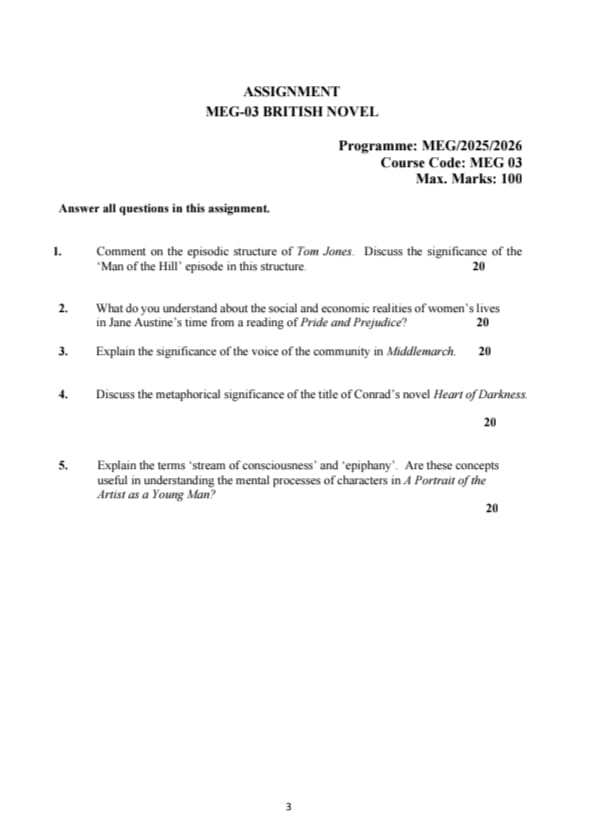
Comment on the episodic structure of Tom Jones. Discuss the significance of the “Man of the Hill” episode in this structure.
Introduction
Henry Fielding (1707–1754) was one of the most influential English novelists of the eighteenth century. He is especially admired for combining homour, satire, and realistic social observation in his fiction. His masterpiece, The History of Tom Jones, a Foundling, published in 1749, is regarded as one of the greatest comic novels in English literature because of its brilliant narrative design and memorable characters.
“What a master of composition Fielding was! … I think Oedipus Tyrannus, The Alchemist, and Tom Jones are the three most perfect plots ever planned.” — Samuel Taylor Coleridge
The Romantic poet and critic Samuel Taylor Coleridge praised the novel’s construction, stating that Tom Jones possesses one of the three most perfectly planned plots in literature. This appreciation reflects the remarkable unity that Fielding achieves through a series of carefully connected episodes.
Episodic Structure of Tom Jones
An episodic structure is a narrative technique in which the story develops through a sequence of individual adventures or incidents. In Tom Jones, these episodes are not isolated stories; instead, each one contributes to the growth of the hero and the overall meaning of the novel.
The novel follows Tom Jones, an orphan who is lovingly raised by Squire Allworthy. After being wrongly accused and forced to leave Paradise Hall, Tom begins a long journey across England. During his travels, he meets people from every section of society—soldiers, innkeepers, beggars, merchants, wealthy landowners, and criminals. Through these encounters, Fielding presents a wide and realistic picture of eighteenth-century English life.
The episodic form allows the novelist to explore different social institutions and human behaviours. Every adventure reveals something about morality, class, hypocrisy, generosity, or justice. Rather than slowing the story, these episodes gradually shape Tom into a wiser and more mature individual.
The Significance of the “Man of the Hill” Episode
One of the most important episodes in the novel is the meeting between Tom and the Man of the Hill. Living alone in complete isolation, the old man narrates the painful experiences that made him lose faith in humanity. Betrayal, disappointment, and selfishness have convinced him that society is beyond redemption.
This episode is significant because it introduces a strong philosophical contrast. The Man of the Hill believes that peace can only be found by withdrawing from the world, whereas Tom continues to believe in compassion, forgiveness, and human goodness. Fielding therefore presents two different responses to life’s suffering—cynicism and hope.
The episode also acts as a moral lesson for both Tom and the reader. It suggests that escaping society cannot solve its problems; true virtue is achieved by living honestly within society despite its imperfections.
Conclusion
The episodic structure is one of the greatest strengths of Tom Jones. It transforms the novel into both an entertaining adventure and a realistic social document. Among all its episodes, the “Man of the Hill” stands out as a powerful reflection on human nature, emphasizing that hope and moral integrity are stronger than despair and isolation.
Question 2
What do you understand about the social and economic realities of women’s lives in Jane Austen’s time from a reading of Pride and Prejudice?
Introduction
Jane Austen (1775–1817) was one of the greatest English novelists, celebrated for her insightful portrayal of society, family, and women’s lives. Her novel Pride and Prejudice, published in 1813, is much more than a romantic story; it is a powerful commentary on the limited social and economic choices available to women in early nineteenth-century England.
The famous critic Virginia Woolf admired Austen’s artistic brilliance and described her as one of the writers whose novels reveal extraordinary understanding of human relationships and domestic society. Through the lives of the Bennet sisters, Austen exposes how marriage, property, and social status shaped a woman’s future.
Pride and Prejudice presents a realistic picture of the social and economic conditions of women during Jane Austen’s time. In the early nineteenth century, women had very few opportunities to earn an independent living. Their financial security largely depended upon marriage, inheritance, or the support of male relatives. Austen uses the Bennet family to illustrate this unequal social system.
The most important economic issue in the novel is the entailment of property. The Bennet estate, Longbourn, cannot be inherited by the five Bennet daughters because it is legally reserved for the nearest male heir, Mr. Collins. This immediately creates anxiety for Mrs. Bennet, whose constant desire to marry off her daughters is not merely comic but deeply practical. She understands that without suitable marriages, her daughters may face financial insecurity.
Elizabeth Bennet represents a different attitude towards marriage. Unlike Charlotte Lucas, she refuses to marry simply for economic comfort. She rejects Mr. Collins despite knowing that his proposal could provide her with wealth and social security. Elizabeth believes that marriage should be based on love, respect, and mutual understanding, making her one of Austen’s most independent female characters.
Charlotte Lucas, however, reflects the harsh reality experienced by many women. At the age of twenty-seven, with limited prospects and little fortune, she accepts Mr. Collins’s proposal because marriage offers stability rather than happiness. Austen does not criticize Charlotte; instead, she shows how society forces women to make practical choices.
Lydia Bennet presents another social reality. Her impulsive relationship with Wickham threatens not only her own reputation but also the honour of her entire family. Austen highlights how women’s social status was closely connected with ideas of modesty and respectability, while men often escaped similar moral judgement.
Through characters such as Lady Catherine de Bourgh and Georgiana Darcy, the novel also reveals the influence of class and wealth on women’s lives. Although wealthy women possess greater social authority, they are still expected to follow rigid social conventions.
Conclusion
In Pride and Prejudice, Jane Austen brilliantly combines romance with social criticism. The novel demonstrates that women’s lives were shaped by property laws, economic dependence, class hierarchy, and the institution of marriage. Through Elizabeth Bennet’s intelligence and independence, Austen quietly challenges these restrictions and suggests that personal dignity and rational choice are more valuable than wealth alone.
Question 3
Explain the significance of the voice of the community in Middlemarch.
Introduction
George Eliot (1819–1880) was one of the most important Victorian novelists, admired for her psychological realism and deep understanding of society. Her masterpiece, Middlemarch: A Study of Provincial Life, published in 1871–72, presents the lives of ordinary people living in a small English town. Rather than focusing on a single hero, Eliot explores how individual lives are constantly shaped by the opinions, traditions, and values of the community.
The critic Virginia Woolf described Middlemarch as:
“one of the few English novels written for grown-up people”.
emphasizing its extraordinary insight into human relationships and social life. This makes the voice of the community central to the novel’s meaning.
In Middlemarch, the voice of the community refers to the collective opinions, judgments, gossip, and moral values of the people living in the town of Middlemarch. George Eliot shows that no character exists in isolation; every decision is influenced by family expectations, social reputation, and public opinion. The community almost functions as an invisible character that shapes the lives of everyone.
One of the clearest examples is Dorothea Brooke. Her marriage to the elderly scholar Edward Casaubon surprises the town, and people constantly discuss her choice. After Casaubon’s death, Dorothea’s growing affection for Will Ladislaw becomes another subject of public gossip. Society expects her to protect her reputation, and the fear of criticism creates emotional conflict in her life.
The community also influences Dr. Tertius Lydgate, an ambitious young doctor who dreams of introducing modern medical practices. Although he possesses intelligence and idealism, the conservative citizens of Middlemarch resist change. Their suspicion, combined with rumours about his financial difficulties and his marriage to Rosamond Vincy, gradually destroys his professional reputation. Eliot demonstrates how public opinion can be stronger than personal ability.
Gossip is another powerful element of community life. Conversations in drawing rooms, markets, and social gatherings spread information rapidly, often without evidence. These rumours affect marriages, careers, friendships, and social status. Eliot does not present gossip merely as entertainment; she reveals it as a force that controls behaviour and reinforces social norms.
At the same time, the community is not entirely negative. It creates a sense of belonging and shared responsibility. Eliot believes that human beings are connected through sympathy and mutual dependence. Individual happiness and suffering always influence the wider society.
Conclusion
The voice of the community is one of the defining features of Middlemarch. Through gossip, public judgment, and shared moral values, George Eliot shows how society shapes individual choices and destinies. The novel ultimately suggests that personal freedom and community life are deeply interconnected, making Middlemarch a profound study of Victorian social reality.
Question 4
Discuss the metaphorical significance of the title Heart of Darkness.
Introduction
Joseph Conrad (1857–1924) was a Polish-born British novelist whose works explore imperialism, morality, and the complexities of the human mind. His novella Heart of Darkness, published in 1899, is considered one of the greatest modern works of English literature because it goes beyond the story of colonial Africa to examine the darkness within human civilization itself.
The title is highly symbolic, and throughout the novella Conrad uses it as a metaphor for geographical, moral, psychological, and imperial darkness.
The title Heart of Darkness is much more than the name of a place. It represents the central idea of the novella—that the greatest darkness exists not in Africa but within the human heart and in the destructive nature of colonialism.
On the surface, the “heart of darkness” refers to the Congo, where the narrator Marlow travels in search of Kurtz. Europeans viewed Africa as an unknown and mysterious continent, describing it as dark because it was unfamiliar to them. However, Conrad gradually challenges this colonial viewpoint by showing that the real evil comes from the so-called civilized Europeans rather than the African people.
The title also symbolizes the moral darkness of imperialism. European colonial powers claimed they were bringing civilization, education, and progress to Africa. In reality, they exploited the land, extracted ivory, and treated Africans with extreme cruelty. Through this contrast, Conrad exposes the hypocrisy of the “civilizing mission.”
Another important meaning is psychological darkness. Kurtz begins as an intelligent and idealistic man, but once he gains unlimited power in the Congo, he becomes greedy, violent, and morally corrupt. His famous final words—“The horror! The horror!”—suggest his realization of the darkness within his own soul. Marlow’s journey therefore becomes an exploration of the hidden evil present in every human being.
Finally, the title reflects the darkness of human civilization itself. Conrad suggests that the line between civilization and savagery is extremely fragile. When social laws disappear, human beings may easily surrender to selfishness, violence, and the desire for power.
Conclusion
The title Heart of Darkness operates as a powerful metaphor for imperial exploitation, moral corruption, psychological conflict, and the hidden darkness within humanity. Conrad’s novella ultimately argues that the greatest darkness is not geographical but deeply rooted in the human heart, making the work a timeless critique of both colonialism and civilization.
Question 5
Explain the terms “stream of consciousness” and “epiphany.” Are these concepts useful in understanding the mental processes of characters in A Portrait of the Artist as a Young Man?
Introduction
James Joyce (1882–1941) was one of the pioneers of modernist fiction, renowned for experimenting with narrative technique and psychological realism. His novel A Portrait of the Artist as a Young Man, published in 1916, traces the intellectual and artistic growth of Stephen Dedalus from childhood to adulthood.
The novel is especially important because Joyce employs stream of consciousness and epiphany to represent the inner life of his protagonist.
The term stream of consciousness refers to a narrative technique that presents a character’s continuous flow of thoughts, memories, emotions, and sensations as they naturally occur in the mind. Instead of describing events objectively, the novelist allows readers to experience the character’s mental world directly.
In A Portrait of the Artist as a Young Man, Joyce uses this technique to show Stephen’s changing consciousness. The language itself develops as Stephen grows older. The opening pages contain simple childlike expressions because they reflect the mind of a young child, while the later chapters become increasingly philosophical and complex, mirroring Stephen’s intellectual maturity.
The second important concept is epiphany. Joyce uses this term to describe a sudden moment of spiritual or intellectual realization in which an ordinary experience reveals a deeper truth. An epiphany changes the way a character understands life, identity, or reality.
One of Stephen’s greatest epiphanies occurs when he sees the young girl standing by the sea. Instead of feeling guilt or religious fear, he experiences a powerful vision of beauty and recognizes his calling as an artist. This moment transforms his life and marks his decision to pursue art rather than conform to social or religious expectations.
These two concepts work together throughout the novel. Stream of consciousness allows readers to enter Stephen’s mind, while epiphanies mark the crucial turning points in his emotional and artistic development. Rather than focusing on external action, Joyce emphasizes the growth of consciousness itself.
Conclusion
Both stream of consciousness and epiphany are essential for understanding A Portrait of the Artist as a Young Man. Joyce demonstrates that human identity is formed through inner reflection and moments of sudden insight, making Stephen Dedalus one of the most psychologically complex characters in modern English fiction.
Important Tips for IGNOU MEG-03 Assignment
Before submitting your assignment, keep these points in mind:
- Answer all five questions in approximately 350–400 words each.
- Begin every answer with a short introduction related to the topic.
- Use headings and subheadings to improve presentation.
- Mention important characters, themes, and literary techniques wherever relevant.
- Support your arguments with textual examples or critical ideas instead of merely narrating the story.
- End every answer with a brief conclusion summarising your argument.
- Write the assignment in your own words to maintain academic originality.
Frequently Asked Questions (FAQs)
1. How many questions do I have to answer in the MEG-03 assignment?
The official 2025–26 assignment asks students to answer any five questions.
2. How many marks is each MEG-03 assignment question worth?
Each question carries 20 marks. The total maximum marks for the assignment are 100.
3. How many words should each MEG-03 answer contain?
IGNOU specifies approximately 350–400 words for each answer in the 2025–26 MEG-03 assignment.
4. Is MEG-03 British Novel?
Yes. MEG-03 is British Novel, an 8-credit course in the IGNOU Master’s Degree in English programme.
5. Are these official IGNOU answers?
No. These are model answers prepared for academic guidance. Students should understand the arguments and write their assignments in their own words.
Conclusion
The IGNOU MEG-03 Solved Assignment 2025–26 introduces students to some of the most influential novels in British literature, including Tom Jones, Pride and Prejudice, Middlemarch, Heart of Darkness, and A Portrait of the Artist as a Young Man.
These model answers are designed to help you understand the major themes, characters, narrative techniques, and critical perspectives required for your IGNOU assignments. Rather than memorising the answers, focus on understanding the ideas and presenting them in your own academic style.
For more IGNOU solved assignments, British Literature notes, previous-year questions, and exam-oriented study material, keep visiting Shariyawrites.com.
Happy Learning & All the Best for Your IGNOU Exams!
Explore More IGNOU MEG Resources
If you’re preparing for the IGNOU M.A. English examination, you may also find these guides helpful:
- IGNOU MEG-01 Solved Assignment 2025–26 | Complete British Poetry Answers
- IGNOU MEG-02 Solved Assignment 2025–26 (British Drama)
- IGNOU MEG 05 Solved Assignment 2025-2026 (Free PDF) | Literary Theory & Criticism
- IGNOU July 2026 Admission Last Date Extended to 31 July
- IGNOU MEG-01 Complete Syllabus & 16 Years PYQ Trend Analysis (2010–2025) | British Poetry
Disclaimer
Save this post—you’ll need to return to it regularly before exam day.
This article is written for educational purposes and is based on multiple academic sources, interpreted in the author’s own words.
About the Author
Shariya Writes believes that literature is not a burden to memorize, but an emotion to understand. Through blogs, reels, and videos, she simplifies English Literature for students who want to connect texts with life.
Explore more here:
https://linktr.ee/shariyawrites