
Post-Structuralism Explained: Language, Literature, Meaning, and the Limits of Truth

Language is one of humanity’s most powerful tools. Through language, we communicate ideas, tell stories, preserve history, and shape our understanding of the world. But can language ever express a single, fixed meaning? Or do words change their meaning depending on who reads them, when they are read, and the context in which they appear?
These questions form the foundation of Post-Structuralism, one of the most influential intellectual movements of the twentieth century. Emerging in France during the 1960s, Post-Structuralism challenged many of the assumptions made by Structuralism. While Structuralists believed that language and culture were governed by stable underlying structures, Post-Structuralists argued that meaning is never completely fixed. Instead, it is fluid, dynamic, and constantly reshaped by language, culture, history, and interpretation.
This approach transformed literary criticism, philosophy, linguistics, cultural studies, psychology, and media studies. Rather than searching for one correct interpretation of a text, Post-Structuralism encourages readers to explore multiple meanings and question established assumptions.
Today, its influence extends far beyond literature. From political discourse and social media to advertising, film, and digital communication, Post-Structuralist ideas continue to shape the way we think about language, identity, knowledge, and power.
In this guide, you will learn what Post-Structuralism is, how it emerged, why it challenged Structuralism, its key concepts, major thinkers, practical applications, criticisms, and why it remains relevant in the modern world.
What Is Post-Structuralism?
Post-Structuralism is a philosophical and literary theory that argues meaning is never fixed or absolute. It suggests that language does not simply reflect reality; instead, it helps create the ways in which we understand reality.
Unlike Structuralism, which sought to uncover the hidden structures governing language and culture, Post-Structuralism questions whether those structures are as stable and universal as they appear.
In simple terms:
- Structuralism asks: What hidden structure produces meaning?
- Post-Structuralism asks: Can meaning ever remain completely stable?
According to Post-Structuralists, every text can be interpreted in different ways because readers bring their own experiences, beliefs, cultural backgrounds, and historical perspectives to what they read. Meaning is therefore not something permanently stored inside a text but something that is continually produced through interpretation.
A Simple Everyday Example
Imagine receiving a message from a friend that says:
“That’s interesting.”
Without context, what does it mean?
It could express:
- Genuine curiosity
- Surprise
- Sarcasm
- Disagreement
- Appreciation
- Polite indifference
The words remain the same, but their meaning changes depending on tone, context, relationship, and situation.
Post-Structuralism argues that literary texts function in much the same way. A novel, poem, or play does not possess only one final meaning. Different readers may interpret the same passage differently, and each interpretation may reveal new insights.
The Historical Background of Post-Structuralism
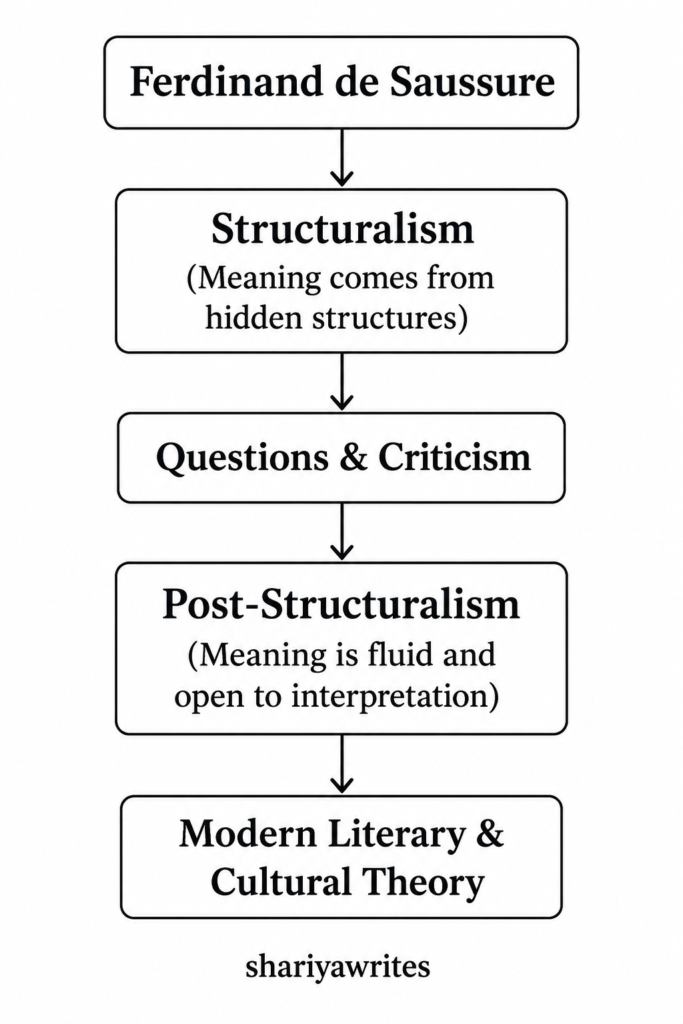
Post-Structuralism emerged during the 1960s as a response to the success and limitations of Structuralism.
Earlier in the twentieth century, Structuralism had transformed the study of language and literature. Inspired by the linguistic theories of Ferdinand de Saussure, Structuralists believed that meaning could be understood by studying the relationships within systems of language, myths, narratives, and culture.
This method proved highly influential. Scholars began identifying recurring patterns in stories, myths, rituals, and social institutions across different societies.
However, by the 1960s, many philosophers and literary critics began questioning whether these structures could truly explain the complexity of human language and experience.
They asked important questions:
- Can language ever provide complete certainty?
- Does every reader understand a text in the same way?
- Can the author’s intention determine the only correct meaning?
- Are social structures fixed, or do they change over time?
These questions marked the beginning of Post-Structuralism.
Rather than rejecting Structuralism entirely, Post-Structuralism built upon its insights while challenging its belief in stable meanings and universal systems.
Why Did Post-Structuralism Challenge Structuralism?
Structuralism introduced revolutionary ways of studying language and literature, but Post-Structuralists believed it overlooked several important realities.
1. Meaning Is Never Completely Stable
Structuralists believed that meaning could be explained through relationships between signs.
Post-Structuralists agreed that relationships matter but argued that these relationships are constantly changing. Words often carry multiple meanings, and those meanings shift according to context.
For example, the word “freedom” can refer to political liberty, personal independence, artistic expression, or economic opportunity. Its meaning depends on how and where it is used.
2. Readers Actively Create Meaning
Structuralism focused primarily on the structure of the text.
Post-Structuralism emphasizes the role of the reader.
A Shakespeare play may be interpreted differently by a modern student, a historian, a feminist critic, or a theatre director. Each perspective highlights different aspects of the same text.
Instead of asking which interpretation is correct, Post-Structuralists ask what each interpretation reveals.
3. Language Constantly Evolves
Language is not a closed system.
New words appear, old meanings disappear, and familiar expressions acquire new significance.
Consider the word “viral.”
Originally associated with medicine, it is now commonly used to describe online content that spreads rapidly across the internet.
This continual evolution demonstrates that language is flexible rather than permanently fixed.
4. Context Shapes Interpretation
No text exists in isolation.
Historical events, cultural traditions, social values, political beliefs, and personal experiences all influence the way readers understand language.
A novel written in the nineteenth century may be interpreted differently today because society itself has changed.
For Post-Structuralists, context is not merely background information—it is an essential part of meaning.
The Core Principles of Post-Structuralism
Although Post-Structuralism includes a wide range of thinkers and approaches, several key principles unite the movement.
Meaning Is Open Rather Than Fixed
Words rarely possess one permanent meaning.
Instead, meaning changes according to context, culture, and interpretation.
This openness allows literature to remain relevant across different historical periods.
Language Shapes Human Understanding
Language does more than describe reality.
It influences how we understand identity, history, politics, gender, culture, and society.
The words we choose affect the way we think about the world around us.
Multiple Interpretations Can Coexist
Post-Structuralism rejects the idea that every text has only one correct interpretation.
Instead, different readings can exist simultaneously, each supported by evidence within the text and informed by different perspectives.
Certainty Should Be Questioned
Rather than accepting ideas as permanently true, Post-Structuralists encourage readers to question assumptions, examine contradictions, and remain open to alternative viewpoints.
This critical attitude has influenced literary studies, philosophy, cultural analysis, and media criticism.
Texts Are Connected to Other Texts
No work of literature exists entirely on its own.
Every novel, poem, play, or film draws upon earlier traditions, ideas, genres, symbols, and cultural references.
Meaning develops through these ongoing connections rather than existing independently.
Understanding the Key Concepts of Post-Structuralism
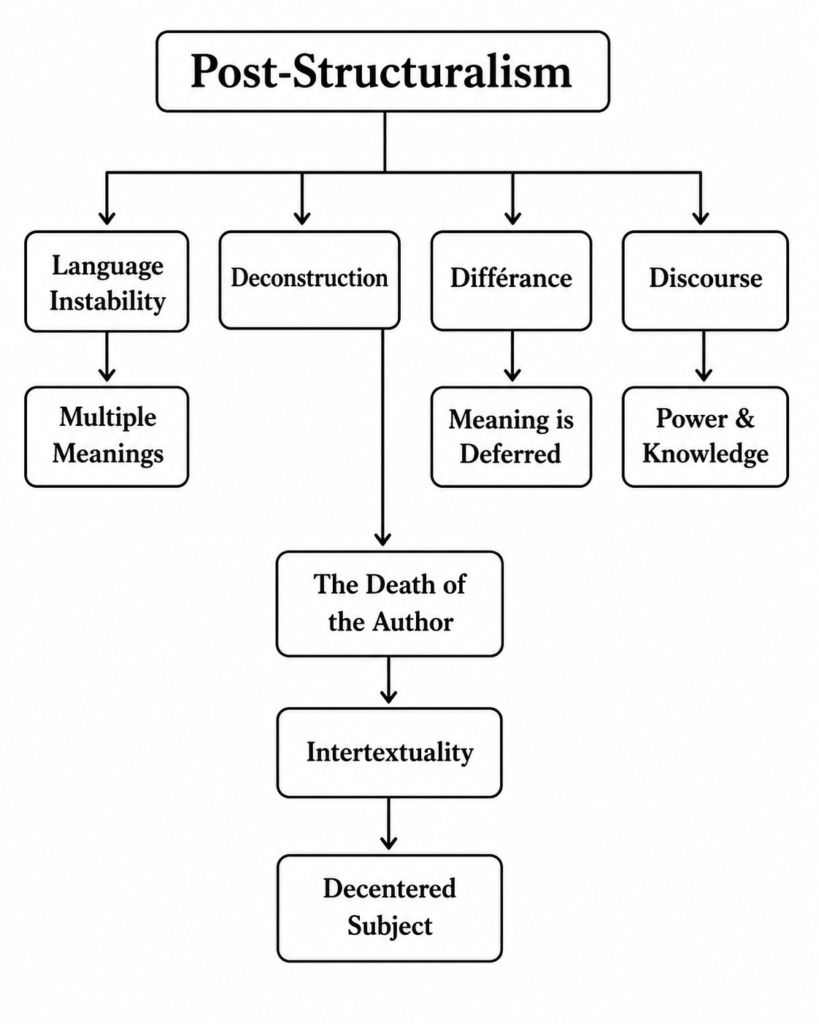
To truly understand Post-Structuralism, we must explore the key ideas that distinguish it from Structuralism. These concepts demonstrate why Post-Structuralists rejected the belief in fixed meanings and instead argued that language is flexible, dynamic, and open to multiple interpretations.
Although these ideas were developed by different scholars, they share a common goal: to question certainty and reveal how meaning is continually created rather than permanently established.
Language and the Instability of Meaning
One of the central principles of Post-Structuralism is that language is inherently unstable. Unlike Structuralists, who believed that language operates as a structured system capable of producing meaning, Post-Structuralists argue that meaning is never completely fixed.
Words do not carry a single, universal meaning. Instead, their meanings change according to context, culture, historical period, and the experiences of the reader.
For example, consider the word “home.”
For one person, it may represent love, comfort, and belonging. For another, it may evoke memories of conflict or loss. Although the word remains the same, its meaning changes depending on individual experience.
Similarly, the word “freedom” can refer to political rights, personal independence, freedom of speech, or economic opportunity. Its meaning depends on the context in which it is used.
Post-Structuralists argue that because words constantly interact with other words and contexts, language can never produce one permanent meaning. Every act of reading creates new possibilities for interpretation.
Deconstruction: Rethinking Texts
Among the most influential concepts associated with Post-Structuralism is Deconstruction, developed by the French philosopher Jacques Derrida.
Despite its name, deconstruction does not mean destroying or criticizing a text. Instead, it is a method of reading that carefully examines a text to uncover hidden assumptions, contradictions, ambiguities, and tensions.
Traditional literary criticism often searches for the central meaning of a work. Deconstruction asks a different question:
What meanings does the text unintentionally reveal?
According to Derrida, language is never perfectly stable. Because words depend on other words for meaning, every text contains multiple interpretations that may even contradict one another.
An Example of Deconstruction
Imagine a novel that celebrates justice while also portraying unjust actions committed by its hero.
A traditional reading might focus on the hero’s noble intentions.
A deconstructive reading, however, asks whether the text unintentionally questions its own definition of justice.
Rather than accepting a single interpretation, deconstruction explores the complexity and contradictions within the text.
Différance: Meaning Through Difference and Deferral
One of Jacques Derrida’s most original contributions is the concept of Différance.
The unusual spelling is intentional.
The French word combines two related ideas:
- Difference — words gain meaning because they differ from other words.
- Deferral — meaning is always postponed because every word leads us to another word for explanation.
For example, if someone asks,
“What is a teacher?”
You might answer,
“A person who educates students.”
Then another question arises:
“What is education?”
Each definition depends on another definition.
Meaning is therefore never fully complete. It is always moving from one explanation to another.
Derrida argued that language functions through this endless process of difference and deferral, making absolute certainty impossible.
The Death of the Author
In his famous essay The Death of the Author, Roland Barthes challenged the traditional belief that the author’s intention determines the meaning of a text.
According to Barthes, once a work is published, it no longer belongs exclusively to its author. Instead, readers actively participate in creating meaning.
Consider Shakespeare’s Hamlet.
A feminist critic may focus on Ophelia’s role.
A political critic may examine questions of power.
A psychoanalytic critic may explore Hamlet’s inner conflicts.
Each interpretation is supported by the text, yet each emphasizes different aspects.
Barthes argued that meaning emerges through the interaction between the text and its readers rather than through the author’s original intention alone.
Power, Knowledge, and Discourse
French philosopher Michel Foucault introduced another influential idea within Post-Structuralism: the relationship between power, knowledge, and discourse.
Foucault argued that knowledge is never completely neutral. Instead, it is shaped by institutions, social practices, and systems of power.
Schools, governments, hospitals, prisons, and the media all influence how societies define concepts such as normality, truth, health, and justice.
For example, ideas about mental illness have changed dramatically over time. Behaviors once considered signs of illness may later be understood differently because the social discourse surrounding mental health has evolved.
According to Foucault, discourse does not merely describe reality—it actively shapes the way people think about reality.
Intertextuality
No literary work exists in complete isolation.
Every text is connected to countless other texts through themes, symbols, genres, references, and cultural traditions. This idea is known as Intertextuality, a concept closely associated with Julia Kristeva.
For example, modern novels often draw inspiration from Greek mythology, Shakespearean drama, religious stories, or classic fairy tales.
Readers who recognize these connections often discover deeper layers of meaning.
Intertextuality reminds us that every act of writing is also an act of responding to previous texts.
The Decentered Subject
Traditional philosophy often assumed that individuals possess a stable and unified identity.
Post-Structuralists challenge this assumption.
They argue that identity is constantly shaped by language, culture, history, gender, family, education, religion, and social institutions.
Rather than being fixed, the self is continually changing.
For example, a person may identify differently as a student, a teacher, a parent, or a friend. These identities are not entirely independent; they are influenced by social relationships and cultural expectations.
The concept of the decentered subject suggests that identity is not an isolated essence but a dynamic process shaped by multiple forces.
Key Thinkers of Post-Structuralism
Post-Structuralism is not the work of a single scholar. Instead, it developed through the ideas of several influential philosophers, literary critics, psychoanalysts, and cultural theorists. While each thinker approached the theory differently, they shared a common goal: to question fixed meanings, challenge established truths, and explore the complexity of language, culture, and human experience.
Jacques Derrida (1930–2004)
Jacques Derrida is widely regarded as the founder of Post-Structuralism and the creator of Deconstruction. He challenged the traditional belief that language can provide absolute certainty or fixed meaning.
Derrida argued that every text contains contradictions and hidden assumptions that make multiple interpretations possible. Through his concept of Différance, he explained that meaning is always produced through differences between words and is constantly deferred rather than fully achieved.
His work transformed literary criticism, philosophy, law, architecture, theology, and cultural studies.
Major Contributions:
- Deconstruction
- Différance
- Critique of fixed meaning
- Instability of language
Michel Foucault (1926–1984)
Michel Foucault explored the relationship between power, knowledge, and discourse. Rather than viewing knowledge as objective, he argued that institutions such as schools, hospitals, prisons, governments, and the media shape what society accepts as truth.
According to Foucault, language is deeply connected to power. The way we speak about madness, crime, sexuality, education, or history influences how society understands these concepts.
His work has had a lasting impact on sociology, history, gender studies, political theory, and cultural studies.
Major Contributions:
- Discourse Theory
- Power and Knowledge
- Social Institutions
- Cultural Analysis
Roland Barthes (1915–1980)
Originally associated with Structuralism, Roland Barthes later became one of the most influential Post-Structuralist thinkers.
His famous essay “The Death of the Author” argued that readers should not depend solely on an author’s intentions to determine the meaning of a text. Instead, meaning emerges through the interaction between the text and its readers.
Barthes also studied myths, advertising, photography, fashion, and popular culture, demonstrating that everyday objects function as systems of signs.
Major Contributions:
- The Death of the Author
- Reader-centered interpretation
- Semiotics
- Cultural criticism
Julia Kristeva (1941–Present)
Julia Kristeva introduced the concept of Intertextuality, suggesting that every text is connected to countless other texts. According to her, writers constantly borrow, transform, and respond to earlier works.
A novel, poem, or film therefore never exists in complete isolation. Instead, it becomes part of a larger network of cultural and literary conversations.
Kristeva’s work significantly influenced feminist criticism, linguistics, psychoanalysis, and literary theory.
Major Contributions:
- Intertextuality
- Feminist literary theory
- Semiotics
- Psychoanalytic criticism
Jacques Lacan (1901–1981)
Jacques Lacan reinterpreted Sigmund Freud’s theories through language.
He argued that human identity develops through language and symbolic systems rather than existing naturally from birth.
According to Lacan, individuals understand themselves through social and linguistic structures, making identity fluid rather than fixed.
His theories greatly influenced psychoanalytic criticism and Post-Structuralist thought.
Major Contributions:
- Language and identity
- Symbolic Order
- Psychoanalytic criticism
Gilles Deleuze (1925–1995)
Gilles Deleuze challenged traditional ways of organizing knowledge through fixed categories.
Instead of focusing on stable structures, he emphasized movement, creativity, diversity, and continuous change.
His philosophy encouraged scholars to think beyond rigid systems and explore multiple possibilities for understanding reality.
Major Contributions:
- Difference
- Multiplicity
- Philosophy of becoming
- Cultural theory
Post-Structuralism in Literature
Post-Structuralism transformed literary criticism by shifting attention from discovering the “correct” meaning of a text to exploring its multiple possible meanings.
Instead of asking,
“What does this text mean?”
Post-Structuralists ask,
“How does this text produce different meanings for different readers?”
This approach recognizes that readers bring unique experiences, beliefs, cultures, and historical backgrounds to every literary work.
Example
Shakespeare’s Hamlet has been interpreted as:
- a tragedy of revenge,
- a psychological study,
- a political drama,
- a feminist text,
- an existential crisis.
None of these interpretations completely excludes the others. Together, they demonstrate the richness of literature.
Post-Structuralism therefore celebrates ambiguity rather than attempting to eliminate it.
Post-Structuralism in Philosophy
In philosophy, Post-Structuralism challenged the traditional search for universal truths.
Earlier philosophers often believed that reason could discover objective and permanent knowledge.
Post-Structuralists questioned this assumption.
They argued that:
- language shapes thought,
- truth depends on historical and cultural contexts,
- knowledge changes over time,
- certainty is often impossible.
Rather than replacing one absolute truth with another, Post-Structuralism encourages continuous questioning and critical reflection.
Post-Structuralism in Cultural Studies
Post-Structuralism also transformed the study of culture.
Instead of viewing culture as fixed and unified, it examines how meanings are produced through media, politics, education, advertising, religion, and popular entertainment.
For example:
A national flag may symbolize patriotism for one person.
For another, it may represent political conflict or historical struggle.
Neither interpretation is completely independent of culture.
Similarly, advertisements do more than sell products. They also shape ideas about beauty, success, gender roles, and lifestyle.
By examining these cultural meanings, Post-Structuralism reveals how everyday life is influenced by language and representation.
Structuralism vs. Post-Structuralism
Although closely related, Structuralism and Post-Structuralism differ in several important ways.
| Structuralism | Post-Structuralism |
|---|---|
| Believes meaning is relatively stable. | Believes meaning is fluid and constantly changing. |
| Focuses on underlying structures. | Questions the stability of those structures. |
| Emphasizes systems of language. | Emphasizes interpretation and context. |
| Gives priority to the structure of the text. | Gives greater importance to readers and multiple interpretations. |
| Searches for universal patterns. | Questions universal truths and fixed meanings. |
| Influenced by Ferdinand de Saussure. | Influenced by Jacques Derrida, Michel Foucault, Roland Barthes, and others. |
Rather than seeing these theories as complete opposites, many scholars view Post-Structuralism as a development that builds upon and critiques Structuralist ideas.
Advantages of Post-Structuralism
Post-Structuralism has made several important contributions to modern scholarship.
Encourages Critical Thinking
It teaches readers to question assumptions rather than accepting ideas without examination.
Accepts Multiple Perspectives
Different interpretations are viewed as opportunities for deeper understanding rather than as mistakes.
Promotes Intellectual Flexibility
Instead of searching for one absolute answer, Post-Structuralism encourages openness to complexity and change.
Broad Applications
Its ideas are useful not only in literature but also in philosophy, media studies, sociology, gender studies, cultural studies, and communication.
Challenges Traditional Authority
Post-Structuralism encourages readers to examine how institutions, language, and power influence knowledge and social beliefs.
Criticisms of Post-Structuralism
Despite its influence, Post-Structuralism has also received significant criticism.
It Can Be Difficult to Understand
Many Post-Structuralist writings use complex philosophical language that beginners may find challenging.
It May Encourage Excessive Relativism
Some critics argue that if every interpretation is considered equally valid, it becomes difficult to distinguish stronger interpretations from weaker ones.
It Questions Objective Truth
Opponents believe that rejecting stable meanings may create uncertainty in literary criticism and philosophy.
Limited Practical Application
Some scholars argue that Post-Structuralist theories are highly abstract and difficult to apply consistently in everyday situations.
Overemphasis on Language
Critics suggest that Post-Structuralism sometimes gives too much importance to language while paying less attention to historical events, economic conditions, or material realities.
Why Post-Structuralism Still Matters Today
Although Post-Structuralism emerged in the 1960s, its ideas remain highly relevant in the twenty-first century. In an age of digital media, artificial intelligence, globalization, and instant communication, questions about language, identity, truth, and interpretation have become more important than ever.
Every day, people encounter information through news websites, social media platforms, advertisements, films, podcasts, and online discussions. The same event can be described in multiple ways depending on the language, perspective, or cultural context. Post-Structuralism helps us understand why these different interpretations exist and how they influence public opinion.
In literature, Post-Structuralism encourages readers to explore texts from multiple perspectives rather than searching for a single “correct” interpretation. A novel may reveal new meanings when examined through feminist, psychoanalytic, postcolonial, or cultural lenses. This openness has made literary criticism more inclusive and dynamic.
In philosophy, Post-Structuralism reminds us that knowledge is not always neutral. Ideas about truth, identity, gender, and history are shaped by language, culture, and institutions. By questioning accepted assumptions, Post-Structuralism promotes critical thinking and intellectual curiosity.
Its influence also extends to fields such as media studies, sociology, education, political theory, communication studies, and cultural studies. Researchers continue to use Post-Structuralist ideas to examine how language shapes social realities and how power influences the production of knowledge.
Rather than providing final answers, Post-Structuralism encourages thoughtful questions. It teaches us that understanding the world requires openness to complexity, multiple perspectives, and continuous interpretation.
Key Takeaways
- Post-Structuralism emerged during the 1960s as a response to Structuralism.
- It argues that meaning is not fixed but changes according to language, context, culture, and interpretation.
- Jacques Derrida introduced Deconstruction and the concept of Différance, challenging the idea of stable meaning.
- Michel Foucault explored the relationship between power, knowledge, and discourse.
- Roland Barthes argued that readers play an active role in creating meaning through his essay The Death of the Author.
- Julia Kristeva introduced the concept of Intertextuality, highlighting the connections between texts.
- Post-Structuralism has influenced literature, philosophy, cultural studies, psychology, media studies, and communication.
- Although criticized for its complexity, it remains one of the most influential approaches in modern literary and cultural theory.
Frequently Asked Questions (FAQs)
1. What is Post-Structuralism?
Post-Structuralism is a literary and philosophical movement that argues meaning is not fixed or universal. Instead, meaning changes according to language, culture, historical context, and the reader’s interpretation.
2. Who founded Post-Structuralism?
Although Post-Structuralism developed through the work of several scholars, Jacques Derrida is widely regarded as its leading figure because of his theory of Deconstruction.
3. What is the main difference between Structuralism and Post-Structuralism?
Structuralism believes that meaning is produced through stable underlying structures, whereas Post-Structuralism argues that these structures are never completely stable and that meaning is always open to interpretation.
4. What is Deconstruction?
Deconstruction is a method of reading developed by Jacques Derrida. It examines texts to reveal hidden assumptions, contradictions, and multiple meanings rather than searching for one final interpretation.
5. What does “The Death of the Author” mean?
Roland Barthes argued that the meaning of a text should not depend solely on the author’s intentions. Instead, readers actively participate in creating meaning through their own interpretations.
6. What is Différance?
Différance is Jacques Derrida’s concept explaining that meaning is created through differences between words and is continually deferred, making complete certainty impossible.
7. What is Intertextuality?
Intertextuality is the idea that every text is connected to other texts through shared themes, symbols, references, and literary traditions. This concept was developed by Julia Kristeva.
8. Why is Post-Structuralism important in literature?
Post-Structuralism encourages readers to explore multiple interpretations of literary works. It highlights the role of language, culture, context, and the reader in shaping meaning.
9. Is Post-Structuralism still relevant today?
Yes. Post-Structuralism continues to influence literary criticism, philosophy, cultural studies, media analysis, communication, gender studies, and digital culture.
10. Is Post-Structuralism difficult to understand?
Some of its concepts can be challenging at first because they involve abstract philosophical ideas. However, with clear examples and gradual study, Post-Structuralism becomes much easier to understand.
Conclusion
Post-Structuralism transformed the study of language, literature, philosophy, and culture by challenging the belief that meaning is fixed and universal. Instead of searching for one final interpretation, it encourages readers to recognize the richness, complexity, and diversity of meaning.
Through the work of thinkers such as Jacques Derrida, Michel Foucault, Roland Barthes, Julia Kristeva, and Jacques Lacan, Post-Structuralism demonstrated that language is dynamic, interpretation is shaped by context, and knowledge is influenced by cultural and historical forces. These ideas continue to shape contemporary discussions in literary criticism, philosophy, media studies, and cultural theory.
Although some critics consider Post-Structuralism difficult or overly theoretical, its emphasis on questioning assumptions and exploring multiple perspectives remains valuable in today’s rapidly changing world. Whether we are reading a novel, watching a film, analyzing a political speech, or engaging with social media, Post-Structuralism reminds us that meaning is rarely simple or absolute.
📖 Suggested Reading:
- 👉 Structuralism Explained: Hidden Patterns Behind Language, Literature, Psychology, and Human Thinking
- 👉 Feminist Criticism: The Ultimate One-Stop Guide for UGC NET English
- 👉New Historicism: Summary, Key Concepts, and Major Critics (UGC NET Notes)
- 👉 What is Allegory? | 2 Types & 5 Forms of Expression | M.H. Abrams ‘Glossary of Literary Terms’
Disclaimer
Save this post—you’ll need to return to it regularly before exam day.
This article is written for educational purposes and is based on multiple academic sources, interpreted in the author’s own words.
About the Author
Shariya Writes believes that literature is not a burden to memorize, but an emotion to understand. Through blogs, reels, and videos, she simplifies English Literature for students who want to connect texts with life.
Explore more here:
https://linktr.ee/shariyawrites