
IGNOU MEG-04 Solved Assignment 2025-26 – Aspects of Language

Introduction
Are you looking for the IGNOU MEG-04 Solved Assignment 2025-26? In this article, you will find clear and well-structured model answers for MEG-04: Aspects of Language.
MEG-04 is an important course in the M.A. English programme because it introduces students to the basic concepts and major areas of linguistics. The assignment covers topics such as descriptive and prescriptive grammar, linguistic signs, morphemes, phonetics and phonology, bilingualism, and the Sapir-Whorf hypotheses.
The purpose of this study material is not simply to provide ready-made answers. The answers are organised in a way that helps students understand the concepts, remember the important points, and develop their own answers for the IGNOU assignment and examination.
All five questions in the 2025–26 assignment are compulsory. Question 1 contains two short-note topics carrying 10 marks each, while Questions 2 to 5 carry 20 marks each.
Note: These are model answers prepared for academic guidance. Students should understand the concepts and write their final assignments in their own words.
IGNOU MEG-04 Assignment Details
| Particular | Details |
|---|---|
| Programme | M.A. English (MEG) |
| Course Code | MEG-04 |
| Course Title | Aspects of Language |
| Assignment Session | 2025–26 |
| Based on | Blocks 1–8 |
| Maximum Marks | 100 |
| Questions to Attempt | Any Five |
| Marks per Question | 20 |
Table of Content
Table of Content
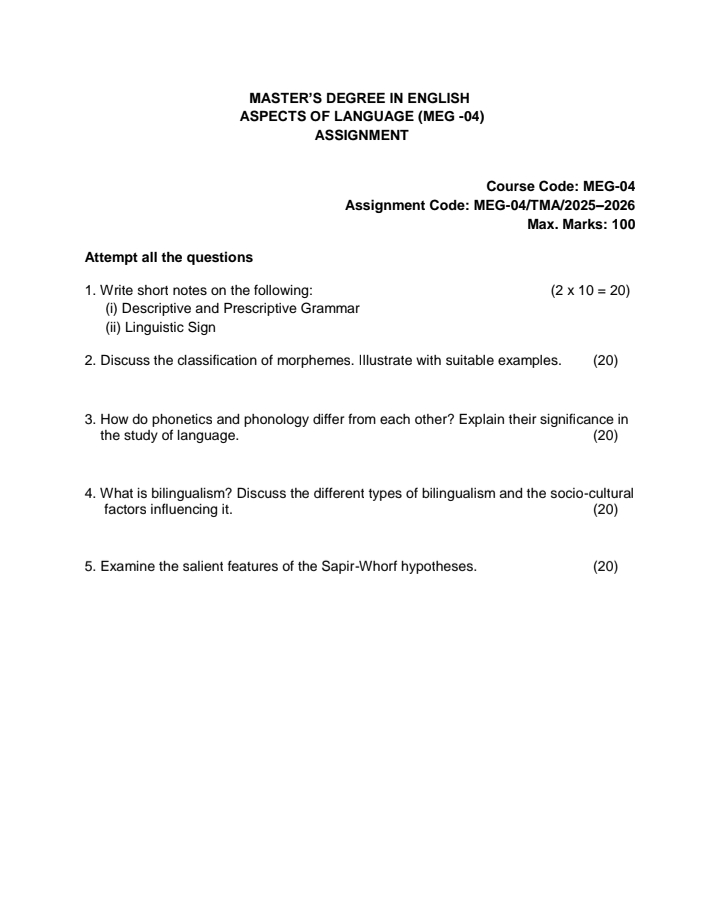
IGNOU MEG-04 Solved Assignment 2025–26 (Aspects of Language) Questions with Answers
Question 1
Writes short notes on the following:
(i) Descriptive and Prescriptive Grammar
Introduction
Grammar is the system through which the words of a language are organised to form meaningful expressions and sentences. However, grammar can be studied from different perspectives. Two important approaches are descriptive grammar and prescriptive grammar. While descriptive grammar is concerned with how people actually use a language, prescriptive grammar focuses on rules about how a language should be used.
Descriptive Grammar
Descriptive grammar studies the language as it is actually spoken or written by its users. It does not begin by deciding whether a particular form is correct or incorrect. Instead, it observes the patterns followed by speakers and tries to explain how those patterns work.
For example, in everyday English, people commonly say:
“I am going to the market.”
A descriptive grammarian is interested in understanding why this structure is used, how its parts function, and how similar structures occur in English.
Descriptive grammar also recognises that language changes over time. New words, expressions, pronunciation patterns, and grammatical forms may become common among speakers. Instead of automatically rejecting these changes, descriptive linguistics studies them as part of the natural development of language.
Therefore, the main concern of descriptive grammar is observation and analysis of actual language use.
Prescriptive Grammar
Prescriptive grammar, on the other hand, establishes rules about what is considered standard or acceptable usage. It tells speakers and writers how language is expected to be used, particularly in formal situations.
For instance, traditional English grammar may discourage certain sentence structures in formal writing even though those structures are frequently heard in everyday conversation.
Prescriptive rules are particularly important in contexts such as academic writing, formal communication, editing, examinations, and professional writing, where a recognised standard is often expected.
Difference between Descriptive and Prescriptive Grammar
| Descriptive Grammar | Prescriptive Grammar |
|---|---|
| Describes actual language use | Establishes rules for language use |
| Asks “How do people use language?” | Asks “How should language be used?” |
| Focuses on observation | Focuses on rules and standards |
| Accepts language variation as something to study | Usually promotes a standard form |
| Studies language change | Often tries to maintain established conventions |
Conclusion
Descriptive and prescriptive grammar represent two different ways of looking at language. Descriptive grammar explains language as it is used, whereas prescriptive grammar lays down standards for how it ought to be used. Both approaches have their own importance: descriptive grammar helps us understand the actual structure and development of language, while prescriptive grammar provides useful conventions for formal and standard communication.
(ii) Linguistic Sign
Introduction
The concept of the linguistic sign is closely associated with the Swiss linguist Ferdinand de Saussure, one of the foundational figures of modern linguistics. Saussure explained that language is not simply a collection of names given to objects. Instead, linguistic meaning is created through a system of signs and the relationships among them.
What is a Linguistic Sign?
According to Saussure, a linguistic sign has two inseparable aspects:
- Signifier
- Signified
The signifier is the sound pattern or linguistic form that we perceive. The signified is the concept or idea associated with that form.
For example, consider the English word:
“Tree”
The spoken or written form “tree” is the signifier, while the mental concept of a tree is the signified.
Together, these two aspects constitute the linguistic sign.
The Signifier and the Signified
It is important to understand that the signified is not the physical object itself. When we hear the word “tree,” we do not receive an actual tree through language. Instead, the word produces a mental concept or idea of a tree.
This distinction is central to Saussure’s theory because it shows that language operates through mental associations, rather than through a simple naming relationship between words and objects.
Arbitrariness of the Sign
One of the most important characteristics of the linguistic sign is its arbitrary nature.
There is no natural connection between the sound of a word and the concept it represents. The same concept is represented by different linguistic forms in different languages.
For example:
- English — tree
- French — arbre
- Hindi — पेड़ (ped)
The concept remains broadly recognisable, but the linguistic forms are different. This demonstrates that the connection between the signifier and signified is established through social convention, rather than through a natural relationship.
The Linguistic Sign and the Language System
Saussure also emphasised that a sign receives its value through its relationship with other signs within the language system. A word does not exist in complete isolation. Its meaning and function are partly understood through the differences and relationships between it and other linguistic units.
This is why Saussure’s theory became extremely influential not only in linguistics but also in later fields such as structuralism, literary studies, and semiotics.
Conclusion
The concept of the linguistic sign provides the foundation for Saussure’s understanding of language as a structured system. The sign consists of the signifier and the signified, and their relationship is largely arbitrary and socially established. By shifting attention from individual words to the relationships within the language system, Saussure laid the groundwork for modern structural approaches to language.
Question 2
Discuss the Classification of Morphemes. Illustrate with Suitable Examples.
Introduction
A morpheme is the smallest linguistic unit that carries meaning or performs a grammatical function. A word may consist of only one morpheme or may contain several morphemes. For example, the word “unhappiness” can be divided into three meaningful units: un- + happy + -ness.
The study of morphemes is an important part of morphology, which deals with the internal structure and formation of words. Morphemes can be classified in different ways depending on whether they can occur independently, what function they perform, and how they contribute to the formation of words.
1. Free and Bound Morphemes
One of the basic classifications is based on whether a morpheme can occur independently as a word.
Free Morphemes
A free morpheme can occur independently and can function as a word by itself.
Examples:
- book
- house
- kind
- play
- run
For example, in the sentence “The child plays,” the morphemes child and play can occur independently.
Free morphemes can further be divided into lexical and grammatical morphemes.
Bound Morphemes
A bound morpheme cannot normally occur independently. It has to be attached to another morpheme to express its meaning or grammatical function.
Examples include:
- un- in unhappy
- re- in rewrite
- -ness in kindness
- -ed in walked
- -s in books
Thus, un- cannot normally function as an independent English word, but when added to happy, it changes the meaning of the word.
2. Lexical and Grammatical Morphemes
Free morphemes can also be understood in terms of their role in language.
Lexical Morphemes
Lexical morphemes carry the main content or meaning of a sentence. They include nouns, main verbs, adjectives, and many adverbs.
Examples:
- teacher
- book
- beautiful
- write
- quickly
They form the vocabulary of a language and can readily receive new additions.
Grammatical Morphemes
Grammatical morphemes mainly express relationships and grammatical information rather than carrying the central meaning of a sentence.
Examples include:
- and
- but
- the
- of
- in
For example, in “the book on the table,” the, on, and the help establish grammatical relationships between the main lexical items.
3. Derivational Morphemes
A derivational morpheme is used to create a new word or to change the meaning or grammatical category of an existing word.
Consider:
happy → unhappy
Here, un- changes the meaning of happy.
Similarly:
teach → teacher
The suffix -er creates a noun referring to a person who teaches.
Other examples include:
- kind → kindness
- develop → development
- modern → modernize
- care → careless
Derivational morphemes are therefore important in word formation.
4. Inflectional Morphemes
An inflectional morpheme does not normally create a completely new lexical item. Instead, it adds grammatical information to an existing word.
For example:
- book → books — plural
- walk → walked — past tense
- play → playing — progressive form
- small → smaller — comparative
- small → smallest — superlative
English has a relatively small set of commonly recognised inflectional suffixes. They indicate grammatical features such as number, tense, comparison, possession, and agreement.
For example:
The girl plays.
The girls play.
The -s in girls indicates plural number, while the -s in plays marks the grammatical form of the verb.
5. Roots and Affixes
Morphemes can also be discussed in terms of their position and function within a word.
Root
The root is the central part of a word that carries its basic lexical meaning.
For example:
unhappiness
Here:
- happy → root
- un- → prefix
- -ness → suffix
The root happy provides the central meaning around which the other morphemes are added.
Affixes
An affix is a bound morpheme attached to a root or stem.
The major types include:
Prefix: comes before the root.
un + happy
re + write
Suffix: comes after the root.
kind + ness
teach + er
English mainly uses prefixes and suffixes, although other languages may have additional types of affixes.
6. Stem
A stem is the form to which an inflectional morpheme can be added.
For example:
teacher + s
Here, teacher functions as the stem and -s adds the plural meaning.
A stem may itself contain more than one morpheme. In teachers, for example, teach + -er forms the stem teacher, to which the plural marker -s is added.
Morpheme Classification at a Glance
| Type | Main Function | Example |
|---|---|---|
| Free morpheme | Can occur independently | book |
| Bound morpheme | Cannot normally occur alone | un- |
| Lexical morpheme | Carries main vocabulary meaning | house |
| Grammatical morpheme | Expresses grammatical relationship | the, and |
| Derivational morpheme | Forms a new word/change in category or meaning | kind + ness |
| Inflectional morpheme | Expresses grammatical information | book + s |
| Root | Central element of a word | happy in unhappiness |
| Affix | Added to a root/stem | un-, -ness |
Why is the Classification of Morphemes Important?
The classification of morphemes helps us understand how words are constructed and how their meanings and grammatical functions are developed. It also shows that words are not always indivisible units. A single word can contain several morphemes, each contributing something different.
For example:
un + help + ful + ness
Here, help provides the basic meaning, while un-, -ful, and -ness modify or develop that meaning. By analysing these parts, we can understand both the structure and formation of the word.
Morpheme analysis is therefore useful in the study of word formation, vocabulary development, grammar, language learning, and linguistic analysis.
Conclusion
Morphemes are the basic meaningful building blocks of words. They can be classified as free or bound, lexical or grammatical, and derivational or inflectional. We can also identify elements such as roots, stems, and affixes when examining the internal structure of words.
Understanding these classifications allows us to see how languages create new words, express grammatical information, and organise meaning. Thus, the study of morphemes provides an essential foundation for understanding the structure and functioning of language.
Question 3
How Do Phonetics and Phonology Differ from Each Other? Explain Their Significance in the Study of Language.
Introduction
Phonetics and phonology are two closely related branches of linguistics that deal with the sound system of language. Although both are concerned with speech sounds, they study them from different perspectives. Phonetics focuses on the physical nature and production of speech sounds, whereas phonology examines how those sounds function and are organised within a particular language.
Understanding the difference between the two helps us understand how spoken language is produced, perceived, and structured.
What is Phonetics?
Phonetics is the branch of linguistics that studies speech sounds as physical phenomena. It is concerned with how sounds are produced by the speech organs, how they travel as sound waves, and how they are heard and perceived.
Phonetics is generally divided into three major areas:
1. Articulatory Phonetics
Articulatory phonetics studies how speech sounds are produced by the human speech organs.
The organs involved include the lungs, vocal cords, tongue, teeth, lips, palate, and other parts of the vocal tract.
For example, when we produce the sound /p/, the lips come together and then release the air. Articulatory phonetics studies this process.
2. Acoustic Phonetics
Acoustic phonetics deals with the physical properties of speech sounds as sound waves. It examines features such as frequency, intensity, duration, and patterns of vibration.
In simple terms, it studies what happens to a speech sound as it travels from the speaker to the listener.
3. Auditory Phonetics
Auditory phonetics is concerned with how speech sounds are received and interpreted by the listener. It studies the role of the ear and the brain in hearing and processing speech sounds.
Thus, phonetics gives us a detailed understanding of the physical side of speech.
What is Phonology?
Phonology studies the way speech sounds are organised and used within a particular language. It is not primarily concerned with the physical production of a sound; rather, it asks how sounds function to create differences in meaning.
For example, the sounds /p/ and /b/ are physically different, but phonology is interested in the fact that the difference between them can distinguish words in English:
pat – bat
Changing /p/ to /b/ changes the meaning of the word. Therefore, the two sounds function as separate phonological units in English.
Phonology studies concepts such as phonemes, sound patterns, syllables, stress, intonation, and the distribution of sounds within a language.
Phoneme
A phoneme is a sound unit that can distinguish meaning in a particular language.
For example:
pin – bin
The difference between /p/ and /b/ changes the meaning. Therefore, /p/ and /b/ function as separate phonemes in English.
Phonetics vs Phonology
The difference can be understood more clearly through the following comparison:
| Phonetics | Phonology |
|---|---|
| Studies the physical nature of speech sounds | Studies the organisation and function of sounds in a language |
| Concerned with production, transmission and perception | Concerned with patterns and sound systems |
| Has articulatory, acoustic and auditory branches | Studies phonemes, sound patterns, stress, intonation, etc. |
| Can examine sounds across languages | Usually examines how sounds function within a particular language |
| Focuses on physical properties | Focuses on linguistic function |
In simple terms:
Phonetics asks: “How is a speech sound produced and perceived?”
Phonology asks: “How does that sound function within a language?”
Relationship Between Phonetics and Phonology
Although they are different, phonetics and phonology cannot be completely separated.
Phonology identifies the sound patterns that are meaningful within a language, while phonetics helps us understand the actual physical realisation of those sounds.
For example, a language may treat two sounds as different phonemes because they distinguish meaning. Phonetic analysis can then help us understand exactly how those sounds are produced and how they differ acoustically.
Therefore, phonetics provides information about the physical side of speech, while phonology helps us understand the linguistic organisation of those sounds.
Significance of Phonetics in the Study of Language
Phonetics is important because it gives us a scientific understanding of speech production and perception. It is particularly useful in:
- understanding how different speech sounds are produced;
- studying pronunciation;
- comparing the sounds of different languages;
- improving language teaching and pronunciation;
- studying speech difficulties and communication disorders;
- developing systems related to speech recognition and speech technology.
For language learners, phonetics can also make pronunciation easier to understand because it explains what the speech organs are doing when a particular sound is produced.
Significance of Phonology in the Study of Language
Phonology helps us understand how a particular language organises its sounds into a meaningful system.
It is useful for:
- identifying phonemes;
- understanding sound contrasts;
- studying syllable structure;
- analysing stress and intonation;
- understanding sound patterns within a language;
- explaining differences between languages;
- improving pronunciation and language teaching.
Phonological analysis is particularly important because simply knowing individual sounds is not enough. We also need to understand how those sounds behave in combination.
Conclusion
Phonetics and phonology are closely connected but have different areas of focus. Phonetics studies speech sounds as physical entities, including their production, transmission, and perception. Phonology studies the way those sounds are organised and function within a particular language.
A simple way to remember the distinction is that phonetics deals with the physical reality of speech sounds, while phonology deals with their linguistic function and patterning. Together, they help us understand one of the most fundamental aspects of human language: the organisation and use of speech sounds.
Question 4
What is Bilingualism? Discuss the Different Types of Bilingualism and the Socio-Cultural Factors Influencing It.
Introduction
Bilingualism refers to the ability of an individual or a community to use two languages for communication. A bilingual person may use both languages in everyday life, but the level of proficiency in each language does not necessarily have to be equal.
Bilingualism is a common feature of multilingual societies such as India, where people may use different languages at home, in education, at work, and in social situations. It is therefore not only a linguistic phenomenon but is also influenced by family, education, society, culture, migration, economic conditions, and language attitudes.
What is Bilingualism?
In simple terms, bilingualism means the regular use or knowledge of two languages by a person or a community.
However, being bilingual does not always mean speaking both languages with exactly the same level of fluency. One language may be stronger in speaking, while another may be stronger in reading or writing.
For example, an Indian student may speak Hindi at home and use English at college. The student may be comfortable speaking Hindi in family situations but use English more frequently for academic work. Both languages therefore have different functions in the person’s life.
Types of Bilingualism
Bilingualism can be classified in different ways depending on proficiency, age of acquisition, and the way languages are used.
1. Balanced Bilingualism
A person is considered a balanced bilingual when they have relatively similar levels of competence in both languages.
However, completely equal proficiency in two languages is uncommon. A person may still have one language that is stronger in a particular area.
2. Dominant Bilingualism
In dominant bilingualism, a person has greater proficiency in one language than the other.
For example, someone may understand and speak English well but be more comfortable expressing personal experiences in their mother tongue.
The dominant language may also change depending on education, occupation, or social environment.
3. Simultaneous Bilingualism
Simultaneous bilingualism develops when a child is exposed to two languages from an early stage of life.
For example, parents may regularly use two different languages with the child. As a result, the child develops familiarity with both languages during the early stages of language development.
4. Sequential or Successive Bilingualism
In sequential bilingualism, a person learns one language first and acquires another language later.
This is common among children who grow up using their home language and later learn a second language through school or the wider community.
5. Additive Bilingualism
Additive bilingualism occurs when learning a second language does not lead to the loss or rejection of the first language. Instead, the individual develops an additional linguistic ability while maintaining the original language.
This situation can strengthen both linguistic and cultural identities.
6. Subtractive Bilingualism
In subtractive bilingualism, learning a second language may gradually reduce the individual’s use or proficiency in the first language.
This can happen when the first language receives little social or educational support and the second language becomes more prestigious or more useful in public life.
Socio-Cultural Factors Influencing Bilingualism
Bilingualism does not develop in isolation. The languages available to an individual are strongly influenced by the social and cultural environment.
1. Family and Home Environment
The family is often the first place where language is acquired. If family members use two languages regularly, children may naturally develop bilingual abilities.
For example, parents may use a regional language at home while the child encounters English through education and media.
2. Education
Education is one of the strongest influences on bilingualism. A child may acquire a second language through school, particularly when that language is used as the medium of instruction.
The quality and amount of exposure also influence the level of proficiency.
3. Migration
Migration often creates situations in which people need to use more than one language. A migrant may continue using their first language with family members while learning the language of the new region for education, employment, and everyday communication.
4. Social Environment
The languages spoken by friends, neighbours, colleagues, and the wider community influence language use. Regular interaction with speakers of another language can increase bilingual competence.
5. Economic Opportunities
Languages may have different economic value in a particular society. People may learn another language because it provides better educational or employment opportunities.
For example, English has considerable importance in higher education and many professional fields in India. This encourages many speakers of Indian languages to acquire English.
6. Language Attitudes and Prestige
People’s attitudes towards languages also affect bilingualism. If a language is regarded as prestigious, modern, or economically valuable, people may be more motivated to learn and use it.
On the other hand, negative attitudes towards a person’s mother tongue can reduce its use and may contribute to language shift.
7. Cultural Identity
Language is closely connected with culture and identity. People may continue using their first language because it connects them with their family, traditions, literature, and cultural community.
Therefore, bilingual speakers often use different languages to express different aspects of their social and cultural lives.
8. Media and Technology
Television, films, social media, music, online education, and digital communication have greatly increased exposure to different languages.
A person may regularly encounter English through the internet while continuing to use another language at home. Such continuous exposure can contribute to bilingual development.
Bilingualism in the Indian Context
India provides an excellent example of bilingual and multilingual language use. People frequently move between languages according to the situation.
A person may use:
Mother tongue → family and cultural situations
Regional language → local communication
Hindi → wider communication in many parts of India
English → education, professional and formal contexts
This shows that bilingualism is often functional. People do not necessarily use both languages in exactly the same situations. Each language may have a particular role in their personal, educational, professional, or social life.
Conclusion
Bilingualism is more than simply knowing two languages. It is a complex linguistic and social phenomenon shaped by family, education, migration, social interaction, economic opportunities, cultural identity, language attitudes, and media.
Different forms of bilingualism—such as balanced, dominant, simultaneous, sequential, additive, and subtractive bilingualism—show that people can acquire and use two languages in very different ways. In a linguistically diverse country like India, bilingualism plays an important role in everyday communication as well as in maintaining cultural connections while participating in wider social and professional environments.
Question 5
Examine the Salient Features of the Sapir-Whorf Hypotheses.
Introduction
The relationship between language and thought is one of the important areas of linguistic study. The Sapir-Whorf hypotheses are associated with the ideas of American linguists Edward Sapir and Benjamin Lee Whorf. Their work encouraged scholars to think about whether the language we use has an influence on the way we understand and interpret the world.
The basic idea is that language is not merely a tool for expressing thoughts that already exist. The structure and categories of a language may also influence how its speakers notice, organise, and interpret experience.
What are the Sapir-Whorf Hypotheses?
The term Sapir-Whorf hypothesis is generally used for a group of ideas concerning the relationship between language, thought, and culture.
It is important to remember that Sapir and Whorf did not simply argue that language completely determines what a person can think. Their ideas are better understood as suggesting that the language available to us can influence the ways in which we habitually organise our experiences.
The theory is usually discussed in two forms:
- Linguistic Determinism
- Linguistic Relativity
1. Linguistic Determinism
The stronger version is known as linguistic determinism.
According to this view, the structure of a language has a strong influence on the way its speakers think. In an extreme interpretation, the categories available in a language could determine the categories through which its speakers understand reality.
For example, if a language makes certain distinctions grammatically while another language does not, speakers of the two languages may pay different kinds of attention to those distinctions.
However, the strongest version of linguistic determinism is generally considered too rigid. Human beings can learn new concepts and understand ideas even when their first language does not have a specific grammatical category for them.
2. Linguistic Relativity
The weaker and more widely useful interpretation is known as linguistic relativity.
It suggests that different languages may encourage their speakers to look at certain aspects of experience in different ways. In other words, language can influence habitual patterns of thought and perception.
This does not mean that speakers of one language are completely incapable of understanding ideas expressed differently in another language. Rather, the language they regularly use may make some distinctions more noticeable or more natural for them.
For example, languages may organise things such as time, space, colour, number, gender, or social relationships in different ways. These differences can influence how speakers habitually describe and interpret their experiences.
Major Features of the Sapir-Whorf Approach
1. Language and Thought are Closely Connected
One of the central ideas is that language and thought cannot be treated as completely separate systems. The linguistic categories available to us can influence how we organise our experiences.
2. Languages Categorise Experience Differently
Different languages divide and classify aspects of reality in different ways. A distinction that is strongly marked in one language may be less important or differently expressed in another.
This suggests that there is no single linguistic system through which all human beings organise experience.
3. Language Influences Perception
Language may influence what speakers habitually notice and pay attention to.
For instance, if a language regularly requires speakers to express a particular distinction, speakers may become more accustomed to observing that distinction in everyday communication.
4. Culture and Language are Related
Sapir and Whorf’s ideas also draw attention to the connection between language and culture. Language develops within a cultural environment and reflects many of the experiences and values of its speakers.
At the same time, linguistic categories can influence how cultural experiences are understood and communicated.
5. Different Languages Provide Different Worldviews
The hypothesis encourages us to recognise that speakers of different languages may develop different habitual ways of organising experience.
This does not necessarily mean that every language creates a completely different “world.” Rather, different languages can provide different perspectives on the same world.
A Simple Example
Consider the way languages deal with time.
English commonly uses expressions such as:
“I am going to Delhi tomorrow.”
Languages can differ considerably in the grammatical ways they express time, duration, completion, or sequence.
The Sapir-Whorf approach asks us to consider whether such linguistic differences influence the way speakers habitually think about temporal relationships.
The important point is not that an English speaker cannot understand another way of expressing time. Instead, the question is whether regular linguistic habits influence patterns of attention and thought.
Strong and Weak Interpretations
It is useful to distinguish between the two major interpretations:
| Strong Interpretation | Weak Interpretation |
|---|---|
| Language determines thought | Language influences thought |
| Associated with linguistic determinism | Associated with linguistic relativity |
| Gives language a very powerful role | Allows other factors to influence thinking |
| Difficult to defend in its strongest form | More widely accepted as a useful approach |
Thus, the modern discussion generally gives greater importance to the idea of influence rather than complete determination.
Importance of the Sapir-Whorf Hypotheses
The Sapir-Whorf approach has been influential because it encouraged linguists and other scholars to look beyond grammar as a formal system.
It raises important questions about:
- how language influences thought;
- how people categorise experience;
- the relationship between language and culture;
- differences between languages;
- perception and attention;
- linguistic diversity and different ways of understanding the world.
The theory has therefore had an influence beyond linguistics, particularly in areas concerned with language, culture, cognition, and communication.
Conclusion
The Sapir-Whorf hypotheses focus on the close relationship between language, thought, perception, and culture. Their central insight is that language is not merely a neutral medium through which already-formed thoughts are communicated. The categories and patterns of a language can influence how its speakers habitually organised and interpret experience.
The stronger idea of linguistic determinism gives language a determining role, while linguistic relativity presents a more flexible position in which language influences thought without completely controlling it. For this reason, the Sapir-Whorf approach remains an important starting point for understanding how our linguistic environment can shape our experience of the world.
How to Write the MEG-04 Assignment
Writing an IGNOU assignment is not only about completing the required number of pages. A good assignment should show that you understand the topic and can explain the important concepts in a clear and organised manner.
For MEG-04, this is particularly important because the course deals with linguistic concepts such as grammar, morphemes, phonetics, phonology, bilingualism, and language theories.
A simple structure for your answers:
Introduction → Explanation → Main Concepts → Examples → Analysis/Discussion → Conclusion
For the 10-mark short notes, students can keep the answer focused and explain the topic with relevant examples.
For the 20-mark answers, students should develop the topic properly instead of giving only a definition. Use suitable headings, explain the major points, and provide examples wherever required.
While writing the assignment:
- Begin each answer with a relevant introduction.
- Define important linguistic terms before discussing them.
- Use headings and subheadings to organise longer answers.
- Give suitable examples, particularly for linguistic concepts.
- Avoid unnecessary repetition.
- Keep the answer connected to the exact wording of the question.
- End every answer with a short but meaningful conclusion.
- Write the final assignment in your own words.
Important Tips for MEG-04 Students
1. Understand the terminology
MEG-04 contains many technical terms. Don’t try to memorise definitions without understanding them.
For example, remember the basic distinction:
Phonetics → physical study of speech sounds
Phonology → organisation and function of sounds in a language
Similarly:
Descriptive grammar → describes actual usage
Prescriptive grammar → focuses on accepted rules and standards
These simple distinctions make revision much easier.
2. Use examples
Examples are especially valuable in a linguistics assignment. When discussing morphemes, linguistic signs, phonemes, or grammatical structures, an appropriate example can make your explanation much clearer.
3. Don’t turn a 20-mark answer into a short note
A 20-mark question requires proper development. Start with the concept and then explain its major aspects systematically.
4. Use your own language
Do not copy answers directly from websites, guidebooks, or other students’ assignments. Understand the material first and then express the ideas in your own words.
5. Keep the presentation clean
Clear handwriting, proper spacing, headings, and paragraph division can make your assignment much easier to read.
Frequently Asked Questions
What is MEG-04?
MEG-04 is titled Aspects of Language and forms part of the IGNOU M.A. English programme.
What topics are covered in the MEG-04 assignment?
The 2025–26 assignment covers grammar, linguistic signs, morphemes, phonetics, phonology, bilingualism, and the Sapir-Whorf hypotheses.
How should I write a MEG-04 answer?
Start with an introduction, explain the central concept, develop the main points using headings and examples, and finish with a conclusion.
Should I use examples in linguistics answers?
Yes. Examples are particularly useful in MEG-04 because they demonstrate that you understand how a linguistic concept actually works.
Can I copy these model answers directly into my assignment?
These answers are provided as study and assignment guidance. It is better to understand the explanation and then prepare your final answer in your own words.
Is a conclusion necessary?
Yes. A short conclusion helps bring the discussion together and gives the answer a proper academic structure.
Conclusion
The IGNOU MEG-04 Solved Assignment 2025–26 covers several fundamental areas of language and linguistics. From the difference between descriptive and prescriptive grammar to morphemes, phonetics, phonology, bilingualism, and the Sapir-Whorf hypotheses, the course helps students understand how language is structured, used, and connected with human thought and society.
The model answers in this article are designed to make these concepts easier to understand and to help students organise their own assignments effectively. However, students should always read the prescribed study material, understand the concepts, and write their final assignment in their own words.
For more IGNOU assignments, MA English study material, literary notes, PYQs, and exam-oriented resources, keep visiting Shariyawrites.com.
All the best for your IGNOU assignment and exams! 📚
Explore More IGNOU MEG Resources
If you’re preparing for the IGNOU M.A. English examination, you may also find these guides helpful:
- IGNOU MEG-01 Solved Assignment 2025–26 | Complete British Poetry Answers
- IGNOU MEG-02 Solved Assignment 2025–26 (British Drama)
- IGNOU MEG-03 Solved Assignment 2025–26 (British Novel) | Complete Answers
- IGNOU MEG 05 Solved Assignment 2025-2026 (Free PDF) | Literary Theory & Criticism
- IGNOU MEG-07 Solved Assignment 2025–26 (Indian English Literature)
- IGNOU July 2026 Admission Last Date Extended to 31 July
- IGNOU MEG-01 Complete Syllabus & 16 Years PYQ Trend Analysis (2010–2025) | British Poetry
Disclaimer
Save this post—you’ll need to return to it regularly before exam day.
This article is written for educational purposes and is based on multiple academic sources, interpreted in the author’s own words.
About the Author
Shariya Writes believes that literature is not a burden to memorize, but an emotion to understand. Through blogs, reels, and videos, she simplifies English Literature for students who want to connect texts with life.
Explore more here:
https://linktr.ee/shariyawrites