
IGNOU MEG-02 Solved Assignment 2025–26 (British Drama)
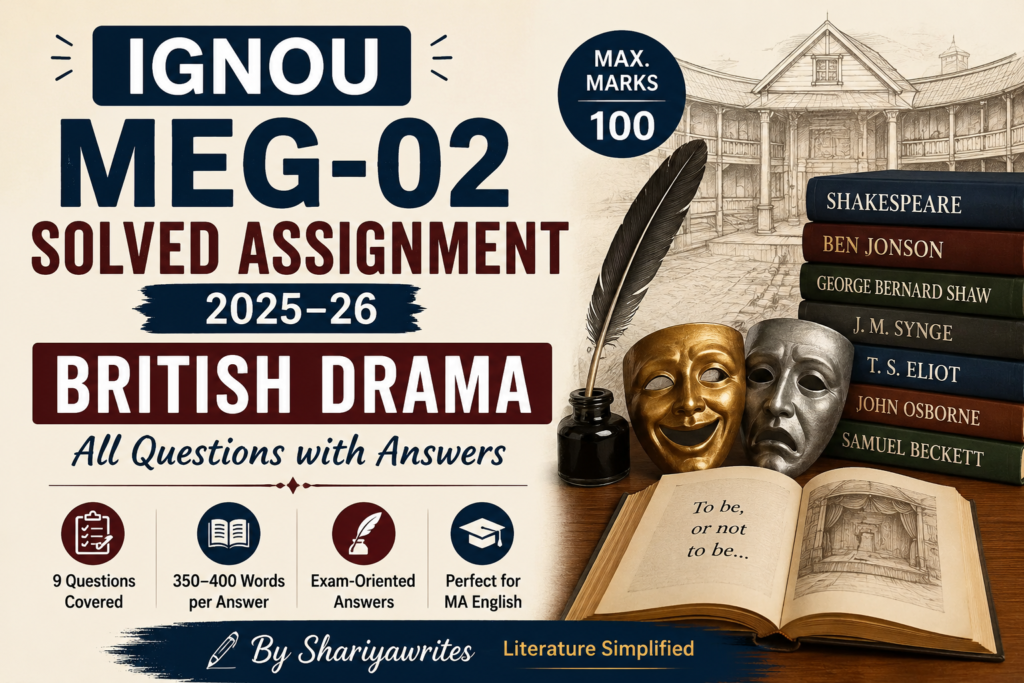
Are you looking for the IGNOU MEG-02 Solved Assignment 2025–26? You are at the right place.
This post provides complete, exam-oriented model answers for all nine questions from the IGNOU MEG-02: British Drama Assignment for the 2025–26 session.
The official assignment is for MEG-02: British Drama, with Assignment Code MEG-02/TMA/2025-26 and a maximum of 100 marks. Students are required to answer any five questions, and each question carries 20 marks. IGNOU asks students to answer each question in approximately 350–400 words.
The questions cover major areas of British drama, including Shakespearean drama, Ben Jonson, George Bernard Shaw, J. M. Synge, T. S. Eliot, John Osborne, and Samuel Beckett.
Note: These are model answers prepared for academic guidance. Students should understand the arguments and write the answers in their own words while completing their assignments.
IGNOU MEG-02 Solved Assignment 2025–26: Assignment Details
| Particular | Details |
|---|---|
| Programme | Master of Arts in English (MEG) |
| Course Code | MEG-02 |
| Course Title | British Drama |
| Assignment Code | MEG-02/TMA/2025-26 |
| Session | 2025–26 |
| Maximum Marks | 100 |
| Questions to Attempt | Any Five |
| Marks per Question | 20 |
| Suggested Length | 350–400 words per answer |
The official IGNOU assignment specifies that all questions carry equal marks and that learners should answer each question in about 350–400 words.
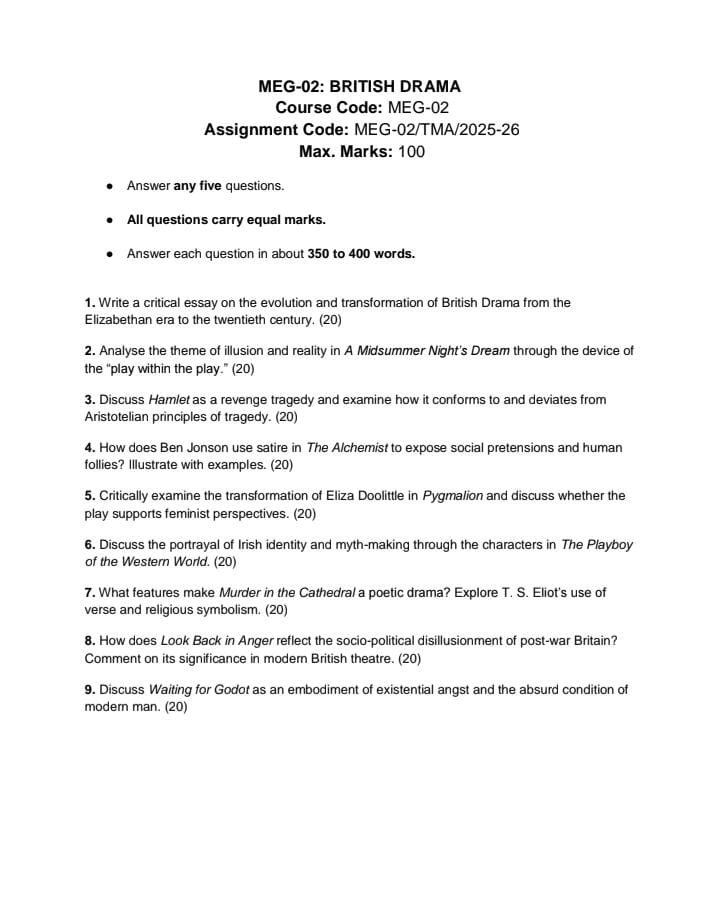
Table of Contents
Q 1. Write a critical essay on the evolution and transformation of British Drama from the Elizabethan era to the twentieth century.
Introduction
British drama has undergone a long and fascinating transformation from the Renaissance stage to the experimental theatre of the twentieth century. Each major period introduced new dramatic forms, themes, techniques, and ideas about human life. The Elizabethan period established English drama as a major literary form through playwrights such as Shakespeare, Marlowe, and Jonson. Later periods witnessed the rise of Restoration comedy, sentimental drama, social criticism, realism, poetic drama, and finally experimental forms of modern theatre. Thus, the history of British drama is also a history of changing society, values, politics, class relations, and ideas about human existence.
“All the world’s a stage,
And all the men and women merely players.”
— William Shakespeare, As You Like It
This famous theatrical metaphor is particularly appropriate to the development of British drama because the stage has continually reflected changing human experiences and social realities. From this foundation, British drama gradually developed into the diverse forms discussed below.
British drama underwent a remarkable transformation from the Elizabethan period to the twentieth century. It moved from the grandeur of Renaissance tragedy and comedy to realistic, psychological, social and experimental forms of modern theatre.
The Elizabethan Age witnessed the flowering of English drama. The public theatres became important cultural spaces, and dramatists such as Christopher Marlowe, William Shakespeare and Ben Jonson transformed the possibilities of English theatre. Shakespeare combined poetry, complex characterization, tragic conflict, comedy and philosophical reflection. Plays such as Hamlet, Macbeth and King Lear explored ambition, revenge, power, morality and human psychology.
During the Jacobean and Caroline periods, drama became darker and more concerned with corruption, violence and moral instability. Writers such as John Webster produced tragedies characterized by revenge, death and political intrigue. However, the development of drama was interrupted when the theatres were closed under the Puritan government in 1642.
After the Restoration of the monarchy in 1660, theatre reopened. Restoration drama was strongly influenced by French drama and became famous for its comedy of manners. Playwrights such as William Congreve explored fashionable society, marriage, sexual relationships and social hypocrisy. The witty dialogue and sophisticated characters reflected the concerns of the upper classes.
The eighteenth century saw the development of sentimental comedy and domestic drama. Theatre gradually became more concerned with respectable middle-class morality and emotional experience.
The Victorian period brought further changes. Although melodrama remained popular, drama also developed through the works of writers such as Oscar Wilde and George Bernard Shaw. Wilde’s The Importance of Being Earnest used wit and comedy to expose social conventions, while Shaw transformed drama into a vehicle for social criticism.
The twentieth century witnessed perhaps the greatest transformation. Shaw’s Pygmalion combined comedy with questions of class, language and gender. J. M. Synge brought Irish identity and folklore into drama. T. S. Eliot revived poetic drama in works such as Murder in the Cathedral. Later, John Osborne’s Look Back in Anger introduced a more socially disillusioned theatre, while Samuel Beckett’s Waiting for Godot challenged conventional dramatic structure through the Theatre of the Absurd.
Thus, British drama evolved from Renaissance poetic and heroic theatre to realistic, social, psychological and experimental drama. This transformation reflects changing ideas about society, politics, religion, class, identity and human existence.
Q 2. Analyses the theme of illusion and reality in A Midsummer Night’s Dream through the device of the “play within the play.”
Introduction
William Shakespeare’s A Midsummer Night’s Dream is one of the most celebrated comedies of the Elizabethan period. The play was most probably written around 1595–1596 and was first published in the First Folio of 1623, several years after Shakespeare’s death. Combining romance, comedy, fantasy, magic, and theatricality, the play explores the complex relationship between illusion and reality. Shakespeare creates a world in which lovers, fairies, craftsmen, and rulers move between different levels of reality, while dreams and magical transformations repeatedly challenge what appears to be real. The theme becomes particularly significant through the play within the play, in which the craftsmen perform the tragic story of Pyramus and Thisbe. Through this device, Shakespeare not only creates comedy but also draws attention to the nature of theatrical illusion itself. Puck, one of the play’s central characters, aptly captures the comic confusion created by the lovers’ experiences when he observes:
“Lord, what fools these mortals be!”
William Shakespeare’s A Midsummer Night’s Dream constantly blurs the boundary between illusion and reality. The theme becomes particularly significant through the device of the play within the play, performed by the group of Athenian craftsmen for the wedding celebrations.
The main play itself contains several layers of reality and illusion. The lovers enter the forest, where supernatural forces led by Oberon and Puck interfere with their relationships. The magical flower causes characters to fall in love with inappropriate people. As a result, the lovers experience a world in which their emotions and perceptions become unstable.
The craftsmen, or “mechanicals,” provide the most humorous representation of theatrical illusion. They decide to perform the tragic story of Pyramus and Thisbe at the wedding of Theseus and Hippolyta. However, they are inexperienced actors and become extremely concerned about how the audience might react to their performance.
The character of Bottom is central to this comic treatment of illusion. Puck transforms Bottom’s head into that of an ass, while Titania, under the influence of magic, falls in love with him. This creates a situation in which illusion becomes temporarily accepted as reality.
The performance of Pyramus and Thisbe further complicates the distinction. The audience knows that the actors are merely performing, yet the actors themselves attempt to make the tragic events believable. The wall, moonshine and lion are represented by actors, making the artificial nature of theatre visible to the audience.
Shakespeare therefore draws attention to the fact that theatre itself is a form of illusion. The audience willingly enters an imaginary world while knowing that it is not literally real.
The ending restores social order. The lovers are correctly paired, Bottom returns to normal, and the magical disturbances disappear. Yet Shakespeare does not completely reject illusion. Instead, he suggests that imagination and theatre have an important role in human experience.
Thus, A Midsummer Night’s Dream presents reality and illusion as closely connected. Through magic, dreams and the play-within-the-play, Shakespeare demonstrates that human beings often understand reality through imagination. Theatre itself becomes a powerful example of how illusion can create emotional and intellectual truth.
Q 3. Discuss Hamlet as a revenge tragedy and examine how it conforms to and deviates from Aristotelian principles of tragedy.
Introduction
William Shakespeare’s Hamlet is one of the greatest tragedies of the Elizabethan-Jacobean period and one of the most significant examples of the English revenge tragedy. The play was probably written around 1599–1601 and was first printed in quarto in 1603, followed by a substantially different Second Quarto in 1604–05. The central plot is based on Prince Hamlet’s attempt to avenge the murder of his father, King Hamlet, by his uncle Claudius. Although the play uses many conventional elements of revenge tragedy—such as murder, revenge, supernatural intervention, madness, violence, and multiple deaths—Shakespeare transforms the genre through Hamlet’s philosophical questioning and psychological hesitation. At the same time, the play can be examined in relation to Aristotelian principles of tragedy, particularly the tragic protagonist, emotional effect, and tragic catastrophe, while also departing from classical expectations such as the strict unities.
“The play’s the thing
Wherein I’ll catch the conscience of the king.”
— Hamlet, Hamlet
This quotation reveals Hamlet’s unusual approach to revenge. Rather than acting impulsively, he attempts to discover the truth through theatrical performance, making the play itself a tool of investigation and psychological revelation.
William Shakespeare’s Hamlet is one of the most important examples of English revenge tragedy. At the same time, it develops beyond the conventional revenge structure and does not strictly follow the principles of tragedy associated with Aristotle.
The revenge element is introduced when the ghost of King Hamlet tells Prince Hamlet that he was murdered by his brother Claudius, who has now become king and married Queen Gertrude. The ghost demands revenge. Hamlet accepts the responsibility but hesitates because he wants to establish the truth before acting.
The play contains several conventional features of revenge tragedy: murder, revenge, the supernatural, madness, violence, betrayal and death. The play-within-the-play, through which Hamlet attempts to test Claudius’s guilt, is also an important feature of the revenge plot.
However, Shakespeare transforms the traditional revenge hero into a deeply reflective character. Hamlet constantly questions action, morality, death and existence. His famous soliloquies reveal his psychological conflict. His delay in taking revenge becomes one of the central characteristics of the play.
In relation to Aristotelian tragedy, Hamlet contains several important features. Hamlet can be viewed as a tragic protagonist whose decisions contribute to the destruction of himself and others. The play also produces pity and fear, emotions associated with Aristotle’s idea of catharsis. The tragic ending involves the deaths of Hamlet, Claudius, Gertrude, Laertes and others.
However, Hamlet does not strictly follow the classical unities of time, place and action. The plot contains several subplots, including the stories of Laertes and Fortinbras. The action moves across different locations and covers a considerable period.
Moreover, the supernatural ghost, comic scenes, the gravedigger episode and the play-within-the-play expand the traditional tragic structure.
Therefore, Hamlet is both a revenge tragedy and a transformation of the genre. Shakespeare uses the revenge framework but fills it with psychological complexity, philosophical reflection and moral uncertainty. The play’s deviation from classical principles demonstrates Shakespeare’s ability to adapt traditional dramatic conventions to create a more complex representation of human experience.
Q 4. How does Ben Jonson use satire in The Alchemist to expose social pretensions and human follies? Illustrate with examples.
Introduction
Ben Jonson’s The Alchemist is one of the finest examples of Jacobean satirical comedy. The play was first performed in 1610 and was published in quarto in 1612. Set in London, it presents a world dominated by greed, ambition, superstition, deception, and the desire for rapid social and economic advancement. Jonson constructs a group of characters whose private desires make them easy victims of fraud. Subtle, Face, and Dol Common exploit these weaknesses by pretending to possess magical and alchemical powers. Through characters such as Sir Epicure Mammon, Dapper, Drugger, Tribulation Wholesome, and Ananias, Jonson exposes different forms of human folly and social hypocrisy. Satire therefore becomes the central dramatic method through which Jonson entertains his audience while simultaneously criticizing the pretensions, greed, gullibility, and moral corruption of his society.
“Our purposes are our own, our own purposes.”
— Ben Jonson, The Alchemist
Ben Jonson’s The Alchemist is a powerful example of Jacobean satirical comedy. The play exposes human greed, foolishness, social pretension and the desire for quick wealth. Jonson creates a world in which characters are easily deceived because their own desires make them vulnerable to deception.
The central characters—Subtle, Face and Dol Common—operate a fraudulent scheme in London while Lovewit, the owner of the house, is away. Subtle pretends to possess magical and alchemical powers, while Face manages the practical side of their business. Dol Common helps them maintain their disguises.
The victims reveal different forms of human folly. Sir Epicure Mammon dreams of obtaining unlimited wealth through the philosopher’s stone. His imagination becomes so excessive that he begins planning a luxurious life before he has acquired any wealth. Jonson uses Mammon to satirize greed and unrealistic ambition.
Dapper, a lawyer’s clerk, wants supernatural assistance to become successful at gambling. His willingness to believe in magical solutions exposes human superstition and desire for easy success.
Drugger, the tobacconist, seeks Subtle’s help in making his business prosperous. His dependence on fraudulent advice demonstrates the gullibility of ordinary people.
The Puritan Tribulation Wholesome and Ananias are also targets of satire. They pretend to be morally strict but are willing to participate in fraudulent schemes when they see the possibility of financial gain. Jonson therefore exposes the hypocrisy that can exist behind religious and moral pretensions.
The title itself is significant because alchemy becomes a symbol of the desire to transform worthless material into gold. The characters also attempt to transform their social and economic positions through deception.
Jonson’s satire is created through exaggerated characters, comic situations, disguise, irony and deception. Rather than presenting isolated individuals, he uses them to represent common human weaknesses.
Thus, The Alchemist is more than a comedy of tricks. It is a sharp criticism of a society driven by greed, superstition, ambition and pretension. Jonson’s humour entertains the audience while simultaneously encouraging it to recognize the follies of human behaviour.
Q 5. Critically examine the transformation of Eliza Doolittle in Pygmalion and discuss whether the play supports feminist perspectives.
Introduction
George Bernard Shaw’s Pygmalion is a major modern social comedy that explores language, class, identity, gender, and social mobility. Shaw wrote the play in 1912, and it was first performed in 1913. The title alludes to the classical myth of Pygmalion, in which a sculptor creates an ideal woman from a statue. Shaw transforms this myth into a modern social experiment in which Professor Henry Higgins attempts to transform Eliza Doolittle, a poor Cockney flower girl, into a woman capable of passing as a member of the upper class. However, Eliza’s transformation is not merely linguistic or physical. As she acquires new speech and social confidence, she also develops a stronger awareness of her own identity and independence. The play therefore raises important questions about class hierarchy, male authority, female agency, and the extent to which an individual can create an identity independent of social expectations.
“The difference between a lady and a flower girl is not how she behaves, but how she’s treated.”
— Eliza Doolittle, Pygmalion
George Bernard Shaw’s Pygmalion presents the transformation of Eliza Doolittle, a poor flower girl, through language education and social training. However, her transformation is not simply about changing her appearance or accent. It raises important questions about class, identity, independence and gender.
At the beginning of the play, Eliza is a working-class flower seller whose Cockney accent marks her social position. Professor Henry Higgins believes that through phonetic training he can transform her speech so completely that she can pass as a respectable upper-class woman.
The experiment initially appears to make Eliza dependent on Higgins. He treats her as an object of linguistic experimentation rather than as an independent individual. However, Eliza gradually develops confidence and self-awareness.
The most important part of her transformation is therefore psychological. She begins to understand that social identity is not simply determined by birth or accent. Her ability to speak differently gives her access to new social possibilities, but she also discovers that changing her language does not automatically give her emotional or economic independence.
The play can be interpreted through a feminist perspective because Eliza refuses to remain merely Higgins’s creation. She begins to challenge his authority and demands recognition as an individual. Her declaration of independence demonstrates that she does not want to be treated as a passive object.
At the same time, the play contains certain limitations. Higgins continues to behave arrogantly and often fails to recognize Eliza’s emotional needs. The relationship between the two raises questions about male authority and female autonomy.
Shaw therefore presents transformation as a complex process. Eliza’s real achievement is not simply that she learns “proper” English. Her greatest transformation is that she develops the confidence to determine her own identity.
Thus, Pygmalion can support a feminist interpretation because it questions traditional gender and class hierarchies and gives Eliza a strong sense of agency. At the same time, Shaw does not provide a simple feminist solution. Instead, the play exposes the social structures that restrict women while showing Eliza’s struggle to become an independent individual.
Q 6. Discuss the portrayal of Irish identity and myth-making through the characters in The Playboy of the Western World.
Introduction
J. M. Synge’s The Playboy of the Western World explores Irish identity through folklore, storytelling, exaggeration and the creation of heroic myths. The play is set in a rural Irish community and examines how people construct identity through stories rather than through objective reality.
The central character, Christy Mahon, arrives at a public house claiming that he has killed his father. Instead of rejecting him, the villagers gradually admire him. His story transforms him from an ordinary and frightened young man into a heroic figure in their imagination.
Pegeen Mike, the daughter of Michael James Flaherty, becomes attracted to Christy partly because of the heroic image created around him. His supposed act of violence makes him appear courageous and extraordinary. Synge therefore demonstrates the power of storytelling in shaping social identity.
However, Christy’s identity is based on a myth. When his father, Old Mahon, appears alive, the heroic image collapses. The villagers suddenly reject Christy. The same community that had celebrated him now turns against him.
The character of Michael James Flaherty also represents the tension between social respectability and the attraction of heroic rebellion. Similarly, Shawn Keogh represents a more conventional and cautious personality.
The women in the play, especially Pegeen and Widow Quin, also participate in the process of myth-making. Their reactions to Christy show how storytelling affects desire, social status and personal identity.
Synge’s treatment of Irish identity is therefore complex. He does not simply present an idealized picture of rural Ireland. Instead, he shows a community fascinated by dramatic stories and heroic violence.
The play’s language, humour and folklore contribute to its distinctive representation of Irish culture. At the same time, its portrayal of Irish villagers led to controversy because some audiences believed Synge had presented an insulting image of Ireland.
Ultimately, The Playboy of the Western World suggests that identity is often created through stories. Christy becomes a “playboy” because the community imagines him as one. When the myth collapses, his identity changes again. Synge therefore uses myth-making to explore the relationship between storytelling, imagination and Irish identity.
Q 7. What features make Murder in the Cathedral a poetic drama? Explore T. S. Eliot’s use of verse and religious symbolism.
Introduction
T. S. Eliot’s Murder in the Cathedral is an important example of modern poetic drama. The play combines dramatic action with poetic language, symbolism, religious themes and the influence of classical Greek tragedy.
The play focuses on the martyrdom of Thomas Becket, the Archbishop of Canterbury, who returns to England knowing that his political and religious conflict with King Henry II may lead to his death.
One of the major features of the play is its use of verse. Eliot does not rely on ordinary conversational prose. Instead, he uses rhythm, repetition, imagery and symbolic language to create a poetic atmosphere. The language often resembles religious ritual and liturgical speech.
The Chorus of Canterbury women is another important feature. Inspired partly by Greek tragedy, the Chorus comments on events and expresses the fears and anxieties of ordinary people. Through the Chorus, Eliot gives the community a collective voice.
Religious symbolism is central to the play. Becket’s death becomes a symbol of Christian martyrdom and spiritual sacrifice. The cathedral itself becomes a sacred space in which political and spiritual conflicts are played out.
The appearance of the Four Tempters represents different forms of temptation. They attempt to persuade Becket to choose political power, personal safety or worldly glory. The final temptation is particularly complex because Becket must ensure that his martyrdom is not motivated by personal pride.
Eliot also uses imagery of blood, sacrifice, death and spiritual purification. The murder is therefore presented not merely as a political assassination but as a religious event.
The play also combines historical events with modern concerns. Eliot uses medieval material to explore questions of authority, conscience, sacrifice and the relationship between religion and politics.
Thus, Murder in the Cathedral qualifies as poetic drama because its dramatic structure is inseparable from its poetry. Eliot uses verse, Chorus, symbolism, religious imagery and ritualistic language to create a theatre that is both dramatic and spiritual. The result is a modern play deeply influenced by classical tragedy and Christian dramatic traditions.
Q 8. How does Look Back in Anger reflect the socio-political disillusionment of post-war Britain? Comment on its significance in modern British theatre.
Introduction
John Osborne’s Look Back in Anger is one of the most important British plays of the post-war period. First performed in 1956, it reflects the frustration, anger and social disillusionment experienced by a generation living in post-war Britain.
The central character, Jimmy Porter, is an educated but economically frustrated young man. He belongs to a lower-middle-class background and feels alienated from the social establishment. His anger is directed toward his personal circumstances as well as the larger society.
Jimmy’s marriage to Alison also becomes a site of social and emotional conflict. Alison comes from an upper-middle-class background, while Jimmy resents the privileges associated with her family. Their relationship therefore reflects the class tensions of post-war Britain.
The play’s domestic setting is significant. Rather than presenting heroic characters or grand historical events, Osborne focuses on ordinary people struggling with disappointment, boredom and emotional dissatisfaction.
Jimmy’s anger also reflects the mood associated with the Angry Young Men of the 1950s. This generation often criticized the established social order and expressed frustration with class inequality, limited opportunities and the failure of traditional institutions to provide meaningful direction.
The character of Colonel Redfern, Alison’s father, represents an older generation whose imperial world is disappearing. His nostalgia contrasts sharply with Jimmy’s frustration. Through this contrast, Osborne presents the decline of Britain’s old social and imperial confidence.
The language of the play is another important feature. Jimmy’s long speeches and aggressive verbal exchanges create a sense of emotional pressure. The dialogue is direct, energetic and often confrontational.
The significance of Look Back in Anger lies in its departure from conventional British theatre. It brought working-class and lower-middle-class frustration into the centre of serious drama. It also helped establish a new tradition of social realism.
Therefore, the play is not simply about an unhappy marriage. It represents a wider crisis of identity in post-war Britain. Jimmy’s anger becomes a dramatic expression of a society struggling with class divisions, changing values and the loss of its former confidence.
Q 9. Discuss Waiting for Godot as an embodiment of existential angst and the absurd condition of modern man.
Introduction
Samuel Beckett’s Waiting for Godot is one of the most influential examples of the Theatre of the Absurd. The play presents two characters, Vladimir and Estragon, who wait beside a tree for a mysterious figure named Godot. However, Godot never arrives.
The simple act of waiting becomes a powerful representation of the human condition. Vladimir and Estragon repeatedly discuss leaving, but they remain in the same place. Their existence is marked by uncertainty, repetition and purposelessness.
The play reflects existential angst, the feeling that human beings exist in a world without clear meaning or certainty. The characters do not know exactly who Godot is, why they are waiting for him, or whether he will ever arrive. Nevertheless, they continue waiting.
The structure of the play reinforces this uncertainty. The two acts are remarkably repetitive. Similar events happen again, and the second act does not provide a conventional resolution. The lack of a clear ending challenges traditional dramatic expectations.
Language itself becomes unstable. Characters frequently misunderstand one another, repeat statements and engage in seemingly meaningless conversations. Beckett uses language not simply to communicate information but also to reveal the difficulty of communication.
The characters Pozzo and Lucky introduce another dimension to the play. Their relationship raises questions about power, dependence and human suffering. Lucky’s famous speech becomes an example of language breaking down into fragments and apparent meaninglessness.
The tree is another important symbol. It provides a minimal connection with nature and perhaps offers a suggestion of hope, but its significance remains uncertain.
Godot himself can be interpreted in many ways—as God, salvation, meaning, authority or an imagined future. Beckett deliberately refuses to provide a definitive interpretation.
The play therefore embodies the absurd condition of modern humanity through waiting, repetition, uncertainty, silence and failed communication. Unlike traditional drama, it does not provide a clear solution or moral lesson.
Waiting for Godot is significant because it transforms the absence of meaning into a dramatic form. Beckett suggests that modern human beings may continue searching for meaning even when they have no certainty that such meaning exists.
Important Tips for MEG-02 Assignment
- Follow the 350–400-word guideline for each answer.
- Answer the question actually asked rather than writing a general summary.
- Use headings where they improve clarity.
- Mention the names of important characters and dramatic techniques.
- Include relevant textual examples.
- Avoid unnecessary biography.
- Maintain a clear academic style.
- Write the answers in your own words after understanding the arguments.
- Proofread your assignment before submission.
Frequently Asked Questions (FAQs)
1. How many questions do I have to answer in the MEG-02 assignment?
The official 2025–26 assignment asks students to answer any five questions.
2. How many marks is each MEG-02 assignment question worth?
Each question carries 20 marks. The total maximum marks for the assignment are 100.
3. How many words should each MEG-02 answer contain?
IGNOU specifies approximately 350–400 words for each answer in the 2025–26 MEG-02 assignment.
4. Is MEG-02 British Drama?
Yes. MEG-02 is British Drama, an 8-credit course in the IGNOU Master’s Degree in English programme.
5. Are these official IGNOU answers?
No. These are model answers prepared for academic guidance. Students should understand the arguments and write their assignments in their own words.
Conclusion
The IGNOU MEG-02 Solved Assignment 2025–26 covers some of the most important texts and themes in British Drama, ranging from Shakespearean drama to modern and contemporary theatre. The assignment questions focus on major works such as A Midsummer Night’s Dream, Hamlet, The Alchemist, Pygmalion, The Playboy of the Western World, Murder in the Cathedral, Look Back in Anger, and Waiting for Godot.
The model answers provided in this article are designed to help you understand the main arguments, important themes, characters, dramatic techniques, and critical perspectives required for each question.
However, do not simply copy the answers. Use them as a reference, understand the points discussed, and present your final assignment in your own words. A well-structured answer with a clear introduction, relevant textual examples, critical analysis, and a strong conclusion can make your assignment more effective.
For more IGNOU MEG study material, solved assignments, British Literature notes, previous-year questions, and exam-oriented resources, keep following Shariyawrites and visit shariyawrites.com.
Keep learning, keep writing, and all the best for your IGNOU exams!
Explore More IGNOU MEG Resources
If you’re preparing for the IGNOU M.A. English examination, you may also find these guides helpful:
- IGNOU MEG 05 Solved Assignment 2025-2026 (Free PDF) | Literary Theory & Criticism
- IGNOU MEG-01 Solved Assignment 2025–26 | Complete British Poetry Answers
- IGNOU July 2026 Admission Last Date Extended to 31 July
- What is Allegory? | 2 Types & 5 Forms of Expression | M.H. Abrams ‘Glossary of Literary Terms’
Disclaimer
Save this post—you’ll need to return to it regularly before exam day.
This article is written for educational purposes and is based on multiple academic sources, interpreted in the author’s own words.
About the Author
Shariya Writes believes that literature is not a burden to memorize, but an emotion to understand. Through blogs, reels, and videos, she simplifies English Literature for students who want to connect texts with life.
Explore more here:
https://linktr.ee/shariyawrites