
IGNOU MEG-01 Solved Assignment 2025–26 | Complete British Poetry Answers
If you are an IGNOU M.A. English student searching for MEG-01 Solved Assignment 2025–26, you are in the right place. This guide provides original, well-structured model answers that can help you understand the questions and prepare your own assignment.
Course Code: MEG-01
Course Title: British Poetry
Session: July 2025 & January 2026
Important Note: These answers are provided for study and reference purposes only. Read them carefully, understand the concepts, and write the assignment in your own words before submitting it to IGNOU.
Question 1 – IGNOU MEG-01 Solved Assignment 2025–26
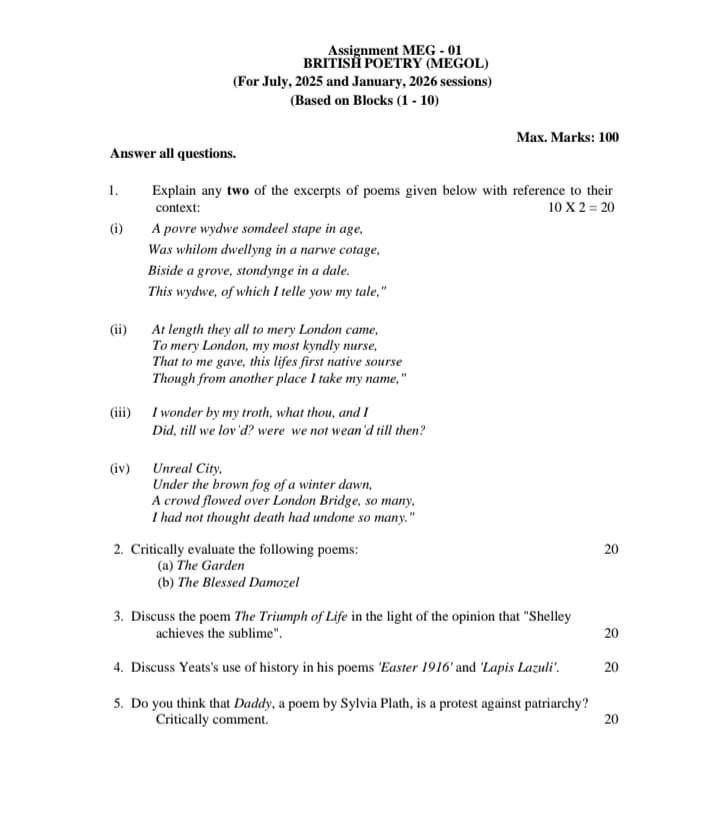
Explain any two of the excerpts of poems given below with reference to their context.
Note: Although IGNOU asks you to attempt any two, the explanations for all four extracts are provided here for your convenience.
Extract (i)
A povre wydwe somdeel stape in age,
Was whilom dwelling in a narwe cotage,
Biside a grove, stondyng in a dale.
This wydwe, of which I telle yow my tale,
Context
These lines are taken from Geoffrey Chaucer’s The Nun’s Priest’s Tale, one of the stories in The Canterbury Tales. Before introducing the main characters, Chaucer describes the peaceful life of an elderly widow who lives in a small cottage in the countryside.
Explanation
The extract paints a vivid picture of a poor but contented widow. Chaucer emphasizes that although she possesses very little wealth, she enjoys a peaceful and honest life. Her cottage is situated beside a grove in a quiet valley, symbolizing harmony with nature.
The widow represents the medieval Christian ideal of humility and contentment. She does not complain about her poverty but accepts her circumstances with dignity. Through this simple description, Chaucer suggests that true happiness depends more on virtue than on material possessions.
The calm rural setting also prepares the reader for the humorous animal fable involving Chanticleer, the proud rooster, and Pertelote, the hen. The contrast between the widow’s simplicity and Chanticleer’s vanity adds depth to the narrative.
Another important aspect of this passage is Chaucer’s realistic portrayal of medieval village life. His detailed description reflects his close observation of ordinary people and their everyday experiences.
Critical Appreciation
This extract demonstrates Chaucer’s remarkable ability to create realistic characters with only a few lines. The widow’s peaceful life reflects moral values such as simplicity, honesty, patience, and satisfaction. It also highlights Chaucer’s sympathy for common people.
Conclusion
The passage serves as an effective introduction to The Nun’s Priest’s Tale. It establishes a peaceful atmosphere while emphasizing that virtue and contentment are more valuable than wealth.
Extract (ii)
At length they all to mery London came,
To mery London, my most kyndly nurse,
That to me gave, this lifes first native sourse
Though from another place I take my name.
Context
These lines are taken from Edmund Spenser’s Prothalamion, a celebratory poem written in honour of the double marriage of the daughters of the Earl of Worcester. While describing the festive journey along the River Thames, Spenser affectionately praises London, the city where he spent an important part of his life.
Explanation
In this passage, Spenser calls London his “most kindly nurse,” expressing his deep affection and gratitude towards the city. Although he was born elsewhere, London nurtured his literary career and offered him opportunities for personal and professional growth.
The repetition of the phrase “merry London” creates a joyful and celebratory tone. London is presented not merely as a geographical location but as a living force that nourishes creativity and ambition.
The poet’s emotional attachment to the city also reflects Renaissance patriotism. During the Elizabethan period, London had become the cultural and political centre of England. By praising the city, Spenser celebrates the prosperity and greatness of Elizabethan England itself.
The imagery combines personal memory with national pride, making the passage both intimate and patriotic.
Critical Appreciation
The extract reflects Spenser’s musical style, rich imagery, and deep love for England. His description transforms London into a symbol of cultural identity and artistic inspiration.
Conclusion
These lines celebrate London’s beauty and significance while revealing Spenser’s gratitude towards the city that shaped his literary life.
Extract (iii)
I wonder by my troth, what thou, and I
Did, till we lov’d? were we not wean’d till then?
Context
These famous opening lines are taken from John Donne’s poem The Good-Morrow. It is one of Donne’s finest metaphysical love poems, exploring the spiritual and intellectual transformation brought about by true love.
Explanation
The speaker reflects upon life before he and his beloved fell in love. He wonders what their lives meant before this profound emotional experience. By asking rhetorical questions, he suggests that everything before true love was immature and incomplete.
The phrase “were we not wean’d till then?” compares their earlier lives to those of infants who had not yet matured. Love becomes a symbol of awakening, maturity, and self-discovery.
Unlike conventional romantic poetry, Donne presents love as an intellectual and spiritual union rather than merely physical attraction. The lovers create an entirely new world through their mutual understanding and emotional harmony.
The conversational tone, logical argument, and philosophical reflection are characteristic features of metaphysical poetry.
Critical Appreciation
This extract beautifully illustrates Donne’s originality. His use of paradox, intellectual inquiry, and dramatic speech transforms a simple love poem into a philosophical meditation on human existence.
Conclusion
The passage suggests that genuine love gives life its true meaning. Everything before love appears incomplete, while love itself marks the beginning of real emotional and spiritual fulfillment.
Extract (iv)
Unreal City,
Under the brown fog of a winter dawn,
A crowd flowed over London Bridge, so many,
I had not thought death had undone so many.
Context
These lines are taken from T. S. Eliot’s The Waste Land, one of the most influential poems of the twentieth century. The passage appears in the opening section, “The Burial of the Dead,” where Eliot presents a bleak picture of modern urban civilization.
Explanation
Eliot describes London as an “Unreal City,” suggesting that modern urban life has become artificial, mechanical, and spiritually empty. The “brown fog” creates an atmosphere of gloom, pollution, and uncertainty, symbolizing moral and cultural decay.
The endless crowd crossing London Bridge appears lifeless and mechanical. Eliot compares these people to the souls in Dante’s Inferno, who wander endlessly after death. The line “I had not thought death had undone so many” directly echoes Dante, implying that modern individuals are spiritually dead despite being physically alive.
The passage reflects the deep sense of despair and disillusionment that followed the First World War. Eliot portrays modern civilization as fragmented, isolated, and devoid of meaningful human connection.
His use of symbolism, literary allusions, and striking imagery makes the poem a landmark of Modernist literature.
Critical Appreciation
This extract captures the central themes of The Waste Land—spiritual emptiness, alienation, and the collapse of traditional values. Eliot combines contemporary urban imagery with classical literature to create a powerful critique of modern society.
Conclusion
The passage remains one of the finest examples of Modernist poetry. It portrays London’s crowded streets as a symbol of a civilization suffering from spiritual exhaustion and loss of meaning.
Conclusion of Question 1
The four extracts represent different periods and movements in British poetry—from Chaucer’s medieval realism and Spenser’s Renaissance optimism to Donne’s metaphysical philosophy and Eliot’s Modernist vision. Together, they demonstrate the richness and diversity of English poetic tradition.
Question 2 – IGNOU MEG-01 Solved Assignment 2025–26
Critically evaluate (a) The Garden by Andrew Marvell and *(b) The Blessed Damozel by Dante Gabriel Rossetti. (20 Marks)
(a) Critically Evaluate The Garden by Andrew Marvell
Introduction
Andrew Marvell (1621–1678) is one of the greatest Metaphysical poets of seventeenth-century England. His poetry combines intellectual depth, philosophical reflection, vivid imagery, and emotional sensitivity. The Garden is one of his finest poems, celebrating the beauty of solitude and nature while criticizing human ambition and worldly pursuits.
Unlike traditional pastoral poetry, The Garden presents nature not merely as a beautiful setting but as a source of spiritual peace and intellectual fulfillment. The poem suggests that true happiness is found in communion with nature rather than in society or material success.
Summary of the Poem
The poem begins by criticizing people who devote their lives to fame, wealth, and power. According to Marvell, such ambitions are ultimately meaningless because they distract individuals from the simple pleasures of life.
The speaker contrasts worldly life with the peaceful atmosphere of a secluded garden. Surrounded by trees, flowers, fruits, and birds, he experiences complete mental and spiritual satisfaction. The garden becomes a place where the soul finds freedom and the mind achieves perfect harmony.
Towards the end of the poem, Marvell imagines the Garden of Eden before the creation of Eve. He suggests that Adam enjoyed perfect happiness while living alone in paradise, emphasizing the superiority of peaceful solitude over social life.
Major Themes
1. Nature as a Source of Spiritual Peace
The central theme of The Garden is the healing power of nature. Marvell presents the garden as a sacred space where human beings can escape worldly worries and discover inner peace.
Nature is portrayed not simply as beautiful scenery but as a companion that nourishes both the body and the soul.
2. Criticism of Worldly Ambition
Marvell argues that people waste their lives chasing honour, wealth, and fame. These ambitions often lead to anxiety and disappointment.
The peaceful garden offers a better alternative because it provides lasting happiness without competition or conflict.
3. Solitude versus Society
Unlike many poets who celebrate human relationships, Marvell praises solitude.
He believes that isolation from society allows individuals to think clearly, meditate deeply, and appreciate nature’s beauty without distraction.
This idea reflects the contemplative tradition found in classical philosophy and Christian spirituality.
4. Harmony between Mind and Nature
One of the poem’s most remarkable ideas is that the human mind becomes more creative in natural surroundings.
Marvell writes that the mind creates “other worlds” while contemplating nature, suggesting that imagination flourishes in peaceful environments.
5. Biblical Allusion
The reference to Adam before Eve introduces an interesting interpretation of the Biblical story.
Marvell suggests that Adam’s happiest moment occurred before human society began, reinforcing the poem’s preference for solitude.
Literary Devices
Imagery
The poem contains rich sensory imagery describing trees, flowers, fruits, birds, and green landscapes.
These vivid descriptions allow readers to experience the calm beauty of the garden.
Symbolism
The garden symbolizes:
- Spiritual peace
- Innocence
- Freedom
- Intellectual fulfillment
Irony
Marvell ironically argues that those seeking greatness actually miss life’s greatest happiness.
Classical and Biblical References
The poem combines references from Greek mythology and the Bible, reflecting Renaissance learning and Metaphysical poetry’s intellectual style.
Critical Analysis
The Garden is much more than a nature poem.
It is a philosophical meditation on the relationship between humanity and nature.
Unlike Romantic poets, who celebrate emotional responses to nature, Marvell presents nature as a place for rational thought and spiritual contemplation.
Critics have admired the poem for its perfect balance between imagination and philosophy. The elegant language, intellectual arguments, and beautiful imagery demonstrate Marvell’s extraordinary poetic skill.
However, some critics argue that Marvell idealizes solitude too much. Human beings naturally need companionship, and complete withdrawal from society may not be practical.
Despite this criticism, the poem remains one of the greatest achievements of Metaphysical poetry.
Conclusion
Andrew Marvell’s The Garden celebrates the beauty of solitude and the restorative power of nature.
Through vivid imagery, philosophical reflection, and symbolic meaning, Marvell encourages readers to look beyond worldly success and discover lasting happiness in simplicity, contemplation, and harmony with nature.
Its timeless message continues to inspire readers even today.
(b) Critically Evaluate The Blessed Damozel by Dante Gabriel Rossetti
Introduction
Dante Gabriel Rossetti (1828–1882) was one of the founders of the Pre-Raphaelite Brotherhood, a literary and artistic movement that emphasized beauty, imagination, symbolism, and medieval ideals.
The Blessed Damozel, first published in 1850, is one of Rossetti’s most celebrated poems. It tells the story of a young woman in heaven who longs to be reunited with her lover on earth.
The poem beautifully combines themes of love, separation, spirituality, and hope, making it one of the finest examples of Pre-Raphaelite poetry.
Summary of the Poem
The Blessed Damozel stands at the golden barrier of heaven and looks down upon the earth.
Although she enjoys the beauty and peace of heaven, she deeply misses her beloved, who is still living on earth.
She dreams of the day when he will join her in heaven. She imagines introducing him to the saints, angels, and the Virgin Mary before they spend eternity together in divine happiness.
Meanwhile, the lover on earth also remembers her with sorrow, creating a touching contrast between heavenly hope and earthly grief.
Major Themes
1. Love Beyond Death
The poem suggests that true love survives physical death.
The Damozel’s feelings remain unchanged even after entering heaven.
Rossetti presents love as an eternal spiritual force.
2. Separation and Longing
Despite living in paradise, the Damozel experiences emotional pain because she remains separated from her beloved.
This longing gives the poem its emotional intensity.
3. Heaven as a Living Reality
Rossetti describes heaven in rich visual detail.
Instead of presenting it as an abstract religious concept, he creates a beautiful world filled with flowers, stars, angels, and music.
4. Spiritual Love
Unlike purely physical love, the relationship between the lovers is deeply spiritual.
The poem suggests that earthly love can ultimately become part of divine love.
5. Faith and Hope
The Damozel never loses hope.
She firmly believes that one day the lovers will be reunited in heaven.
This hope reflects Christian beliefs about eternal life.
Literary Features
Rich Visual Imagery
Rossetti’s greatest strength is his extraordinary imagery.
Readers can vividly imagine heaven through descriptions of golden light, white lilies, shining stars, and celestial music.
Symbolism
Important symbols include:
- Lilies – purity
- Stars – eternity
- Gold – divine glory
- Heaven – spiritual perfection
Musical Language
The poem’s rhythm and repetition create a soft, lyrical quality that enhances its emotional appeal.
Medieval Influence
Rossetti draws inspiration from medieval Christianity, religious paintings, and Italian art.
These influences give the poem its distinctive atmosphere.
Critical Analysis
The Blessed Damozel perfectly represents the ideals of the Pre-Raphaelite movement.
Rather than focusing on realism, Rossetti creates an idealized world filled with beauty, symbolism, and spiritual emotion.
Critics praise the poem for its rich imagery, artistic craftsmanship, and emotional sincerity.
The alternating perspectives between heaven and earth create dramatic tension and remind readers that love involves both hope and suffering.
Some modern critics argue that the poem idealizes women by presenting the Damozel as an almost perfect heavenly figure.
Others feel that its highly decorative style sometimes overshadows psychological realism.
Nevertheless, the poem remains one of the masterpieces of Victorian literature because of its emotional depth and artistic beauty.
Conclusion
The Blessed Damozel is a moving exploration of eternal love, faith, and spiritual longing.
Through beautiful imagery, symbolism, and lyrical language, Rossetti creates a timeless vision of love that transcends death.
The poem continues to be admired for its artistic excellence and its unique blend of romance and spirituality.
Overall Conclusion
Both Andrew Marvell’s The Garden and Dante Gabriel Rossetti’s The Blessed Damozel explore the search for a higher form of happiness, but they do so in different ways. Marvell finds fulfillment in nature, solitude, and contemplation, while Rossetti celebrates love, faith, and the hope of reunion after death. Together, these poems reflect the richness and diversity of British poetry across different literary periods and continue to hold an important place in English literary studies.
Question 3
Question 3 – IGNOU MEG-01 Solved Assignment 2025–26
Discuss The Triumph of Life in the light of the opinion that “Shelley achieves the sublime.” (20 Marks)
Introduction
Percy Bysshe Shelley (1792–1822) is one of the greatest Romantic poets in English literature. His poetry is known for its idealism, revolutionary spirit, philosophical depth, and rich imagination. Among his unfinished works, The Triumph of Life occupies a unique position because of its profound meditation on life, power, truth, and human destiny.
Written during the final months of Shelley’s life in 1822, the poem reflects his mature philosophical outlook. Although incomplete, it is regarded as one of the finest achievements of Romantic poetry. The poem has often been described as “sublime” because of its grand vision, powerful imagery, symbolic richness, and exploration of universal human experiences.
What is the Sublime?
Before discussing the poem, it is important to understand the meaning of the sublime.
In literary criticism, the sublime refers to an experience of overwhelming greatness that inspires both admiration and awe. According to Edmund Burke, the sublime arises from experiences that are vast, mysterious, powerful, and even terrifying. Romantic poets often used the sublime to explore the relationship between human beings, nature, imagination, and the infinite.
In The Triumph of Life, Shelley transforms ordinary experience into something vast and mysterious. His vision of humanity, history, and life creates a feeling of wonder mixed with fear, making the poem an outstanding example of the Romantic sublime.
Summary of the Poem
The poem begins with the speaker witnessing a magnificent yet disturbing procession moving across the earth. This grand procession is led by the powerful figure of Life, who rides triumphantly in a magnificent chariot.
Thousands of people from different ages, nations, and civilizations follow the chariot. Kings, philosophers, poets, religious leaders, warriors, and ordinary people all become prisoners of Life’s irresistible power.
The speaker then meets Jean-Jacques Rousseau, who narrates his own story. Rousseau explains how he too was deceived by Life and eventually became one of its followers.
The poem ends abruptly because Shelley died before completing it. Yet this unfinished ending adds to its mystery and philosophical depth.
The Symbolism of the Triumphal Chariot
The central symbol of the poem is the Triumphal Chariot of Life.
The chariot represents the irresistible force of worldly existence that controls all human beings.
No matter how wise, powerful, or virtuous a person may be, everyone eventually becomes subject to Life’s influence.
The procession symbolizes the endless cycle of ambition, desire, illusion, and suffering that dominates human civilization.
Shelley uses this powerful symbol to suggest that human beings often lose their freedom because they become slaves to worldly success, political power, and material desires.
Life as an Illusion
One of the poem’s major themes is that life is full of illusion.
People believe they are free, independent, and successful, but they are actually controlled by external forces such as ambition, pride, greed, and desire.
Shelley questions whether human beings truly possess free will or merely follow the endless procession created by society.
The poem encourages readers to look beyond appearances and search for deeper truth.
The Journey of Humanity
Unlike many Romantic poems that focus on individual emotions, The Triumph of Life presents the journey of the entire human race.
Shelley includes famous historical figures from different civilizations, suggesting that no one escapes the influence of Life.
Kings, emperors, philosophers, artists, and religious leaders all become part of the same procession.
This universal vision gives the poem extraordinary scope and grandeur.
Rousseau’s Role in the Poem
Jean-Jacques Rousseau serves as the poem’s philosophical guide.
He tells the narrator that he once believed in truth, freedom, and human goodness.
However, he eventually realized that worldly life often destroys these ideals.
Rousseau’s confession represents the disappointment experienced by many idealists.
Through Rousseau, Shelley examines the conflict between human aspirations and harsh reality.
The Sublime Imagery
One of the greatest strengths of the poem is its magnificent imagery.
Shelley creates scenes of extraordinary beauty and power.
Examples include:
- The dazzling light surrounding the procession.
- The magnificent chariot moving across the world.
- Endless crowds representing humanity.
- Vast landscapes filled with symbolic meaning.
- Brilliant descriptions of light, shadow, and movement.
These images create a sense of awe and wonder that is characteristic of the Romantic sublime.
Philosophical Depth
The poem raises several important philosophical questions.
- Is human freedom real?
- Can truth survive in a corrupt society?
- Why do even great leaders become victims of ambition?
- Is life itself an illusion?
- Can human beings ever escape worldly suffering?
Rather than providing simple answers, Shelley invites readers to reflect upon these questions themselves.
This philosophical complexity makes the poem intellectually rewarding.
Romantic Characteristics
The Triumph of Life contains many features of Romantic poetry.
Imagination
Shelley’s imagination transforms abstract philosophical ideas into vivid symbolic images.
Symbolism
The entire poem functions as an extended allegory.
Important symbols include:
- The Chariot
- Light
- Darkness
- The Crowd
- Rousseau
Each symbol represents deeper philosophical ideas.
Individual Vision
The poem reflects Shelley’s unique interpretation of human history and civilization.
Nature
Natural scenery is used not merely as decoration but as a reflection of spiritual and emotional states.
Literary Style
Shelley’s language is elevated, musical, and highly poetic.
His style combines:
- Rich imagery
- Classical references
- Symbolism
- Philosophical reflection
- Dramatic narration
The poem’s flowing rhythm enhances its dreamlike atmosphere.
Although unfinished, its artistic unity remains impressive.
Critical Evaluation
Many critics consider The Triumph of Life Shelley’s greatest unfinished masterpiece.
The poem demonstrates his mature philosophical thinking and remarkable poetic imagination.
Its exploration of illusion, power, and human destiny gives it universal significance.
Critics particularly admire:
- Grand symbolic structure.
- Imaginative richness.
- Intellectual complexity.
- Powerful visual imagery.
- Philosophical depth.
However, some readers find the poem difficult because of its abstract symbolism and complex ideas.
Its unfinished nature also leaves many questions unanswered.
Yet many scholars argue that this incompleteness actually increases the poem’s mystery and artistic power.
Why Shelley Achieves the Sublime
The statement that “Shelley achieves the sublime” is justified for several reasons.
First, the poem presents an immense vision of humanity stretching across history.
Second, its symbolic procession creates feelings of awe and wonder.
Third, Shelley combines beauty with terror, hope with despair, and imagination with philosophy.
Finally, the poem explores universal questions about life, truth, and freedom that remain relevant even today.
These qualities elevate the poem beyond ordinary narrative and place it among the finest achievements of Romantic literature.
Conclusion
The Triumph of Life is a remarkable philosophical poem that demonstrates Shelley’s extraordinary poetic genius. Through the magnificent image of the triumphal procession, he examines the forces that shape human existence and questions whether true freedom is possible. His rich symbolism, powerful imagination, and profound philosophical insights create an overwhelming sense of grandeur that perfectly illustrates the Romantic concept of the sublime.
Although unfinished, the poem remains one of the greatest masterpieces of English literature. Its timeless exploration of illusion, ambition, power, and human destiny continues to inspire readers and confirms Shelley’s position as one of the finest poets of the Romantic Age.
Question 4 – IGNOU MEG-01 Solved Assignment 2025–26
Discuss W. B. Yeats’s use of history in the poems Easter 1916 and Lapis Lazuli. (20 Marks)
Introduction
William Butler Yeats (1865–1939) is one of the greatest poets of the twentieth century and a central figure in Modern English literature. His poetry reflects Irish nationalism, mythology, history, politics, philosophy, and human civilization. Unlike many poets who treat history as a simple record of past events, Yeats presents history as a living force that continually shapes human life.
In both Easter 1916 and Lapis Lazuli, Yeats uses history to explore sacrifice, human suffering, political change, and the resilience of art. While Easter 1916 focuses on a specific political event in Irish history, Lapis Lazuli reflects on the repeated rise and fall of civilizations. Together, these poems reveal Yeats’s mature understanding of history as both tragic and transformative.
Yeats’s Historical Vision
Yeats believed that history moves in recurring cycles rather than in a straight line. His philosophical work, A Vision, explains that civilizations experience continuous phases of growth, decline, destruction, and renewal.
This cyclical view of history appears throughout his poetry. Human achievements may disappear, but new civilizations and new ideas always emerge from the ruins of the old.
Both poems illustrate this belief in different ways.
History in Easter 1916
Historical Background
Easter 1916 was written after the Easter Rising, an armed rebellion against British rule in Ireland that took place in April 1916.
Although the rebellion was quickly suppressed and its leaders were executed, the event became a turning point in Irish history and strengthened the movement for Irish independence.
Yeats personally knew several of the revolutionary leaders, making the poem both historical and deeply personal.
Transformation Through Sacrifice
The central idea of the poem is that history is changed through sacrifice.
The executed revolutionaries were ordinary individuals before the rebellion. However, their willingness to die transformed them into national heroes.
Yeats captures this transformation in the famous line:
“A terrible beauty is born.”
This paradox expresses the mixed emotions surrounding the Easter Rising. The event was tragic because many lives were lost, yet it was also beautiful because it inspired national freedom and courage.
Thus, history is shown as both painful and glorious.
Personal Memory and National History
Yeats combines his own memories with public history.
He remembers meeting the revolutionaries in everyday situations before they became symbols of Irish nationalism.
This blending of private experience with national events gives the poem emotional depth and authenticity.
History is not presented as distant or impersonal; it directly affects the lives of ordinary people.
Symbolism of the Stone
One of the most powerful symbols in the poem is the stone.
Yeats writes that the revolutionaries have hearts
“enchanted to a stone.”
The stone symbolizes determination, unwavering commitment, and sacrifice.
However, it also suggests rigidity and inflexibility.
Through this symbol, Yeats admires the rebels’ courage while questioning whether absolute political commitment may become dangerous.
Political Complexity
Although Yeats honours the revolutionaries, he does not glorify violence without reservation.
He asks whether so much sacrifice was necessary.
This balanced perspective makes the poem more than patriotic propaganda.
Instead, it becomes a thoughtful reflection on the costs and consequences of political revolution.
History in Lapis Lazuli
Historical Background
Lapis Lazuli was written in 1936, when Europe was experiencing political instability and moving toward the Second World War.
Many people feared that civilization itself might collapse.
Instead of responding with despair, Yeats offers a philosophical meditation on history and art.
Cycles of Civilization
The poem argues that civilizations repeatedly rise, decline, and disappear.
Wars, revolutions, and disasters are permanent features of human history.
Yet humanity continues to create art, literature, music, and culture.
This cyclical understanding reflects Yeats’s belief that destruction is always followed by renewal.
The Symbolism of the Lapis Lazuli Sculpture
The title refers to a carved Chinese sculpture made from lapis lazuli.
The sculpture depicts wise old men climbing a mountain peacefully despite the troubles of the world.
This image symbolizes wisdom, artistic endurance, and spiritual detachment.
The sages recognize that suffering is unavoidable but continue appreciating beauty and knowledge.
Art as a Response to History
Unlike political leaders who attempt to control history, artists respond by creating beauty.
Yeats argues that art survives even when civilizations collapse.
The tragedies of history may destroy cities and governments, but they cannot destroy the human imagination.
This optimistic message distinguishes Lapis Lazuli from many modern poems about war.
Tragedy and Joy
An important idea in the poem is that tragedy and joy can exist together.
Artists understand suffering but do not surrender to despair.
Instead, they transform pain into creative expression.
This belief explains why great works of art often emerge during periods of political crisis.
Comparison of the Two Poems
Although both poems deal with history, their focus differs.
Easter 1916
- Based on a real political event.
- Focuses on Irish nationalism.
- Celebrates sacrifice while questioning violence.
- Personal and emotional in tone.
Lapis Lazuli
- Explores universal human history.
- Focuses on philosophy rather than politics.
- Emphasizes artistic endurance.
- Calm, reflective, and symbolic in tone.
Both poems ultimately suggest that history is a powerful force that shapes human destiny.
Literary Features
Symbolism
Yeats uses symbols extensively.
Examples include:
- The stone (Easter 1916)
- Lapis lazuli sculpture
- Mountains
- Birds
- Artists
- The theatre
Each symbol carries philosophical meaning beyond its literal sense.
Imagery
The poems contain vivid visual imagery.
The political scenes in Easter 1916 and the peaceful mountain landscape in Lapis Lazuli help readers understand Yeats’s contrasting views of history.
Paradox
Yeats frequently employs paradox.
The expression
“A terrible beauty is born”
perfectly illustrates how historical events can be both destructive and inspiring.
Philosophical Reflection
Rather than merely describing events, Yeats examines their deeper meaning.
His poetry encourages readers to think critically about history, politics, art, and human existence.
Critical Evaluation
Yeats’s treatment of history is unique because he avoids simple patriotism or pessimism.
In Easter 1916, he honours the courage of the revolutionaries while acknowledging the terrible human cost of political violence.
In Lapis Lazuli, he rises above immediate political concerns and presents a universal philosophy in which art and wisdom endure despite repeated historical disasters.
Critics admire these poems for combining historical events with symbolic richness and philosophical insight.
Yeats transforms specific moments in history into reflections on the nature of civilization itself.
Conclusion
Both Easter 1916 and Lapis Lazuli demonstrate Yeats’s profound understanding of history as a force that shapes individuals, nations, and civilizations. While Easter 1916 portrays history through political sacrifice and national transformation, Lapis Lazuli presents history as an endless cycle of destruction and renewal in which art remains a lasting source of hope.
Through symbolism, paradox, vivid imagery, and philosophical reflection, Yeats elevates historical events into timeless poetic experiences. These poems continue to be admired for their intellectual depth, artistic excellence, and enduring relevance, making them among the finest examples of modern English poetry.
Question 5 – IGNOU MEG-01 Solved Assignment 2025–26
Do you think Daddy by Sylvia Plath is a protest against patriarchy? Critically comment. (20 Marks)
Introduction
Sylvia Plath (1932–1963) is one of the most influential poets of the twentieth century. She is widely associated with Confessional Poetry, a literary movement in which poets express their personal emotions, experiences, and psychological struggles. Her poem Daddy, published posthumously in Ariel (1965), is one of her most controversial and widely discussed works.
The poem explores the speaker’s painful relationship with her father and extends this personal experience into a broader critique of male authority and patriarchal oppression. Through powerful imagery, symbolism, and emotional intensity, Plath presents the psychological effects of domination and the struggle for personal freedom. While Daddy is deeply autobiographical, it also raises universal questions about power, gender, and identity.
Summary of the Poem
The speaker remembers her father as a powerful and frightening figure whose influence continues to dominate her life even after his death. She compares him to a dictator and describes herself as a helpless victim trapped under his authority.
The speaker later marries a man who resembles her father in his controlling behaviour. Gradually, she realizes that this relationship repeats the same pattern of domination and emotional suffering.
Towards the end of the poem, she symbolically rejects both the father and the husband, declaring her independence and emotional liberation.
Daddy as a Protest Against Patriarchy
One of the strongest interpretations of Daddy is that it is a protest against patriarchal power.
Patriarchy refers to a social system in which men hold authority over women in the family, society, politics, and culture. Throughout history, women have often been expected to remain obedient, silent, and dependent.
In the poem, the father represents not merely an individual parent but the larger structure of male dominance.
The speaker’s struggle against her father therefore becomes a symbolic struggle against patriarchal oppression itself.
The Father as a Symbol of Male Authority
The father in the poem is portrayed as an overwhelming authority whose presence controls every aspect of the speaker’s life.
Although he dies when she is young, his psychological influence never disappears.
He becomes a symbol of fear, power, and unquestioned authority.
Plath suggests that patriarchal control often continues long after its physical presence has disappeared because it becomes deeply rooted in memory and identity.
The Husband as a Continuation of Patriarchy
The poem suggests that patriarchal domination does not end with the father.
The speaker admits that she married a man who resembled her father.
Instead of escaping oppression, she unknowingly repeats it.
This repetition illustrates how social structures often encourage women to accept controlling relationships because such patterns become normalized.
By rejecting both father and husband, the speaker symbolically breaks this cycle.
Search for Identity
A major theme of the poem is the search for personal identity.
Throughout the poem, the speaker struggles to separate herself from male authority.
She gradually realizes that she cannot develop an independent identity while remaining psychologically controlled by patriarchal figures.
Her final declaration represents an attempt to reclaim her own voice and individuality.
Confessional Nature of the Poem
Daddy is an outstanding example of Confessional Poetry.
Plath openly discusses personal emotions such as grief, fear, anger, guilt, and frustration.
Rather than hiding her emotional suffering, she transforms it into artistic expression.
This honesty gives the poem remarkable emotional power.
Symbolism
Plath uses numerous symbols to express complex psychological ideas.
The Father
Represents:
- Patriarchal authority
- Fear
- Psychological domination
The Black Shoe
The speaker compares herself to a foot trapped inside a black shoe.
The shoe symbolizes oppression, confinement, and lack of freedom.
Vampire
The husband is described as a vampire.
This image suggests emotional exploitation and the draining of the speaker’s independence.
Historical Imagery
One of the most debated aspects of Daddy is Plath’s use of references to Nazi Germany.
The speaker compares herself to a victim of persecution and associates the father with a dictator.
These references should not be interpreted literally.
Instead, they function as metaphors expressing the speaker’s intense emotional suffering and her perception of absolute domination.
The exaggerated imagery emphasizes psychological trauma rather than historical comparison.
Language and Style
The language of Daddy is simple yet emotionally intense.
Plath combines:
- Short lines
- Childlike rhythm
- Repetition
- Powerful metaphors
- Dramatic imagery
The nursery-rhyme quality creates an ironic contrast with the serious subject matter, making the poem even more disturbing.
Feminist Perspective
Many feminist critics regard Daddy as an important protest against patriarchal society.
The poem challenges traditional expectations that women should remain silent and submissive.
Instead, the speaker openly expresses anger and demands emotional freedom.
Her refusal to remain a victim represents resistance against male domination.
However, some critics argue that the poem is primarily a personal psychological document rather than a political statement.
From this perspective, the father’s symbolic role grows out of Plath’s personal experiences rather than a direct attack on all men.
A balanced reading recognizes both dimensions: the poem is deeply autobiographical while also raising broader questions about gender, power, and authority.
Critical Evaluation
Daddy remains one of the most influential poems in modern literature because of its emotional honesty and artistic power.
Critics praise Plath’s ability to transform private suffering into universal poetry.
The poem combines autobiography with symbolism, psychology, feminism, and social criticism.
Its vivid imagery and dramatic language leave a lasting impression on readers.
Some critics question the intensity of its historical metaphors, while others believe these images effectively communicate the speaker’s emotional reality.
Despite differing interpretations, the poem continues to inspire critical discussion because of its complexity and emotional depth.
Conclusion
Daddy is much more than a personal elegy. It is a powerful exploration of memory, identity, psychological trauma, and the struggle for freedom. Through the symbolic figures of the father and the husband, Sylvia Plath examines the oppressive structures of patriarchal authority while portraying a woman’s determination to reclaim her voice.
Although rooted in the poet’s personal experiences, the poem speaks to broader social and psychological issues, making it one of the most significant works of Confessional and feminist poetry. Therefore, it is fair to conclude that Daddy can indeed be read as a powerful protest against patriarchy, while also remaining a deeply personal expression of emotional conflict.
IGNOU MEG-01 Solved Assignment 2025–26: Assignment Writing Tips
- Read the prescribed IGNOU study material before writing your assignment.
- Write the answers in your own words after understanding the concepts.
- Use clear headings and well-organized paragraphs.
- Include relevant textual references wherever appropriate.
- Revise your work for grammar and spelling before submission.
- Maintain neat presentation and proper formatting if writing by hand.
Frequently Asked Questions (FAQs)
1. Is this MEG-01 solved assignment based on the latest IGNOU assignment?
Yes. These model answers are prepared according to the IGNOU MEG-01 Assignment 2025–26 for the July 2025 and January 2026 sessions.
2. Can I copy these answers directly?
No. These answers are provided for learning and reference. You should understand the ideas and write the assignment in your own words to meet IGNOU’s academic expectations.
3. Are these answers plagiarism-free?
They are written as original model answers for educational purposes. However, if many students copy them verbatim, that reduces originality. Rewriting them in your own style is always the better approach.
4. Is this page useful for exam preparation?
Yes. These answers explain the major themes, literary devices, and critical viewpoints, making them useful for both assignment writing and examination revision.
Final Conclusion
This IGNOU MEG-01 Solved Assignment 2025–26 provides original model answers to all five questions from British Poetry (MEG-01). The answers are designed to help students understand the prescribed poems, develop critical thinking, and prepare well-structured assignments. Use them as a study guide, strengthen your own understanding, and present your ideas in a clear and organized manner for the best academic results.
Suggested Reading:
- IGNOU MEG 05 Solved Assignment 2025-2026 (Free PDF) | Literary Theory & Criticism
- Feminist Criticism: The Ultimate One-Stop Guide for UGC NET English
- New Historicism: Summary, Key Concepts, and Major Critics (UGC NET Notes)
- What is Allegory? | 2 Types & 5 Forms of Expression | M.H. Abrams ‘Glossary of Literary Terms’
Disclaimer
Save this post—you’ll need to return to it regularly before exam day.
This article is written for educational purposes and is based on multiple academic sources, interpreted in the author’s own words.
About the Author
Shariya Writes believes that literature is not a burden to memorize, but an emotion to understand. Through blogs, reels, and videos, she simplifies English Literature for students who want to connect texts with life.
Explore more here:
https://linktr.ee/shariyawrites